
Striped cucumber beetle
Acalymma vittatum
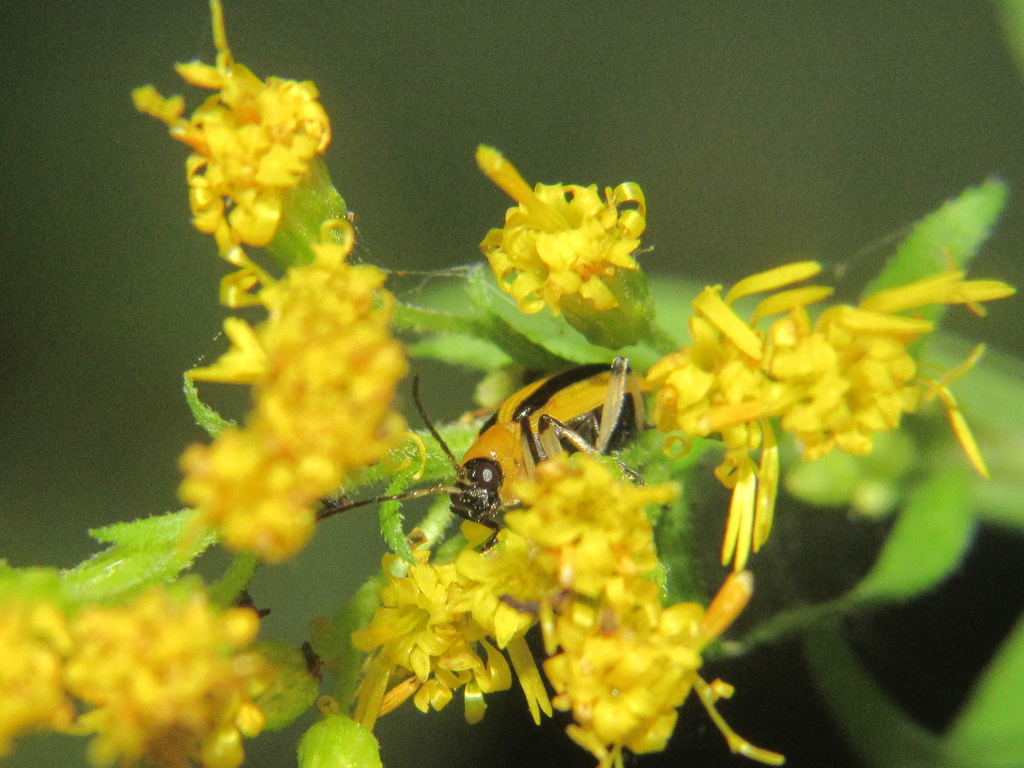
Acalymma vittatum, the striped cucumber beetle, is a beetle of the family Chrysomelidae and a serious pest of cucurbit crops in both larval and adult stages.
- Kingdom
- Animalia
- Phylum
- Arthropoda
- Class
- Insecta
- Order
- Coleoptera
- Family
- Chrysomelidae
- Genus
- Acalymma
- Species
- Acalymma vittatum
Description
Acalymma vittatum, the striped cucumber beetle, is a beetle of the family Chrysomelidae and a serious pest of cucurbit crops in both larval and adult stages. The striped cucumber beetle has a distinctive appearance, displaying a yellow-colored elytra with black stripes. It is distributed from eastern North America to the Rocky Mountains and can be found as far south as Mexico and as far North as southern Canada. In western North America, past the Rocky Mountains, the striped cucumber beetle is replaced by Acalymma trivittatum, a duller colored species often with grayish or pale white elytra rather than yellow. The striped cucumber beetle is unique in that it is resistant to a chemical, cucurbitacin, that is found in plants and serves as a defense mechanism against herbivores. In fact, the striped cucumber beetles are drawn towards this chemical; this is an example of coevolution, where one species evolves a phenotype against a defensive phenotype of another. The reason they are called the striped cucumber beetle is because they are found commonly in cucurbit plants, like cucumbers. Male striped cucumber beetles also release pheromones that cause aggregation of other striped cucumber beetles to the site of feeding. This creates opportunities for the males to mate with females. Due to the striped cucumber beetle's detrimental effect on cucurbit crops, such as cucumbers and pumpkins, many management methods have been developed to curb striped beetle populations in the early spring to reduce the negative impact on farmers. Some examples include biological control agents and strategies involving bait crops.
Gallery
Ajouter des photos
Partagez vos photos de cette espèce (jusqu'à 20 à la fois) : elles sont vérifiées automatiquement, puis publiées.
Répartition
Occurrences observées (données GBIF). Les zones hors aire d'origine peuvent indiquer une présence introduite ou invasive.
Sources et crédits
Informations provenant de plusieurs sources vérifiées. Dernière mise à jour : .
Crédits photos (8)
- Photo : Jacob Schick (@seismicshrimp) · CC BY-NC 4.0 · via iNaturalist
- Photo : @ncb1221 · CC BY 4.0 · via iNaturalist
- Photo : Grady G. (@gradythenatureguy) · CC BY-NC 4.0 · via iNaturalist
- Photo : @marvellis · CC BY-NC 4.0 · via iNaturalist
- Photo : Brendan O'Loughlin (@brenainn) · CC BY 4.0 · via iNaturalist
- Photo : Heather Haughn (@hhaughn) · CC BY-NC 4.0 · via iNaturalist
- Photo : @kathleenfspicer · CC BY-NC 4.0 · via iNaturalist
- Photo : ZCoracēs (@zcoraces) · CC BY-NC 4.0 · via iNaturalist
Mentions de licence
Texte disponible sous licence CC BY-SA 4.0. Il adapte notamment Wikipedia (CC BY-SA) : Acalymma vittatum (Wikipédia, auteurs dans l’historique de l’article).
- Taxonomie : GBIF Backbone Taxonomy (CC BY 4.0)
- Carte : occurrences GBIF, fond © contributeurs OpenStreetMap (ODbL)
Détail : Sources et licences.
Discussion (0)
Aucun message pour l’instant. Lancez la discussion sur cette fiche (sources, précisions, débats éditoriaux).
Connectez-vous pour participer à la discussion.