
Mantis shrimp
Oratosquilla oratoria
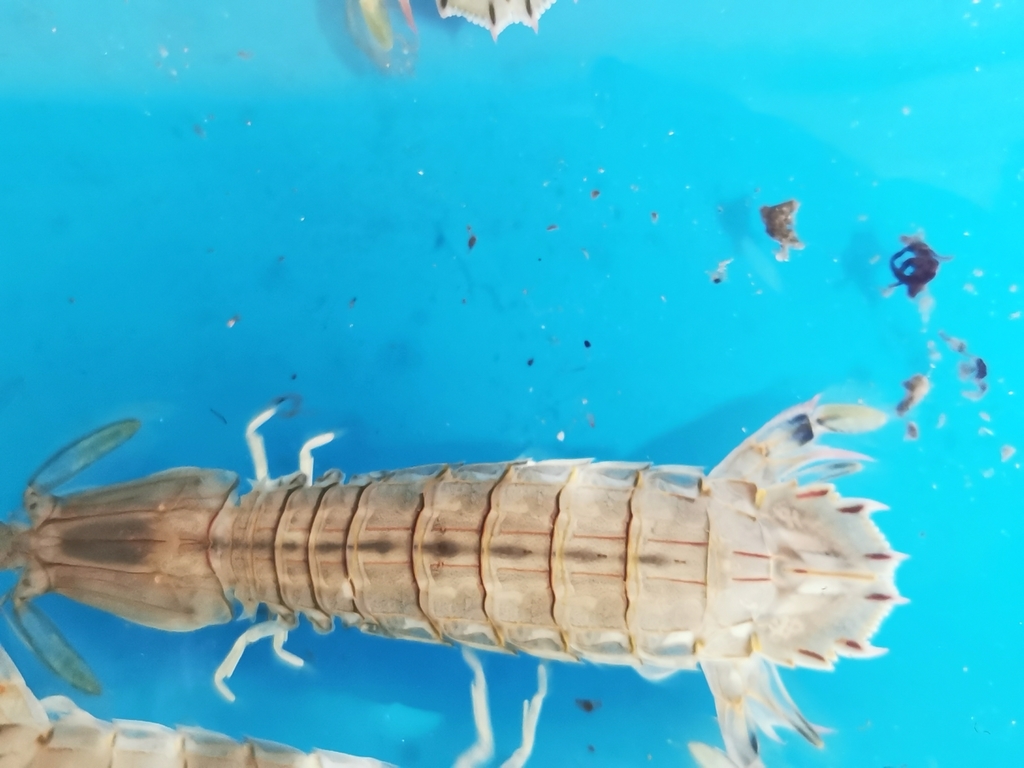
Oratosquilla oratoria, commonly known as the Japanese mantis shrimp, is a species of mantis shrimp found in the western Pacific.
- Kingdom
- Animalia
- Phylum
- Arthropoda
- Class
- Malacostraca
- Order
- Stomatopoda
- Family
- Squillidae
- Genus
- Oratosquilla
- Species
- Oratosquilla oratoria
Description
Oratosquilla oratoria, commonly known as the Japanese mantis shrimp, is a species of mantis shrimp found in the western Pacific. It is known as shako in Japan, where it is widely harvested and eaten as sushi. This species is an important commercial fishing target and widely consumed in many countries along the coast of the Northwest Pacific Ocean. It is a secondary consumer in its natural habitats, preying upon small creatures and being eaten by large fish and Cephalopods. Like other members of its order it has a powerful spear, which it uses to hunt invertebrates and small fish. It grows to a length of 185 millimetres (7.3 in), and lives at depths of 10–100 metres (33–328 ft). It lives in burrows on the muddy seafloor and conducts most of its activities inside those burrows, including spawning and feeding, for predator protection. This species has great temperature tolerance. Through altering its metabolic pathways it can regulate temperature sensitivity, allowing it to occupy a wide range of habitats. This species has been observed outside of its native range. It is now considered an invasive species in both New Zealand and Australia. Similar environmental conditions of the habitats, including muddy estuaries, have promoted the establishment of new invasive populations. Similar to other Stomatopods, mantis shrimp possess highly specialized sensory systems to facilitate hunting and mating. Its complex compound eyes allow it to detect a broad spectrum of wavelengths, even ultraviolet and polarized light. The sensitivity of its visual system, however, makes this species potentially vulnerable to artificial polarized light pollution. It also relies on sensitive antennules with a chemoreceptor to detect chemical cues dissolved in the water. Its normal population distribution is influenced by density, since cannibalism is possible when other food sources are scarce. During the mating season of late spring and early summer, males and females perform intricate social behavior. Then, females lay and nurse their eggs in the burrows until the larvae hatch. Being pelagic instead of benthic, the larval stage of this species adopts a reflective camouflage called eyeshine as crypsis.
Gallery
Ajouter des photos
Partagez vos photos de cette espèce (jusqu'à 20 à la fois) : elles sont vérifiées automatiquement, puis publiées.
Répartition
Occurrences observées (données GBIF). Les zones hors aire d'origine peuvent indiquer une présence introduite ou invasive.
Sources et crédits
Informations provenant de plusieurs sources vérifiées. Dernière mise à jour : .
Crédits photos (2)
- Photo : Caroline Lin (@fangzhulin) · CC BY-NC 4.0 · via iNaturalist
- Photo : @mc_observer · CC BY-NC 4.0 · via iNaturalist
Mentions de licence
Texte disponible sous licence CC BY-SA 4.0. Il adapte notamment Wikipedia (CC BY-SA) : Oratosquilla oratoria (Wikipédia, auteurs dans l’historique de l’article).
- Taxonomie : GBIF Backbone Taxonomy (CC BY 4.0)
- Carte : occurrences GBIF, fond © contributeurs OpenStreetMap (ODbL)
Détail : Sources et licences.
Discussion (0)
Aucun message pour l’instant. Lancez la discussion sur cette fiche (sources, précisions, débats éditoriaux).
Connectez-vous pour participer à la discussion.