
Lyreidus tridentatus
Lyreidus tridentatus
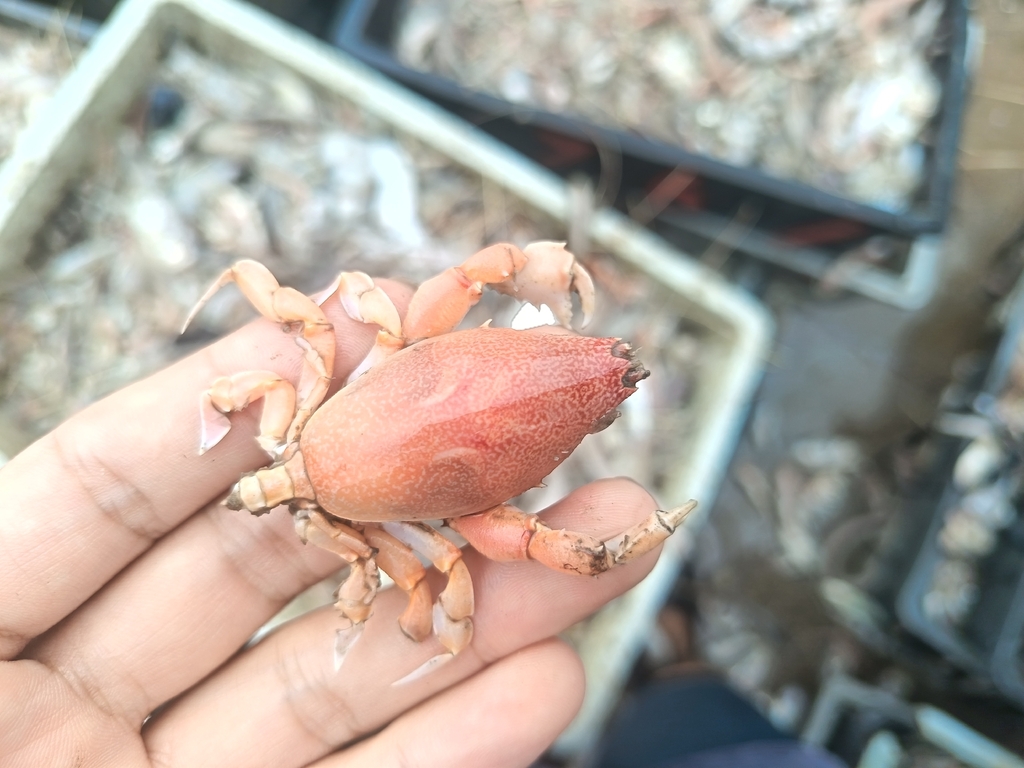
Lyreidus tridentatus, commonly known as the harp crab, is a species of crab in the family Raninidae.
- Kingdom
- Animalia
- Phylum
- Arthropoda
- Class
- Malacostraca
- Order
- Decapoda
- Family
- Lyreididae
- Genus
- Lyreidus
- Species
- Lyreidus tridentatus
Description
Lyreidus tridentatus, commonly known as the harp crab, is a species of crab in the family Raninidae. The species is distributed across the Western Pacific, with specimens found in the Kermadec Islands, New Zealand, Australia, New Caledonia, and Japan. Dell (1963) noted that before 1949, only one specimen had been collected in New Zealand, and there is a high level of doubt as to whether the New Zealand form is the same as the Australian, and thus, if the Australian was the same as the Japanese. The New Zealand form has since been largely collected off the East Coast of the North Island. It is particularly common in the Bay of Plenty, found at depths of about 80 fathoms. Dell also noted that the species lives on soft mud, for which it supposedly burrows, with the front tip of its carapace showing. Lyreidus tridentatus has a smooth and shining back, which measures up to three quarters of an inch in width.
Ajouter des photos
Partagez vos photos de cette espèce (jusqu'à 20 à la fois) : elles sont vérifiées automatiquement, puis publiées.
Répartition
Occurrences observées (données GBIF). Les zones hors aire d'origine peuvent indiquer une présence introduite ou invasive.
Sources et crédits
Informations provenant de plusieurs sources vérifiées. Dernière mise à jour : .
Crédits photos (1)
- Photo : Chao 江星辰 (@chao7) · CC0 (domaine public) · via iNaturalist
Mentions de licence
Texte disponible sous licence CC BY-SA 4.0. Il adapte notamment Wikipedia (CC BY-SA) : Lyreidus tridentatus (Wikipédia, auteurs dans l’historique de l’article).
- Taxonomie : GBIF Backbone Taxonomy (CC BY 4.0)
- Carte : occurrences GBIF, fond © contributeurs OpenStreetMap (ODbL)
Détail : Sources et licences.
Discussion (0)
Aucun message pour l’instant. Lancez la discussion sur cette fiche (sources, précisions, débats éditoriaux).
Connectez-vous pour participer à la discussion.