
Caprella mutica
Caprella mutica
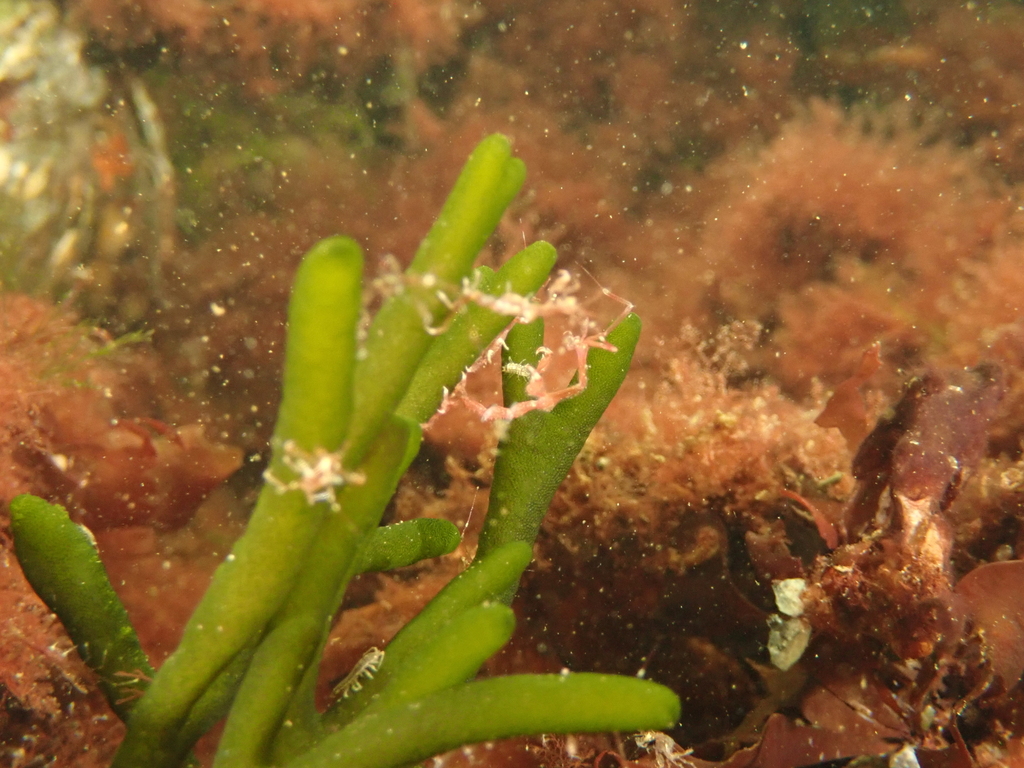
Caprella mutica, commonly known as the Japanese skeleton shrimp, is a species of skeleton shrimp.
- Kingdom
- Animalia
- Phylum
- Arthropoda
- Class
- Malacostraca
- Order
- Amphipoda
- Family
- Caprellidae
- Genus
- Caprella
- Species
- Caprella mutica
Description
Caprella mutica, commonly known as the Japanese skeleton shrimp, is a species of skeleton shrimp. They are relatively large caprellids, reaching a maximum length of 50 mm (2.0 in). They are sexually dimorphic, with the males usually being much larger than the females. They are characterized by their "hairy" first and second thoracic segments and the rows of spines on their bodies. Body color ranges from green to red to blue, depending on the environment. They are omnivorous highly adaptable opportunistic feeders. In turn, they provide a valuable food source for fish, crabs, and other larger predators. They are usually found in dense colonies attached to submerged man-made structures, floating seaweed, and other organisms. C. mutica are native to shallow protected bodies of water in the Sea of Japan. In as little as 40 years, they have become an invasive species in the North Atlantic, North Pacific, and along the coasts of New Zealand. They are believed to have been accidentally introduced to these areas through the global maritime traffic and aquaculture. Outside of their native range, C. mutica are often exclusively synanthropic, being found in large numbers in and around areas of human activity. Their ecological and economic impact as an invasive species is unknown, but they pose a serious threat to native populations of skeleton shrimp in the affected areas.
Gallery
Ajouter des photos
Partagez vos photos de cette espèce (jusqu'à 20 à la fois) : elles sont vérifiées automatiquement, puis publiées.
Répartition
Occurrences observées (données GBIF). Les zones hors aire d'origine peuvent indiquer une présence introduite ou invasive.
Sources et crédits
Informations provenant de plusieurs sources vérifiées. Dernière mise à jour : .
Crédits photos (5)
- Photo : Marjolein Vereijken (@endlessdiving) · CC BY-NC 4.0 · via iNaturalist
- Photo : @ge2nny · CC BY-NC 4.0 · via iNaturalist
- Photo : @sarosaurus · CC BY-NC 4.0 · via iNaturalist
- Photo : Deep Marine Scenes (@deepmarinescenes) · CC BY 4.0 · via iNaturalist
- Photo : Teá Montagna (@teamontagna) · CC BY 4.0 · via iNaturalist
Mentions de licence
Texte disponible sous licence CC BY-SA 4.0. Il adapte notamment Wikipedia (CC BY-SA) : Caprella mutica (Wikipédia, auteurs dans l’historique de l’article).
- Taxonomie : GBIF Backbone Taxonomy (CC BY 4.0)
- Carte : occurrences GBIF, fond © contributeurs OpenStreetMap (ODbL)
Détail : Sources et licences.
Discussion (0)
Aucun message pour l’instant. Lancez la discussion sur cette fiche (sources, précisions, débats éditoriaux).
Connectez-vous pour participer à la discussion.