
Taenia solium
Taenia solium
Taenia solium, the pork tapeworm, belongs to the cyclophyllid cestode family Taeniidae.
- Kingdom
- Animalia
- Phylum
- Platyhelminthes
- Class
- Cestoda
- Order
- Cyclophyllidea
- Family
- Taeniidae
- Genus
- Taenia
- Species
- Taenia solium
Description
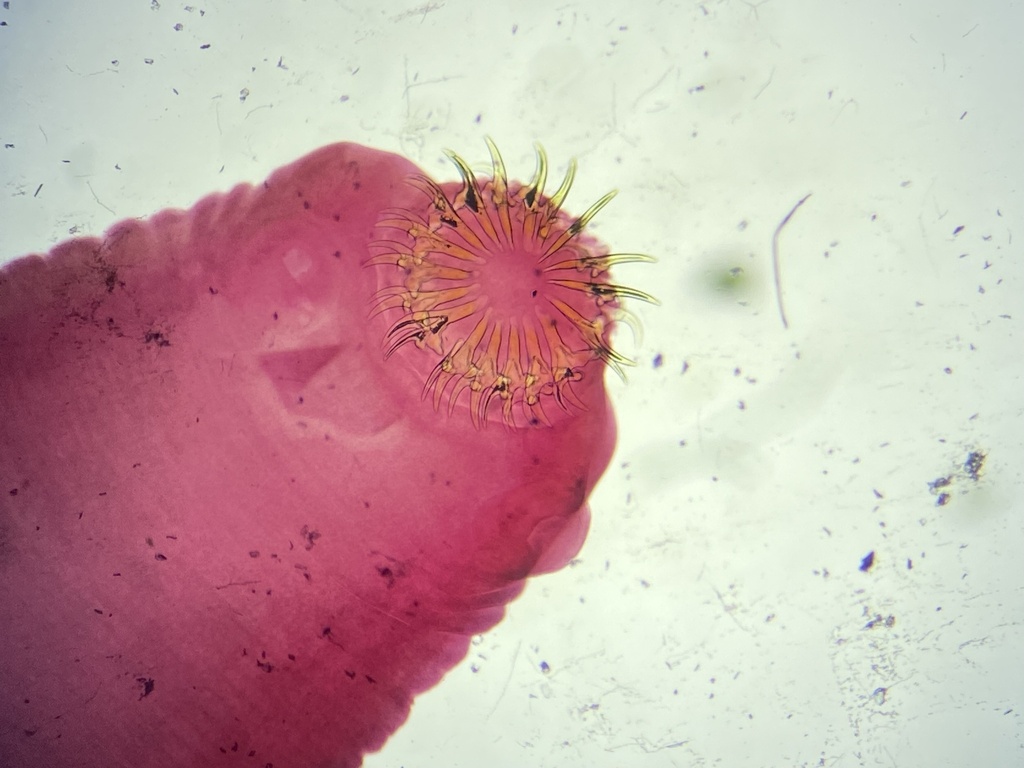
Taenia solium, the pork tapeworm, belongs to the cyclophyllid cestode family Taeniidae. It is found throughout the world and is most common in countries where pork is eaten. It is a tapeworm that uses humans (Homo sapiens) as its definitive host and pigs and boars (family Suidae) as the intermediate or secondary hosts. It is transmitted to pigs through human feces that contain the parasite eggs and contaminate their fodder. Pigs ingest the eggs, which develop into larvae, then into oncospheres, and ultimately into infective tapeworm cysts, called cysticerci. Humans acquire the cysts through consumption of uncooked or undercooked pork and the cysts grow into adult worms in the small intestine. There are two forms of human infection. One is "primary hosting", called taeniasis, and is due to eating undercooked pork that contains the cysts, resulting in adult worms in the intestines. This form generally is without symptoms; the infected person does not know they have tapeworms. This form is easily treated with anthelmintic medications which eliminate the tapeworm. The other form, "secondary hosting", called cysticercosis, is due to eating food, or drinking water, contaminated with faeces from someone infected by the adult worms, thus ingesting the tapeworm eggs, instead of the cysts. The eggs go on to develop cysts primarily in the muscles, and usually with no symptoms. However, some people have obvious symptoms, the most harmful and chronic form of which is when the cysts form in the brain. Treatment of this form is more difficult but possible. The adult worm has a flat, ribbon-like body which is white and measures 2 to 3 metres (6.6 to 9.8 ft) long, or more. Its tiny attachment, the scolex, contains suckers and a rostellum as organs of attachment that attach to the wall of the small intestine. The main body, consists of a chain of segments known as proglottids. Each proglottid is little more than a self-sustainable, very lightly ingestive, self-contained reproductive unit since tapeworms are hermaphrodites. Human primary hosting is best diagnosed by microscopy of eggs in faeces, often triggered by spotting shed segments. In secondary hosting, imaging techniques such as computed tomography and nuclear magnetic resonance are often employed. Blood samples can also be tested using antibody reaction of enzyme-linked immunosorbent assay. T. solium deeply affects developing countries, especially in rural settings where pigs roam free, as clinical manifestations are highly dependent on the number, size, and location of the parasites as well as the host's immune and inflammatory response.
Gallery
Ajouter des photos
Partagez vos photos de cette espèce (jusqu'à 20 à la fois) : elles sont vérifiées automatiquement, puis publiées.
Répartition
Occurrences observées (données GBIF). Les zones hors aire d'origine peuvent indiquer une présence introduite ou invasive.
Sources et crédits
Informations provenant de plusieurs sources vérifiées. Dernière mise à jour : .
Crédits photos (2)
- Photo : Randall Jiménez (@cicciocostarica) · CC BY-NC 4.0 · via iNaturalist
- Photo : 鐦鍆錒/锎钔锕(Man Hoimoon) (@pandahead_hoimoon) · CC BY-NC 4.0 · via iNaturalist
Mentions de licence
Texte disponible sous licence CC BY-SA 4.0. Il adapte notamment Wikipedia (CC BY-SA) : Taenia solium (Wikipédia, auteurs dans l’historique de l’article).
- Taxonomie : GBIF Backbone Taxonomy (CC BY 4.0)
- Carte : occurrences GBIF, fond © contributeurs OpenStreetMap (ODbL)
Détail : Sources et licences.
Discussion (0)
Aucun message pour l’instant. Lancez la discussion sur cette fiche (sources, précisions, débats éditoriaux).
Connectez-vous pour participer à la discussion.