
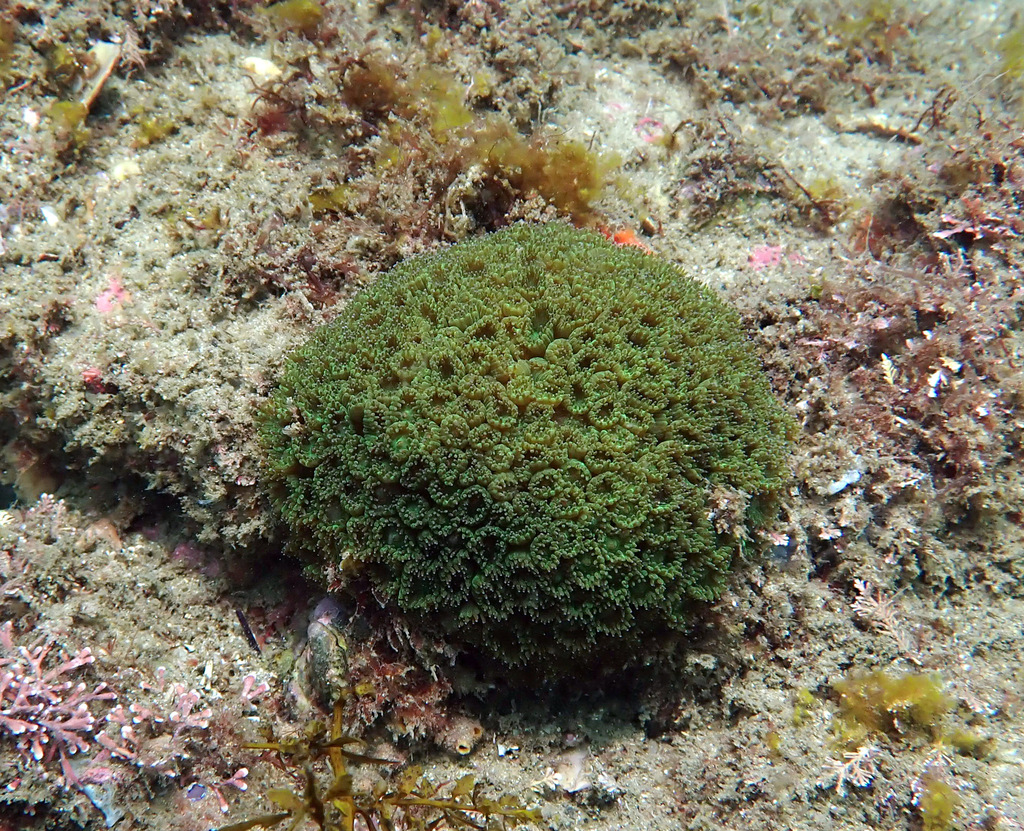
Small knob coral
Plesiastrea versipora
Plesiastrea versipora is an encrusting coral found in the Indian and Pacific Oceans.
- Kingdom
- Animalia
- Phylum
- Cnidaria
- Class
- Anthozoa
- Order
- Scleractinia
- Family
- Plesiastreidae
- Genus
- Plesiastrea
- Species
- Plesiastrea versipora
Description
Plesiastrea versipora is an encrusting coral found in the Indian and Pacific Oceans. It is of interest because of its ability to thrive in both tropical and temperate environments, and to grow massive. Existing massive colonies of P. versipora can be long lived, and so analysis of their internal composition allows deducing the climatic records of past decades and centuries, at localities where the corals grow. Being the only coral genus in temperate waters that is capable of growing massive (up to a metre in thickness), P. versipora is a valuable indicator of climatic records of temperate seas. Plesiastrea versipora is also a model for communication between corals and their zooxanthellae. The substances that communicate to the symbiont are host-generated soluble compounds which can either signal the release of photosynthetic products (mainly glycerol) by the zooxanthellae, or can inhibit photosynthesis. This phenomenon may potentially be generalised to other coral genera, as identical Symbiodinium strains often occur in several coral host genera. P. versipora is the type host for a newly described minor symbiont Chromera velia, which is present in small numbers in a host P. versipora coral colony, compared to the dominant Symbiodinium which is present in large numbers, to the point where C. velia cells may be barely detectable in the host except by culturing. The host P. versipora reproduces sexually, with larvae obtaining symbiotic algae from the environment, though anecdotal evidence shows some symbionts may also be a transmitted via the eggs, indicating transmission may be mixed in this host species. The species adopts a range of colours, being host pigments that protect the coral from ultraviolet radiation. Colonies often occur close to one another, and contact one another. The range of colour morphs of P. versipora is broad and so it is very often obvious by their colours where one colony begins and another ends.
Ajouter des photos
Partagez vos photos de cette espèce (jusqu'à 20 à la fois) : elles sont vérifiées automatiquement, puis publiées.
Répartition
Occurrences observées (données GBIF). Les zones hors aire d'origine peuvent indiquer une présence introduite ou invasive.
Sources et crédits
Informations provenant de plusieurs sources vérifiées. Dernière mise à jour : .
Crédits photos (1)
- Photo : Harry Rosenthal (@harryrosenthal) · CC BY-NC 4.0 · via iNaturalist
Mentions de licence
Texte disponible sous licence CC BY-SA 4.0. Il adapte notamment Wikipedia (CC BY-SA) : Plesiastrea versipora (Wikipédia, auteurs dans l’historique de l’article).
- Taxonomie : GBIF Backbone Taxonomy (CC BY 4.0)
- Carte : occurrences GBIF, fond © contributeurs OpenStreetMap (ODbL)
- Statut de conservation : Liste rouge de l'UICN, via Wikidata (CC0)
Détail : Sources et licences.
Discussion (0)
Aucun message pour l’instant. Lancez la discussion sur cette fiche (sources, précisions, débats éditoriaux).
Connectez-vous pour participer à la discussion.