
Fried egg jellyfish
Phacellophora camtschatica
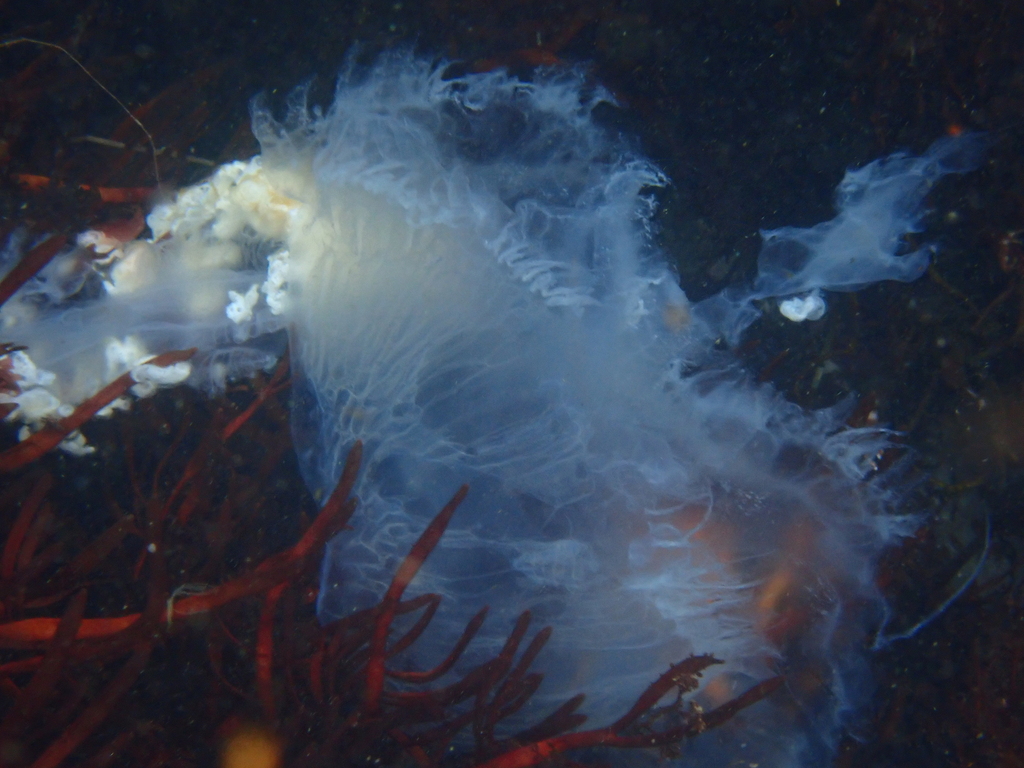
Phacellophora, commonly known as the fried egg jellyfish or egg-yolk jellyfish, is a very large jellyfish in the monotypic family Phacellophoridae containing a single species Phacellophora camtschatica.
- Kingdom
- Animalia
- Phylum
- Cnidaria
- Class
- Scyphozoa
- Order
- Semaeostomeae
- Family
- Phacellophoridae
- Genus
- Phacellophora
- Species
- Phacellophora camtschatica
Description
Phacellophora, commonly known as the fried egg jellyfish or egg-yolk jellyfish, is a very large jellyfish in the monotypic family Phacellophoridae containing a single species Phacellophora camtschatica. This genus can be easily identified by the yellow coloration in the center of its body which closely resembles an egg yolk, hence its common name. Some individuals can have a bell close to 60 cm (2 ft) in diameter, and most individuals have 16 clusters of up to a few dozen tentacles, each up to 6 m (20 ft) long. A smaller jellyfish, Cotylorhiza tuberculata, typically found in warmer water, particularly in the Mediterranean Sea, is also popularly called a fried egg jellyfish. Also, P. camtschatica is sometimes confused with the lion's mane jellyfish (Cyanea capillata). It feeds primarily by collecting medusae and plankton with its tentacles, and bringing them into its mouth for digestion. It is capable of only limited motion, and mostly drifts with the current, even when swimming. This species and most of its relatives in the Cnidaria phylum often use suspension feeding as their main food gathering strategy. The body of this jellyfish does not contain any respiratory, circulatory, or excretory systems. Instead, it uses its large surface area to accomplish these things. Also, this species (and all others in the phylum cnidaria) lack a mesoderm and instead uses mesoglea. Therefore, there are not three true tissue layers, in turn making this species (and all other cnidarians) diploblastic, not triploblastic. The reproduction and life cycle of this jellyfish has been well documented. It mostly follows the same life cycle as other members in the class Scyphozoa. It alternates between a polyp form that reproduces asexually and a medusa form that reproduces sexually. These jellyfish are a cool water species found in most of the world's oceans, but most commonly in the Northern Pacific.
Gallery
Ajouter des photos
Partagez vos photos de cette espèce (jusqu'à 20 à la fois) : elles sont vérifiées automatiquement, puis publiées.
Répartition
Occurrences observées (données GBIF). Les zones hors aire d'origine peuvent indiquer une présence introduite ou invasive.
Sources et crédits
Informations provenant de plusieurs sources vérifiées. Dernière mise à jour : .
Crédits photos (3)
- Photo : Sheldon Logan (@muddphoto) · CC BY-NC 4.0 · via iNaturalist
- Photo : Holly Partridge (@obsessedwithslugs) · CC BY-NC 4.0 · via iNaturalist
- Photo : Ben Torres (@creaturedoctor) · CC BY-NC 4.0 · via iNaturalist
Mentions de licence
Texte disponible sous licence CC BY-SA 4.0. Il adapte notamment Wikipedia (CC BY-SA) : Phacellophora camschatica (Wikipédia, auteurs dans l’historique de l’article).
- Taxonomie : GBIF Backbone Taxonomy (CC BY 4.0)
- Carte : occurrences GBIF, fond © contributeurs OpenStreetMap (ODbL)
Détail : Sources et licences.
Discussion (0)
Aucun message pour l’instant. Lancez la discussion sur cette fiche (sources, précisions, débats éditoriaux).
Connectez-vous pour participer à la discussion.