
Anisakis simplex
Anisakis simplex
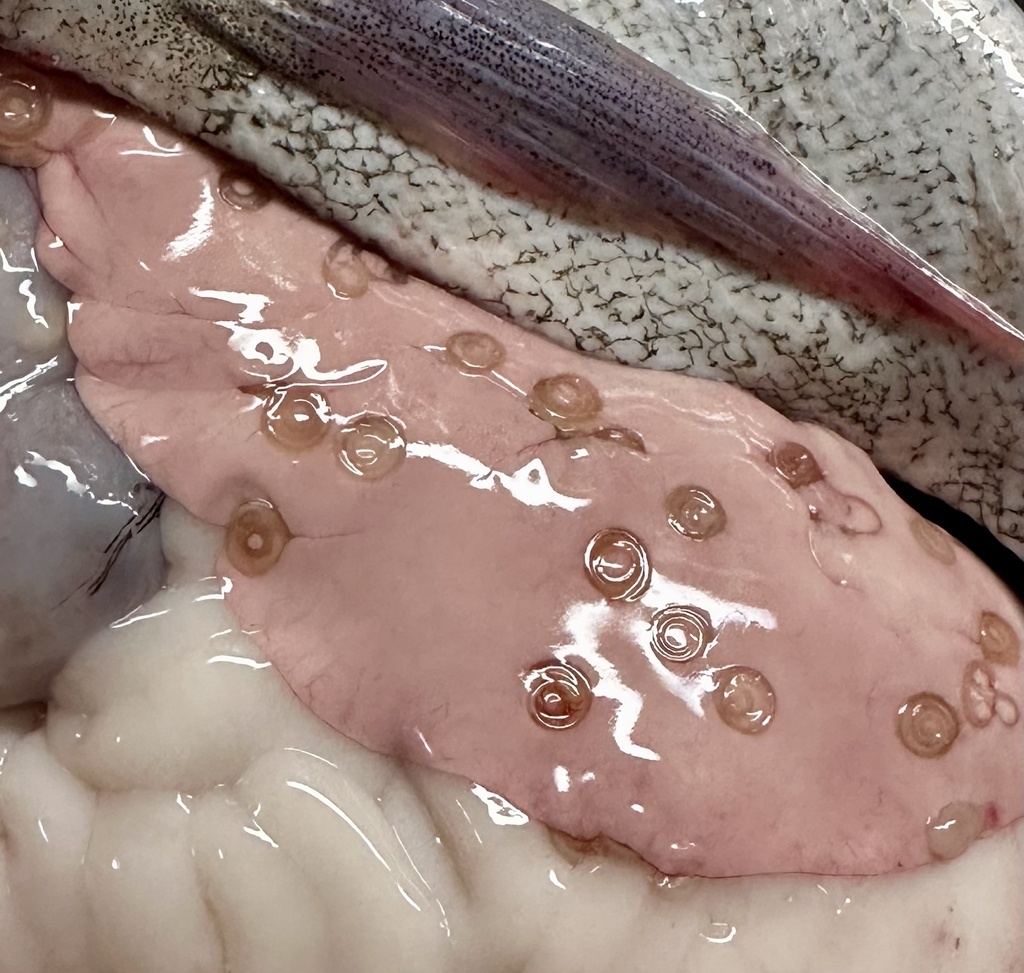
Anisakis simplex, known as the herring worm, is a species of nematode in the genus Anisakis.
- Kingdom
- Animalia
- Phylum
- Nematoda
- Class
- Chromadorea
- Order
- Rhabditida
- Family
- Anisakidae
- Genus
- Anisakis
- Species
- Anisakis simplex
Description
Anisakis simplex, known as the herring worm, is a species of nematode in the genus Anisakis. Like other nematodes, it infects and settles in the organs of marine animals, such as salmon, mackerels and squids. It is commonly found in cold marine waters, such as the Pacific Ocean and Atlantic Ocean. This species begins as an egg found in the feces of its host, and hatches as a second-stage larva in the ocean, where it survives for several days. This larva is then consumed by an intermediate host, usually a krill, and it develops into a third stage larva within the body of this intermediate host. The krill is then ingested by a predator, such as squid or fish, which act as the paratenic host for A. simplex. The worm reaches the end of its life cycle when the paratenic host is ingested by a whale or another marine mammal. In the abdominal cavity of this final host, A. simplex develops into a fully mature worm and reproduces to form eggs, which are then expelled from the body of the final host. A. simplex generally possesses digestive and excretory organs, such as an oesophagus and intestine. However, its morphological structure changes as it develops from one life stage to another. When it is fully mature, it has defined lip structures, a regularly patterned outer surface, and fully developed reproductive organs. The consumption of raw or undercooked seafood, such as sashimi and ceviche, puts humans at risk for developing an infection or allergic reaction caused by A. simplex. The worm can infect the stomach or intestine by lodging itself within the walls of the organ and producing digestive enzymes to penetrate mucus layers. It occasionally pierces through the wall completely and travels in the abdominal cavity. Acute symptoms, such as abdominal cramps, nausea and diarrhoea, arise hours after ingestion. The infection can be chronic if not treated. Treatment involves removal of the worm by endoscopy or surgery.
Gallery
Ajouter des photos
Partagez vos photos de cette espèce (jusqu'à 20 à la fois) : elles sont vérifiées automatiquement, puis publiées.
Répartition
Occurrences observées (données GBIF). Les zones hors aire d'origine peuvent indiquer une présence introduite ou invasive.
Sources et crédits
Informations provenant de plusieurs sources vérifiées. Dernière mise à jour : .
Crédits photos (3)
- Photo : りなべる (@re_nebel) · CC BY 4.0 · via iNaturalist
- Photo : @eduardmarques · CC BY-NC 4.0 · via iNaturalist
- Photo : Aoi Sugaya (@aoifish) · CC BY-NC 4.0 · via iNaturalist
Mentions de licence
Texte disponible sous licence CC BY-SA 4.0. Il adapte notamment Wikipedia (CC BY-SA) : Anisakis simplex (Wikipédia, auteurs dans l’historique de l’article).
- Taxonomie : GBIF Backbone Taxonomy (CC BY 4.0)
- Carte : occurrences GBIF, fond © contributeurs OpenStreetMap (ODbL)
Détail : Sources et licences.
Discussion (0)
Aucun message pour l’instant. Lancez la discussion sur cette fiche (sources, précisions, débats éditoriaux).
Connectez-vous pour participer à la discussion.