
Alitta virens
Alitta virens
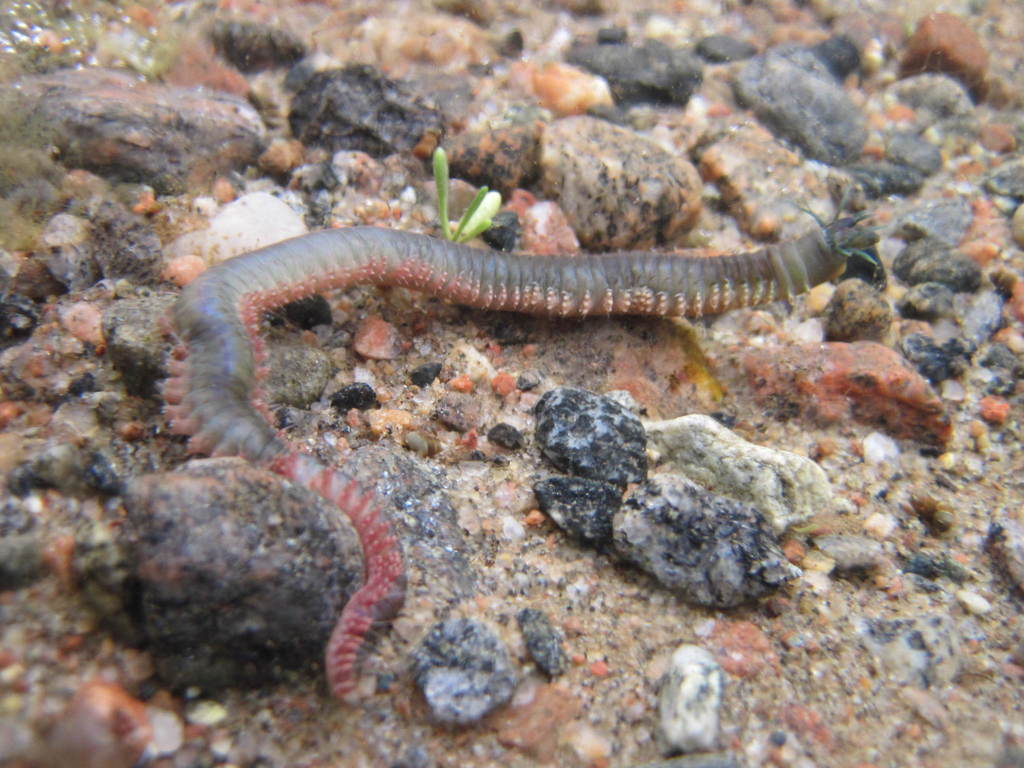
Alitta virens (common names include sandworm, sea worm, and king ragworm; older scientific names, including Nereis virens, are still frequently used) is an annelid worm that burrows in wet sand and mud.
- Kingdom
- Animalia
- Phylum
- Annelida
- Class
- Polychaeta
- Order
- Phyllodocida
- Family
- Nereididae
- Genus
- Alitta
- Species
- Alitta virens
Description
Alitta virens (common names include sandworm, sea worm, and king ragworm; older scientific names, including Nereis virens, are still frequently used) is an annelid worm that burrows in wet sand and mud. They construct burrows of different shapes (I, U, J and Y). They range from being very complex to very simple. Long term burrows are held together by mucus. Their burrows are not connected to each other; they are generally solitary creatures. The spacing between the burrows depends on how readily they can propagate water signals. It was first described by biologist Michael Sars in 1835. It is classified as a polychaete in the family Nereididae. Sandworms make up a large part of the live sea-bait industry. To fulfill the needs of this industry, some sandworms are commercially grown. Sandworming, the harvesting of sandworms from mudflats, employs over 1,000 people in Maine, US. As of 2006, the population of sandworms had diminished greatly over the preceding few years due in large part to overharvesting before the worms are able to reproduce by spawning. Sandworms are also essential to the study of the investigation of metal uptake in marine biology. They are vital to evaluate the effects of metals in marine organisms. Sandworms eat seaweed and microorganisms. Sandworms are known to be omnivores. Their diet consists of surface sediment, plant and animal remains. They are oftentimes exposed to metals through their diet and their burrowing tactics. They have many distinctive traits, including: They often reach great lengths, sometimes exceeding four feet They are large in size (approximately ~30 cm) These sandworms are abundant within European coasts and fjord environments. They dominate fully saline coastal areas and have large distribution along with large biomass. They have numerous, highly vascularized parapodia along both sides of their bodies They have a blue head with two large pincer teeth which have the capacity to bite humans among other things. The parapodia function both as external gills (the animal's primary respiratory surfaces), and as means of locomotion (appearing much like short legs). Usually, sandworms are gonochoric, meaning that they reproduce sexually between the males and females of the species. Sandworms reproduce via a process termed 'swarming'. The female sandworm releases pheromones that attract males to release sperm. Then, the female sandworm ejects eggs to have them fertilized. The production of gametes occurs via the metanephridia gland.
Gallery
Ajouter des photos
Partagez vos photos de cette espèce (jusqu'à 20 à la fois) : elles sont vérifiées automatiquement, puis publiées.
Répartition
Occurrences observées (données GBIF). Les zones hors aire d'origine peuvent indiquer une présence introduite ou invasive.
Sources et crédits
Informations provenant de plusieurs sources vérifiées. Dernière mise à jour : .
Crédits photos (6)
- Photo : Vsevolod Rudyi (@ruseva) · CC BY 4.0 · via iNaturalist
- Photo : Ricarda Bergen (@flyber) · CC BY-NC 4.0 · via iNaturalist
- Photo : Helle Hvitved (@helleh) · CC BY-NC 4.0 · via iNaturalist
- Photo : @leila_a · CC BY-NC 4.0 · via iNaturalist
- Photo : Emil B (@bergylta) · CC BY-NC 4.0 · via iNaturalist
- Photo : @vfhbz · CC BY-NC 4.0 · via iNaturalist
Mentions de licence
Texte disponible sous licence CC BY-SA 4.0. Il adapte notamment Wikipedia (CC BY-SA) : Alitta virens (Wikipédia, auteurs dans l’historique de l’article).
- Taxonomie : GBIF Backbone Taxonomy (CC BY 4.0)
- Carte : occurrences GBIF, fond © contributeurs OpenStreetMap (ODbL)
Détail : Sources et licences.
Discussion (0)
Aucun message pour l’instant. Lancez la discussion sur cette fiche (sources, précisions, débats éditoriaux).
Connectez-vous pour participer à la discussion.