
Staghorn coral
Acropora cervicornis
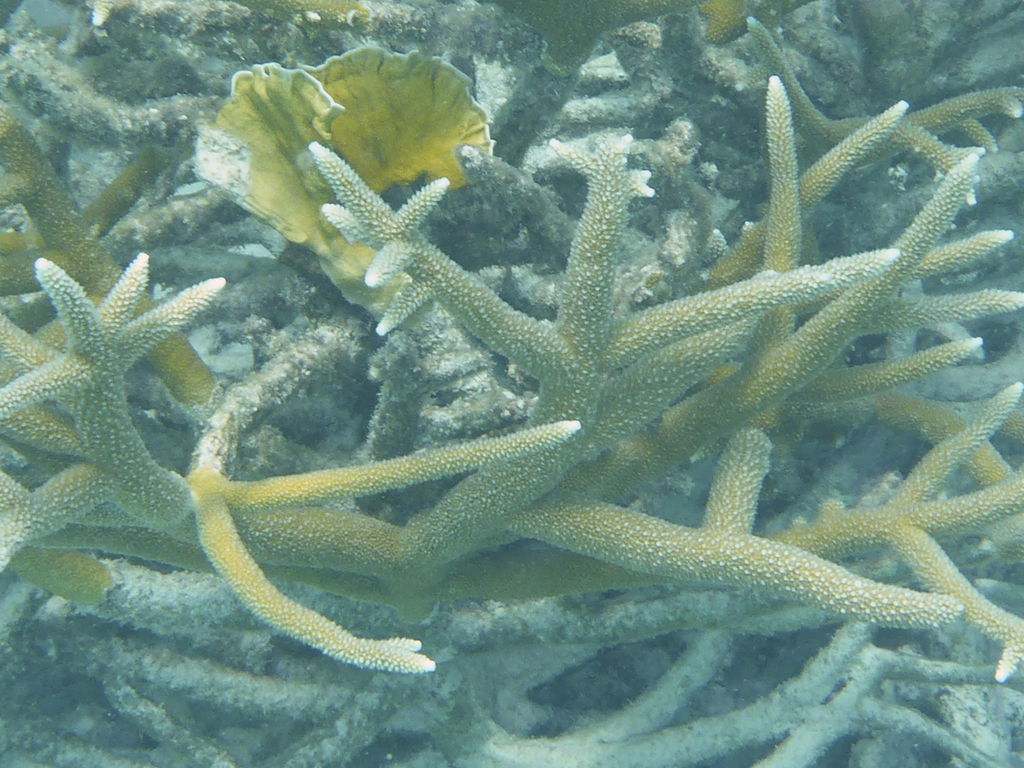
The staghorn coral (Acropora cervicornis) is a branching, stony coral, within the Order Scleractinia.
- Kingdom
- Animalia
- Phylum
- Cnidaria
- Class
- Anthozoa
- Order
- Scleractinia
- Family
- Acroporidae
- Genus
- Acropora
- Species
- Acropora cervicornis
Description
The staghorn coral (Acropora cervicornis) is a branching, stony coral, within the Order Scleractinia. It is characterized by thick, upright branches which can grow in excess of 2 meters (6.5 ft) in height and resemble the antlers of a stag, hence the name, Staghorn. It grows within various areas of a reef but is most commonly found within shallow fore and back reefs, as well as patch reefs, where water depths rarely exceed 20 meters (65 ft). Staghorn corals can exhibit very fast growth, adding up to 5 cm (~2 in) in new skeleton for every 1 cm of existing skeleton each year, making them one of the fastest growing fringe coral species in the Western Atlantic. Due to this fast growth, Acropora cervicornis, serve as one of the most important reef building corals, functioning as marine nurseries for juvenile fish, buffer zones for erosion and storms, and center points of biodiversity in the Western Atlantic. Up until the late 1970s, much of the fore reef zones within the Atlantic around the coasts of Southern Florida and the Caribbean Islands were covered with vast, dense colonies of Staghorn coral consisting largely of single-species stands; however, a combination of white-band disease and various anthropogenic factors have reduced this coral coverage by over 95% in some areas. As of 2006, staghorn coral is listed as Critically Endangered under the International Union for Conservation of Nature and are federally designated as a threatened species under the Endangered Species Act of 1973.
Gallery
Ajouter des photos
Partagez vos photos de cette espèce (jusqu'à 20 à la fois) : elles sont vérifiées automatiquement, puis publiées.
Répartition
Occurrences observées (données GBIF). Les zones hors aire d'origine peuvent indiquer une présence introduite ou invasive.
Sources et crédits
Informations provenant de plusieurs sources vérifiées. Dernière mise à jour : .
Crédits photos (6)
- Photo : Robin Gwen Agarwal (@anudibranchmom) · CC BY-NC 4.0 · via iNaturalist
- Photo : Jonh Arias (@jonharias) · CC BY-NC 4.0 · via iNaturalist
- Photo : Joshua Rapp Learn (@vagabondreports) · CC BY-NC 4.0 · via iNaturalist
- Photo : John C. (@casseljs) · CC BY-NC 4.0 · via iNaturalist
- Photo : Becs (@becs_dianne_9) · CC BY-NC 4.0 · via iNaturalist
- Photo : Sequoia Janirella Wrens (@astrobirder) · CC BY-NC 4.0 · via iNaturalist
Mentions de licence
Texte disponible sous licence CC BY-SA 4.0. Il adapte notamment Wikipedia (CC BY-SA) : Staghorn coral (Wikipédia, auteurs dans l’historique de l’article).
- Taxonomie : GBIF Backbone Taxonomy (CC BY 4.0)
- Carte : occurrences GBIF, fond © contributeurs OpenStreetMap (ODbL)
- Statut de conservation : Liste rouge de l'UICN, via Wikidata (CC0)
Détail : Sources et licences.
Discussion (0)
Aucun message pour l’instant. Lancez la discussion sur cette fiche (sources, précisions, débats éditoriaux).
Connectez-vous pour participer à la discussion.