
Trichonephila clavipes
Trichonephila clavipes
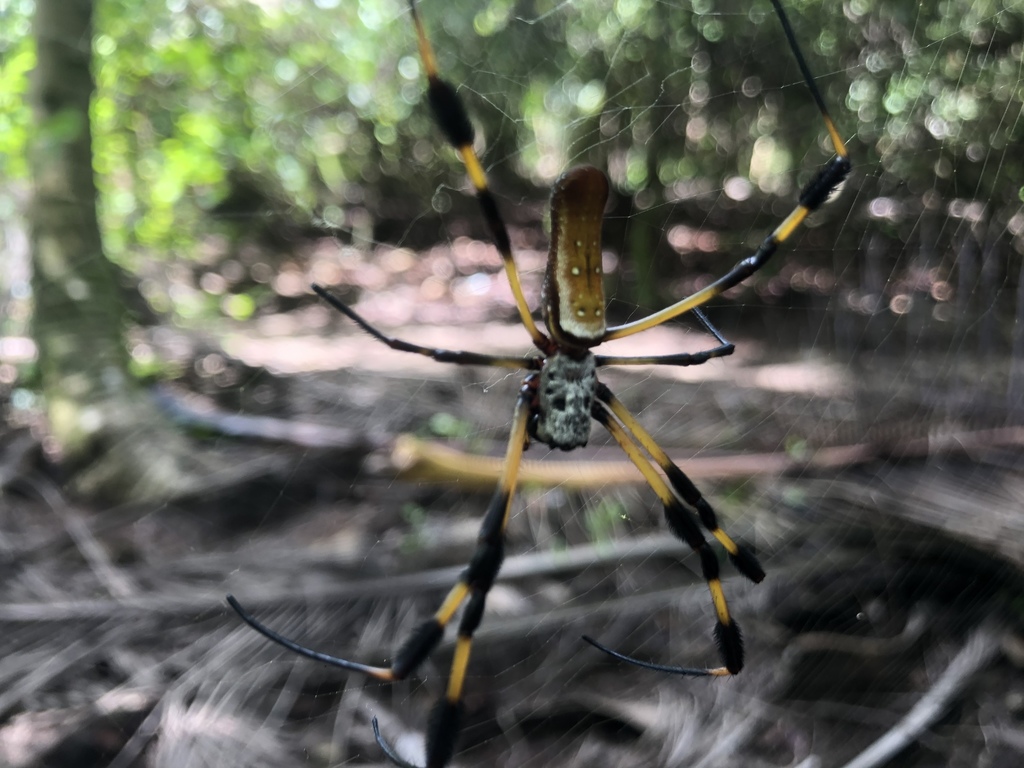
Trichonephila clavipes (formerly known as Nephila clavipes), commonly known as the golden silk orb-weaver, golden silk spider, golden orb weaver spider or colloquially banana spider (a name shared with several others), is an orb-weaving…
- Kingdom
- Animalia
- Phylum
- Arthropoda
- Class
- Arachnida
- Order
- Araneae
- Family
- Araneidae
- Genus
- Trichonephila
- Species
- Trichonephila clavipes
Description
Trichonephila clavipes (formerly known as Nephila clavipes), commonly known as the golden silk orb-weaver, golden silk spider, golden orb weaver spider or colloquially banana spider (a name shared with several others), is an orb-weaving spider species which inhabits forests and wooded areas ranging from the southern US to Argentina. It is indigenous to both continental North and South America. Known for the golden color of their silk, the large size of their females, and their distinctive red-brown and yellow coloring, T. clavipes construct large, asymmetrical circular webs attached to trees and low shrubs in woods to catch small- and medium-size flying prey, mostly insects. They are excellent web-builders, producing and utilizing seven different types of silk, and they subdue their prey by injecting them with venom, as opposed to related species which immobilize their prey by wrapping them in silk first. They are not known to be aggressive towards humans, only biting out of self-defense if touched, and their relatively harmless venom has a low toxicity, posing little health concern to healthy human adults. Due to their prevalence in forests, T. clavipes may be encountered by hikers. Like many orb-weaver species, T. clavipes shows sexual dimorphism, with females possessing both a larger size and more complex and noticeable coloration. Males of the species do not suffer sexual cannibalism or genital mutilation to the same rate that males of other related species in the subfamily Nephilinae do, making T. clavipes a focus of study into the mating behaviors of spiders. The species shows both monogynous and polygynous mating, with a preference for polygyny in most mating environments. T. clavipes is a well-studied species with a high recognized value to humans because of their usefulness in spider silk research. Analysis of the species' genome, the first of the orb-weaving spiders to be completely annotated, has revealed 28 unique genes for the proteins comprising spider silk, known as spidroins. Furthermore, the silk of T. clavipes has the potential to aid in surgeries involving the nervous system, a capability which has been demonstrated in past experimental studies.
Gallery
Ajouter des photos
Partagez vos photos de cette espèce (jusqu'à 20 à la fois) : elles sont vérifiées automatiquement, puis publiées.
Répartition
Occurrences observées (données GBIF). Les zones hors aire d'origine peuvent indiquer une présence introduite ou invasive.
Sources et crédits
Informations provenant de plusieurs sources vérifiées. Dernière mise à jour : .
Crédits photos (8)
- Photo : @srhhrvy · CC BY-NC 4.0 · via iNaturalist
- Photo : @kolibri-sunshine · CC BY-NC 4.0 · via iNaturalist
- Photo : H.Grenier (@hgrenier) · CC BY-NC 4.0 · via iNaturalist
- Photo : @matthias2t · CC BY-NC 4.0 · via iNaturalist
- Photo : Jaico Caballero (@jaico) · CC BY-NC 4.0 · via iNaturalist
- Photo : @mamu_man · CC BY-NC 4.0 · via iNaturalist
- Photo : @lydiaap · CC BY-NC 4.0 · via iNaturalist
- Photo : @loufuller · CC BY-NC 4.0 · via iNaturalist
Mentions de licence
Texte disponible sous licence CC BY-SA 4.0. Il adapte notamment Wikipedia (CC BY-SA) : Trichonephila clavipes (Wikipédia, auteurs dans l’historique de l’article).
- Taxonomie : GBIF Backbone Taxonomy (CC BY 4.0)
- Carte : occurrences GBIF, fond © contributeurs OpenStreetMap (ODbL)
Détail : Sources et licences.
Discussion (0)
Aucun message pour l’instant. Lancez la discussion sur cette fiche (sources, précisions, débats éditoriaux).
Connectez-vous pour participer à la discussion.