
Tigrosa helluo
Tigrosa helluo
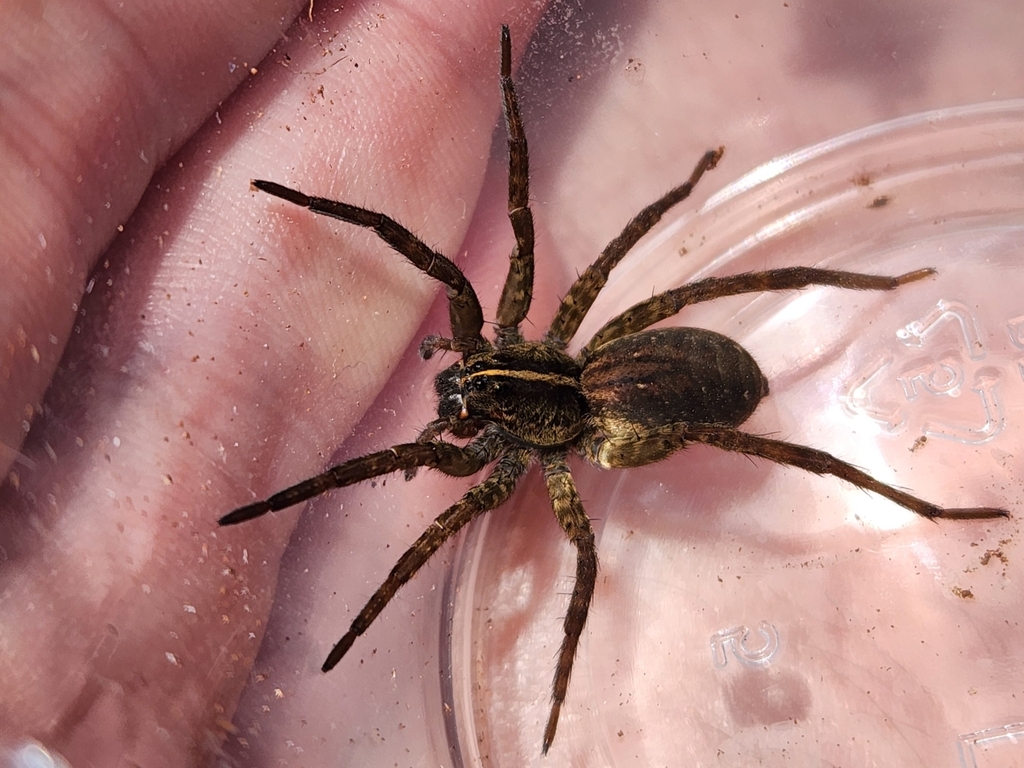
Tigrosa helluo, commonly known as the Wetland Giant Wolf Spider, is a species of spider belonging to the family Lycosidae, also known as wolf spiders.
- Kingdom
- Animalia
- Phylum
- Arthropoda
- Class
- Arachnida
- Order
- Araneae
- Family
- Lycosidae
- Genus
- Tigrosa
- Species
- Tigrosa helluo
Description
Tigrosa helluo, commonly known as the Wetland Giant Wolf Spider, is a species of spider belonging to the family Lycosidae, also known as wolf spiders. T. helluo was formerly known as Hogna helluo before differences between dorsal color patterns, habitat preferences, body structures, etc. were discovered. The species is native to the United States, Canada, and Mexico. It can be found across the eastern half of the United States, primarily in the Northeast and New England, and as far west as Nebraska and Kansas. T. helluo can be found in diverse habitats including woods, marshes, fields, and riparian areas. Typically, members of this species prefer to live in wetter areas as opposed to dry environments. Males tend to live for around a year and females will live for close to two years. The defining characteristic of T. helluo is its brown carapace and distinct yellow stripe starting from its anterior eyes extending down the cephalothorax. The underside of the abdomen has distinct black spots that distinguish T. helluo from other wolf spiders. At an average size of around 17 mm (0.67 in), T. helluo is one of the smaller wolf spiders. In addition, females tend to be larger than males in a display of sexual dimorphism. Like other spiders of the family Lycosidae, wolf spiders are solitary and live and hunt alone. Unless in the process of mating, T. helluo will remain alone. It is usually active at night, during which it hunts for prey. In addition, T. helluo does not create webs, although females will make burrows under rocks or boards. Relying on their excellent eyesight and senses, T. helluo members are great hunters. Members of T. helluo are not very aggressive and will not attack humans unless provoked. Their bites inject venom; however, it is not medically significant to humans, as only minor pain and swelling occur. Antivenom is rarely needed.
Gallery
Ajouter des photos
Partagez vos photos de cette espèce (jusqu'à 20 à la fois) : elles sont vérifiées automatiquement, puis publiées.
Répartition
Occurrences observées (données GBIF). Les zones hors aire d'origine peuvent indiquer une présence introduite ou invasive.
Sources et crédits
Informations provenant de plusieurs sources vérifiées. Dernière mise à jour : .
Crédits photos (8)
- Photo : Adrian (@cyanocittacristata) · CC BY-NC 4.0 · via iNaturalist
- Photo : Gerry Salmon (@gtsalmon) · CC BY-NC 4.0 · via iNaturalist
- Photo : @nsferguson · CC BY-NC 4.0 · via iNaturalist
- Photo : John Abrams (@john_abrams) · CC BY 4.0 · via iNaturalist
- Photo : Maya (@mayacrow) · CC BY-NC 4.0 · via iNaturalist
- Photo : Moony (@enicospilus) · CC BY-NC 4.0 · via iNaturalist
- Photo : Zachary Dankowicz (@zdanko) · CC BY 4.0 · via iNaturalist
- Photo : Nick Moore (@nickmoore91) · CC BY-NC 4.0 · via iNaturalist
Mentions de licence
Texte disponible sous licence CC BY-SA 4.0. Il adapte notamment Wikipedia (CC BY-SA) : Tigrosa helluo (Wikipédia, auteurs dans l’historique de l’article).
- Taxonomie : GBIF Backbone Taxonomy (CC BY 4.0)
- Carte : occurrences GBIF, fond © contributeurs OpenStreetMap (ODbL)
Détail : Sources et licences.
Discussion (0)
Aucun message pour l’instant. Lancez la discussion sur cette fiche (sources, précisions, débats éditoriaux).
Connectez-vous pour participer à la discussion.