
Steatoda bipunctata
Steatoda bipunctata
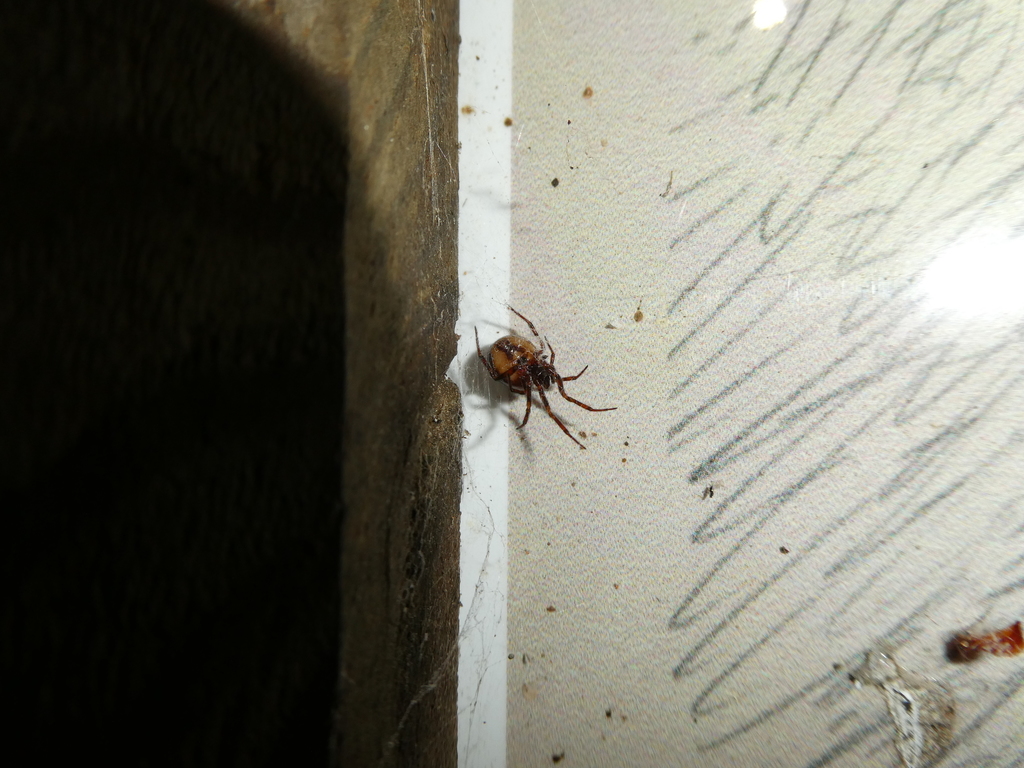
Steatoda bipunctata is a species of cob-web spider, of the genus Steatoda, in the family Theridiidae.
- Kingdom
- Animalia
- Phylum
- Arthropoda
- Class
- Arachnida
- Order
- Araneae
- Family
- Theridiidae
- Genus
- Steatoda
- Species
- Steatoda bipunctata
Description
Steatoda bipunctata is a species of cob-web spider, of the genus Steatoda, in the family Theridiidae. With a holarctic distribution, it is common in North America and Europe. It may be found in proximity to human structures, such as basements or sheds. A nickname for this arachnid is the rabbit hutch spider, since rabbit hutches often make a suitable habitat. Steatoda bipunctata is similar in shape to the black widow spiders in the genus Latrodectus and can thus be mistaken for them, although its bite is significantly less dangerous to humans. For this reason, species of the genus Steatoda are commonly called 'false widows'. The abdomens of both sexes are bulbous and brownish in coloration, typically with a broken pale line down the center and another pale line across the anterior portion of the abdomen. The apodemes (places of muscle attachment) on the dorsal side of the abdomen look like pairs of dark dimples and presumably give the spider its Latin name bi- (two) and -punctata (spots). The underside of the abdomen of the Rabbit Hutch Spider reveals a most interesting pattern resembling the infinity sign. The female abdomen is light brown and often shiny compared to the males. Steatoda bipunctata rarely exceeds 7 mm in body length and there are no known instances of envenomation. It is highly unlikely the fangs of this small species can penetrate human skin.
Gallery
Ajouter des photos
Partagez vos photos de cette espèce (jusqu'à 20 à la fois) : elles sont vérifiées automatiquement, puis publiées.
Répartition
Occurrences observées (données GBIF). Les zones hors aire d'origine peuvent indiquer une présence introduite ou invasive.
Sources et crédits
Informations provenant de plusieurs sources vérifiées. Dernière mise à jour : .
Crédits photos (8)
- Photo : Juha Kivijärvi (@kivij) · CC BY-NC 4.0 · via iNaturalist
- Photo : Stephan Pflume (@misumeta) · CC BY-NC 4.0 · via iNaturalist
- Photo : T. Pedro Hafermann (@mangoblatt) · CC0 (domaine public) · via iNaturalist
- Photo : @metalguy3000 · CC BY-NC 4.0 · via iNaturalist
- Photo : Risto ja Kirsi Gylden (@k-r-gylden) · CC BY-NC 4.0 · via iNaturalist
- Photo : Вадим Рыбаков (@vadimrybakov69) · CC BY-NC 4.0 · via iNaturalist
- Photo : Francis Birlenbach (@francisbirlenbach) · CC BY-NC 4.0 · via iNaturalist
- Photo : Emanuel Kern (@emanuelkern) · CC BY 4.0 · via iNaturalist
Mentions de licence
Texte disponible sous licence CC BY-SA 4.0. Il adapte notamment Wikipedia (CC BY-SA) : Steatoda bipunctata (Wikipédia, auteurs dans l’historique de l’article).
- Taxonomie : GBIF Backbone Taxonomy (CC BY 4.0)
- Carte : occurrences GBIF, fond © contributeurs OpenStreetMap (ODbL)
Détail : Sources et licences.
Discussion (0)
Aucun message pour l’instant. Lancez la discussion sur cette fiche (sources, précisions, débats éditoriaux).
Connectez-vous pour participer à la discussion.