
Portia schultzi
Portia schultzi
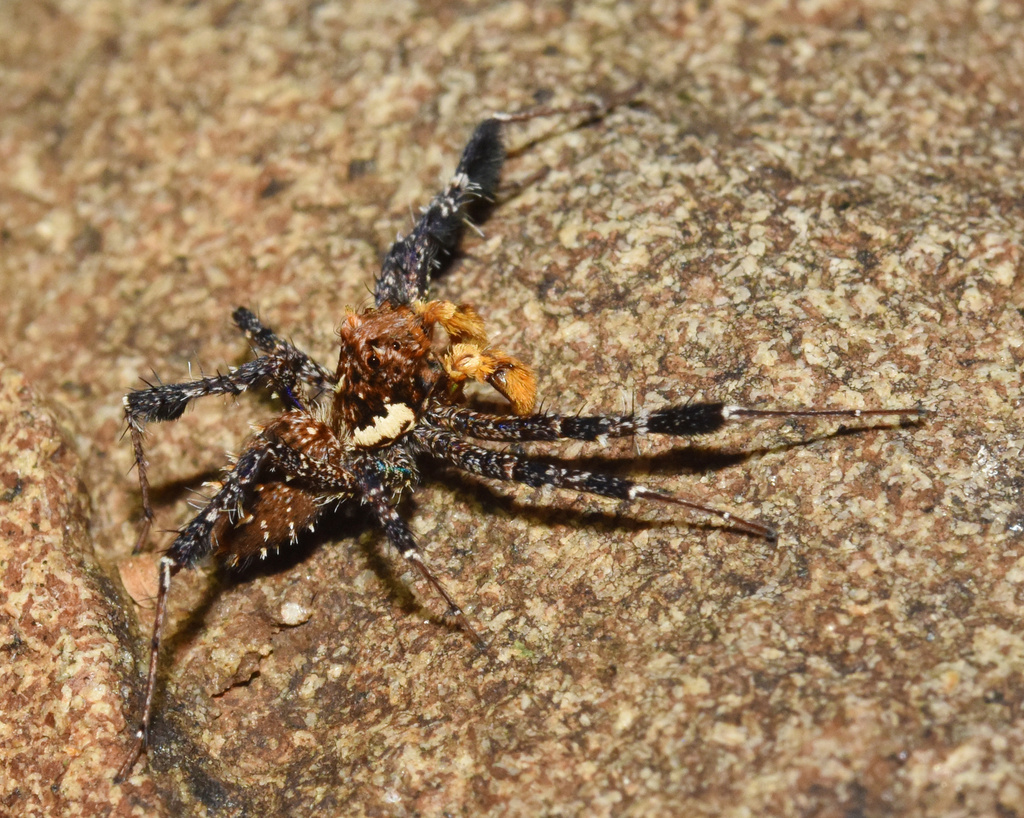
Portia schultzi is a species of jumping spider which ranges from South Africa in the south to Kenya in the north, and also is found in West Africa and Madagascar.
- Kingdom
- Animalia
- Phylum
- Arthropoda
- Class
- Arachnida
- Order
- Araneae
- Family
- Salticidae
- Genus
- Portia
- Species
- Portia schultzi
Description
Portia schultzi is a species of jumping spider which ranges from South Africa in the south to Kenya in the north, and also is found in West Africa and Madagascar. In this species, which is slightly smaller than some other species of the genus Portia, the bodies of females are 5 to 7 mm (0.20 to 0.28 in) long, while those of males are 4 to 6 mm (0.16 to 0.24 in) long. The carapaces of both sexes are orange-brown with dark brown mottling, and covered with dark brown and whitish hairs lying over the surface. Males have white tufts on their thoraces and a broad white band above the bases of the legs, and these features are less conspicuous in females. Both sexes have tufts of orange to dark orange above the eyes, which are fringed with pale orange hairs. Males' abdomens are yellow-orange to orange-brown with blackish mottling, and on the upper sides are black and light orange hairs, and nine white tufts. Those of females are pale yellow and have black markings with scattered white and orange-brown hairs on the upper side. P. schultzi has relatively longer legs than other Portia, and a "lolloping" gait. While most jumping spiders focus accurately up to about 75 cm (30 in) away, P. schultzi responds to a maximum of about 10 cm (3.9 in) in good light, and ignores everything in very subdued light. For prey, P. schultzi prefers web-based spiders, then jumping spiders, and finally insects. The females of P. schultzi and other Portia species build "capture webs" to catch prey, and often join their own webs on to web-based spiders to catch the other spiders or their prey. If a P. schultzi female is mature, a male P. schultzi will try to copulate with her, or cohabit with a subadult female and copulate while she is moulting. They usually mate on a web or on a dragline made by the female, and P. schultzi typically copulates for about 100 seconds, while others in the genus can take several minutes or even several hours. Females try to kill and eat their mates during or after copulation, and subadult females mimic adult females to attract males as prey. Contests between Portia females are violent, and embraces in P. schultzi typically take 20 to 60 seconds. Sometimes, one female knocks the other on her back and the other may be killed and eaten if she does not right herself quickly and run away. When hunting, P. schultzi mature females emit olfactory signals that reduce the risk that any other females, males, or juveniles of the same species may contend for the same prey.
Gallery
Ajouter des photos
Partagez vos photos de cette espèce (jusqu'à 20 à la fois) : elles sont vérifiées automatiquement, puis publiées.
Répartition
Occurrences observées (données GBIF). Les zones hors aire d'origine peuvent indiquer une présence introduite ou invasive.
Sources et crédits
Informations provenant de plusieurs sources vérifiées. Dernière mise à jour : .
Crédits photos (8)
- Photo : Sunčana Bradley (@suncana) · CC BY 4.0 · via iNaturalist
- Photo : Ruan Booysen (@razorspider) · CC BY-NC 4.0 · via iNaturalist
- Photo : @youn22 · CC BY-NC 4.0 · via iNaturalist
- Photo : Josef Kleynhans (@kaalvoet87) · CC BY-NC 4.0 · via iNaturalist
- Photo : Moira FitzPatrick (@moira_fitzpatrick) · CC BY-NC 4.0 · via iNaturalist
- Photo : Wynand Uys (@wynand_uys) · CC BY 4.0 · via iNaturalist
- Photo : Jonathan Whitaker (@jonathan_whitaker) · CC0 (domaine public) · via iNaturalist
- Photo : Odette Curtis (@odettecurtis) · CC BY-NC 4.0 · via iNaturalist
Mentions de licence
Texte disponible sous licence CC BY-SA 4.0. Il adapte notamment Wikipedia (CC BY-SA) : Portia schultzi (Wikipédia, auteurs dans l’historique de l’article).
- Taxonomie : GBIF Backbone Taxonomy (CC BY 4.0)
- Carte : occurrences GBIF, fond © contributeurs OpenStreetMap (ODbL)
Détail : Sources et licences.
Discussion (0)
Aucun message pour l’instant. Lancez la discussion sur cette fiche (sources, précisions, débats éditoriaux).
Connectez-vous pour participer à la discussion.