
Portia labiata
Portia labiata
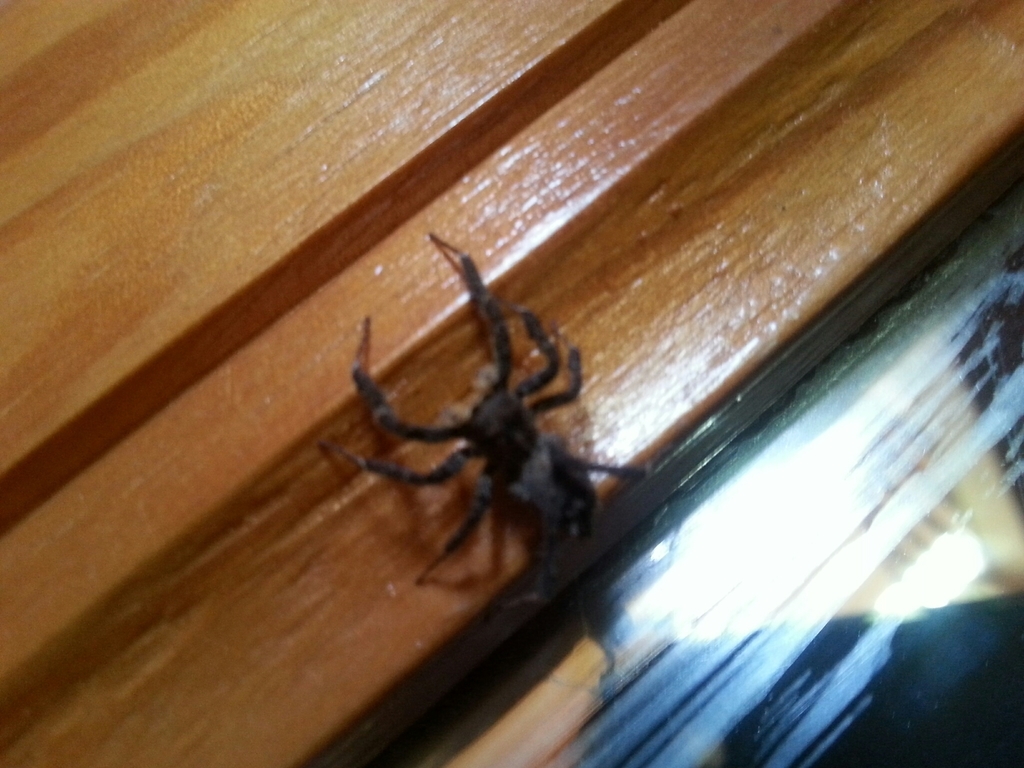
Portia labiata is a jumping spider (family Salticidae) found in Sri Lanka, India, southern China, Burma (Myanmar), Malaysia, Singapore, Java, Sumatra and the Philippines.
- Kingdom
- Animalia
- Phylum
- Arthropoda
- Class
- Arachnida
- Order
- Araneae
- Family
- Salticidae
- Genus
- Portia
- Species
- Portia labiata
Description
Portia labiata is a jumping spider (family Salticidae) found in Sri Lanka, India, southern China, Burma (Myanmar), Malaysia, Singapore, Java, Sumatra and the Philippines. In this medium-sized jumping spider, the front part is orange-brown and the back part is brownish. The conspicuous main eyes provide vision more acute than a cat's during the day and 10 times more acute than a dragonfly's, and this is essential in P. labiata′s navigation, hunting and mating. The genus Portia has been called "eight-legged cats", as their hunting tactics are as versatile and adaptable as a lion's. All members of Portia have instinctive hunting tactics for their most common prey, but often can improvise by trial and error against unfamiliar prey or in unfamiliar situations, and then remember the new approach. While most jumping spiders prey mainly on insects and by active hunting, females of Portia also build webs to catch prey directly and sometimes join their own webs on to those of web-based spiders. Both females and males prefer web spiders as prey, followed by other jumping spiders, and finally insects. In all cases females are more effective predators than males. Populations from Los Baños and from Sagada, both in the Philippines, have slightly different hunting tactics. In laboratory tests, Los Baños P. labiata relies more on trial and error than Sagada P. labiata in finding ways to vibrate the prey's web and thus lure or distract the prey. Around Los Baños the web-building Scytodes pallida, which preys on jumping spiders, is very abundant, and spits a sticky gum on prey and potential threats. A P. labiata from Los Baños instinctively detours round the back of S. pallida while with plucking the web in a way that makes the prey believe the threat is in front of it. In areas where S. pallida is absent, the local members of P. labiata do not use this combination of deception and detouring for a stab in the back. In a test to explore P. labiata′s ability to solve a novel problem, a miniature lagoon was set up, and the spiders had to find the best way to cross it. Specimens from Sagada, in the mountains, almost always repeated the first option they tried, even when that was unsuccessful. When specimens from Los Baños, beside a lake, were unsuccessful the first time, about three quarters switched to another option. Adults of P. labiata sometimes uses "propulsive displays", in which an individual threatens a rival of the same sex, and unreceptive females also threaten males in this way.[c] P. labiata females are extremely aggressive to other females, trying to invade and take over each other's webs, which often results in cannibalism. A test showed that they minimise the risk of confrontations by using silk draglines as territory marks. Another test showed that females can recognise the draglines of the most powerful fighters and prefer to move near the draglines of less powerful ones. Females try to kill and eat their mates during or after copulation, while males use tactics to survive copulation, but sometimes females outwit them. Before being mature enough to mate, juvenile females mimic adult females to attract males as prey. When hunting, P. labiata mature females emit olfactory signals that reduce the risk that any other females, males or juveniles of the same species may contend for the same prey.
Gallery
Ajouter des photos
Partagez vos photos de cette espèce (jusqu'à 20 à la fois) : elles sont vérifiées automatiquement, puis publiées.
Répartition
Occurrences observées (données GBIF). Les zones hors aire d'origine peuvent indiquer une présence introduite ou invasive.
Sources et crédits
Informations provenant de plusieurs sources vérifiées. Dernière mise à jour : .
Crédits photos (8)
- Photo : Riley Pollom (@rileypollom) · CC BY 4.0 · via iNaturalist
- Photo : Woraphot Bunkhwamdi (@woraphot) · CC BY-NC 4.0 · via iNaturalist
- Photo : Harikrishnan S (@hari_krishnan_) · CC BY-NC 4.0 · via iNaturalist
- Photo : @zicky · CC BY-NC 4.0 · via iNaturalist
- Photo : 江国彬 (@gbno) · CC BY-NC 4.0 · via iNaturalist
- Photo : vasanthi k (@vasanthi) · CC BY-NC 4.0 · via iNaturalist
- Photo : Girish Gowda (@girishgowda) · CC BY-NC 4.0 · via iNaturalist
- Photo : Standa Pavouk (@standapavouk) · CC BY-NC 4.0 · via iNaturalist
Mentions de licence
Texte disponible sous licence CC BY-SA 4.0. Il adapte notamment Wikipedia (CC BY-SA) : Portia labiata (Wikipédia, auteurs dans l’historique de l’article).
- Taxonomie : GBIF Backbone Taxonomy (CC BY 4.0)
- Carte : occurrences GBIF, fond © contributeurs OpenStreetMap (ODbL)
Détail : Sources et licences.
Discussion (0)
Aucun message pour l’instant. Lancez la discussion sur cette fiche (sources, précisions, débats éditoriaux).
Connectez-vous pour participer à la discussion.