
Portia africana
Portia africana
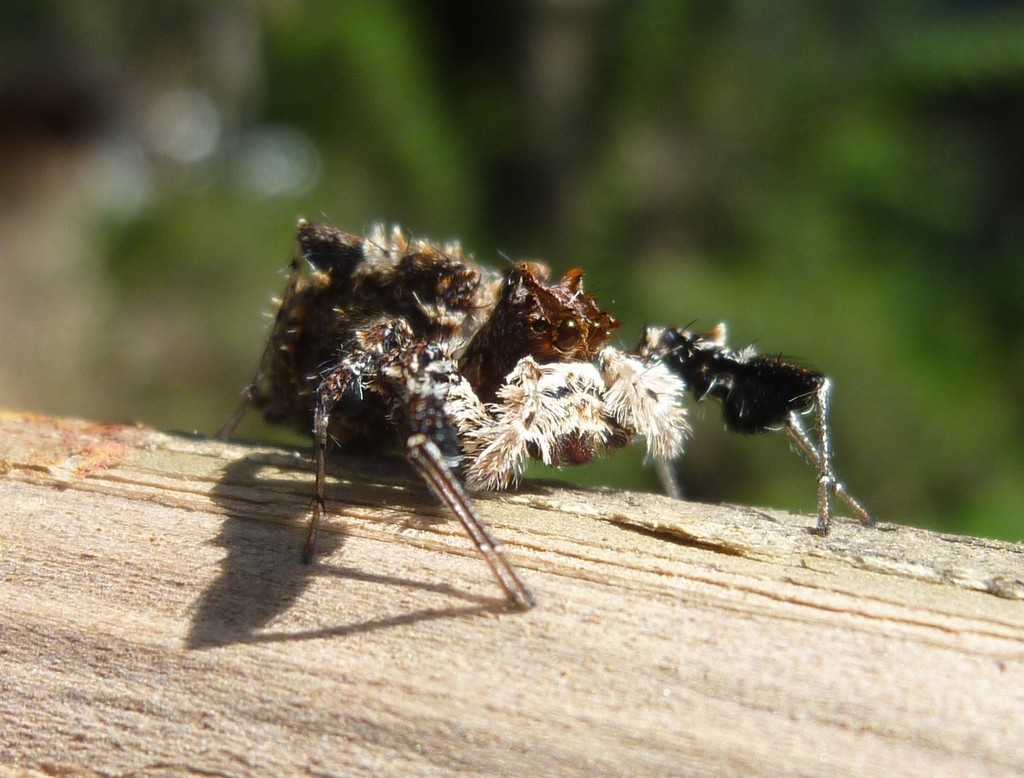
Portia africana is a jumping spider (family Salticidae) found in Angola, Cameroon, the Central African Republic, Gabon, Ghana, the Ivory Coast, Sierra Leone, Zaire and Zambia.
- Kingdom
- Animalia
- Phylum
- Arthropoda
- Class
- Arachnida
- Order
- Araneae
- Family
- Salticidae
- Genus
- Portia
- Species
- Portia africana
Description
Portia africana is a jumping spider (family Salticidae) found in Angola, Cameroon, the Central African Republic, Gabon, Ghana, the Ivory Coast, Sierra Leone, Zaire and Zambia. Its conspicuous main eyes provide vision more acute than a cat's during the day and 10 times more acute than a dragonfly's, and this is essential in P. africana′s navigation, hunting and mating. Like other species of the genus Portia, P. africana prefers to hunt web-based spiders, jumping spiders and other types in that order. When hunting web-based spiders, Portias use trial and error to find a way to mislead the prey until the Portia is in a position to bite the victim. While other Portias live and hunt as individuals, P. africana forms large populations both in savanna areas and in the dense "cities" which social jumping spiders build in vegetation near the shoreline of lakes. In the savanna, groups of P. africana, generally consisting of small juveniles, delay the prey until one juvenile bites the victim, and sometimes the juvenile shares the food with other. In vegetation near shorelines, P. africana hunts in the social jumping spiders' cities. There, two species of assassin bug prey on P. africana, and one also preys on the other. Before courtship, males spin a small web between boughs or twigs, that they hang under, ejaculate into, and then soak the semen into reservoirs on their pedipalps. If a female smells a male of the same species, the female stimulates the males to court. While hunting, mature females of P. africana emit olfactory signals that reduce the risk that any other females, males or juveniles of the same species may contend for the same prey.
Ajouter des photos
Partagez vos photos de cette espèce (jusqu'à 20 à la fois) : elles sont vérifiées automatiquement, puis publiées.
Répartition
Occurrences observées (données GBIF). Les zones hors aire d'origine peuvent indiquer une présence introduite ou invasive.
Sources et crédits
Informations provenant de plusieurs sources vérifiées. Dernière mise à jour : .
Crédits photos (1)
- Photo : Jakob Fahr (@jakob) · CC BY-NC 4.0 · via iNaturalist
Mentions de licence
Texte disponible sous licence CC BY-SA 4.0. Il adapte notamment Wikipedia (CC BY-SA) : Portia africana (Wikipédia, auteurs dans l’historique de l’article).
- Taxonomie : GBIF Backbone Taxonomy (CC BY 4.0)
- Carte : occurrences GBIF, fond © contributeurs OpenStreetMap (ODbL)
Détail : Sources et licences.
Discussion (0)
Aucun message pour l’instant. Lancez la discussion sur cette fiche (sources, précisions, débats éditoriaux).
Connectez-vous pour participer à la discussion.