
Phidippus clarus
Phidippus clarus
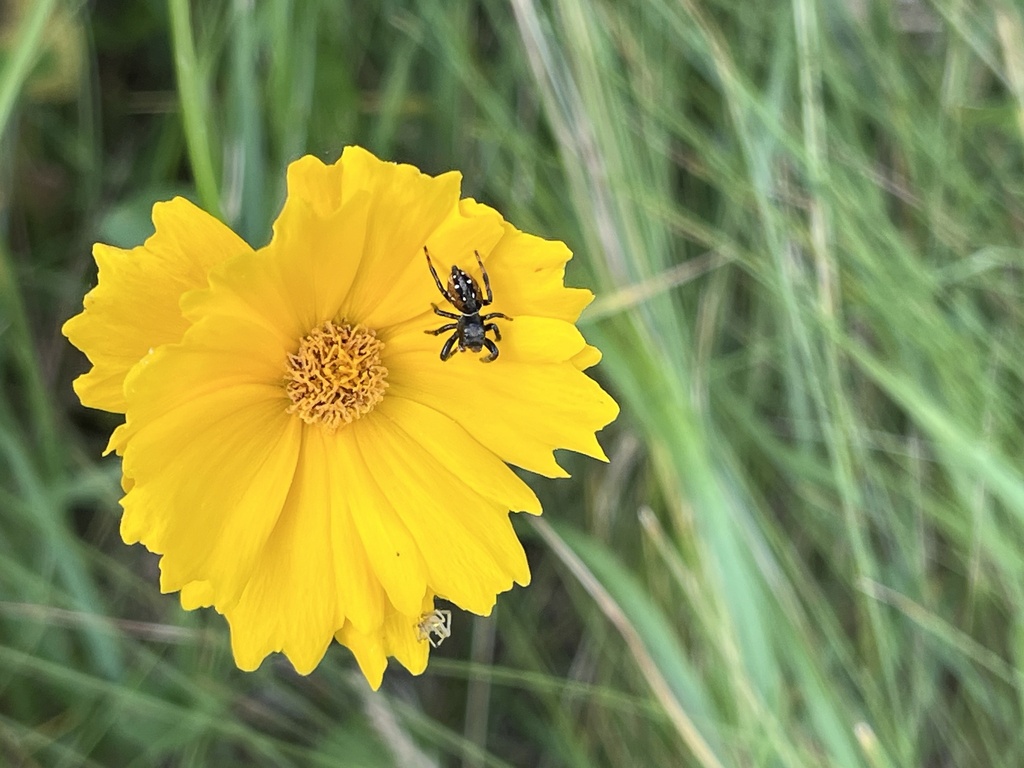
Phidippus clarus, also known as the brilliant jumping spider, is a species of jumping spider (family Salticidae) found in old fields throughout eastern North America.
- Kingdom
- Animalia
- Phylum
- Arthropoda
- Class
- Arachnida
- Order
- Araneae
- Family
- Salticidae
- Genus
- Phidippus
- Species
- Phidippus clarus
Description
Phidippus clarus, also known as the brilliant jumping spider, is a species of jumping spider (family Salticidae) found in old fields throughout eastern North America. It often waits upside down near the top of a plant, which may be useful for detecting prey, and then quickly jumps down before the prey can escape. The spider is one of 60 species in the genus Phidippus, and one of about 5,000 in the Salticidae, a family that accounts for about 10% of all spider species. P. clarus is a predator, mostly consuming insects, other spiders, and other terrestrial arthropods. P. clarus is a relatively large salticid that is able to take prey up to the size of an adult earwig. In an experiment, P. clarus was offered as many fruit flies as it could eat in a four-hour session. On average individuals took 17 flies, with the maximum amount taken was a striking 41. When P. clarus males compete for females, the winners are those that produce the most vibrations on the surface and those that are largest. Contests between females involve less displaying, and physical fights between females are more likely to end in injury or death. The most successful males choose the largest females, as these females produce the most eggs and are the quickest at producing. If a female that has mated already finds another larger male, she will often mate again with the larger male. The average clutch is 135 eggs. Unlike most of the genus Phidippus, P. clarus females die after one brood has left the nest. P. clarus is parasitized by the wasp Aporinellus completus and by mermithid nematodes. In an experiment in 2006, P. clarus showed promise for controlling the fourlined plant bug, Poecilocapsus lineatus, which severely damages the commercially grown sweet basil.
Gallery
Ajouter des photos
Partagez vos photos de cette espèce (jusqu'à 20 à la fois) : elles sont vérifiées automatiquement, puis publiées.
Répartition
Occurrences observées (données GBIF). Les zones hors aire d'origine peuvent indiquer une présence introduite ou invasive.
Sources et crédits
Informations provenant de plusieurs sources vérifiées. Dernière mise à jour : .
Crédits photos (8)
- Photo : @librarybadger · CC BY-NC 4.0 · via iNaturalist
- Photo : Gary James (@gary-james) · CC BY-NC 4.0 · via iNaturalist
- Photo : Roger Debenham (@rdebenham) · CC BY-NC 4.0 · via iNaturalist
- Photo : Patrick E. Phoebus, Ph.D. (@pphoebus) · CC BY-NC 4.0 · via iNaturalist
- Photo : Phoebe Barnes (@vireosylva) · CC BY-NC 4.0 · via iNaturalist
- Photo : Drake Allen (@drakeallen59) · CC BY-NC 4.0 · via iNaturalist
- Photo : Alan Kwok (King Lun), Ada Tai (Ah Heung) / 阿達蘭 AdAlan (@alankwok) · CC BY-NC 4.0 · via iNaturalist
- Photo : Henry Adamson (@hadamso) · CC BY-NC 4.0 · via iNaturalist
Mentions de licence
Texte disponible sous licence CC BY-SA 4.0. Il adapte notamment Wikipedia (CC BY-SA) : Phidippus clarus (Wikipédia, auteurs dans l’historique de l’article).
- Taxonomie : GBIF Backbone Taxonomy (CC BY 4.0)
- Carte : occurrences GBIF, fond © contributeurs OpenStreetMap (ODbL)
Détail : Sources et licences.
Discussion (0)
Aucun message pour l’instant. Lancez la discussion sur cette fiche (sources, précisions, débats éditoriaux).
Connectez-vous pour participer à la discussion.