
Bold Jumper
Phidippus audax
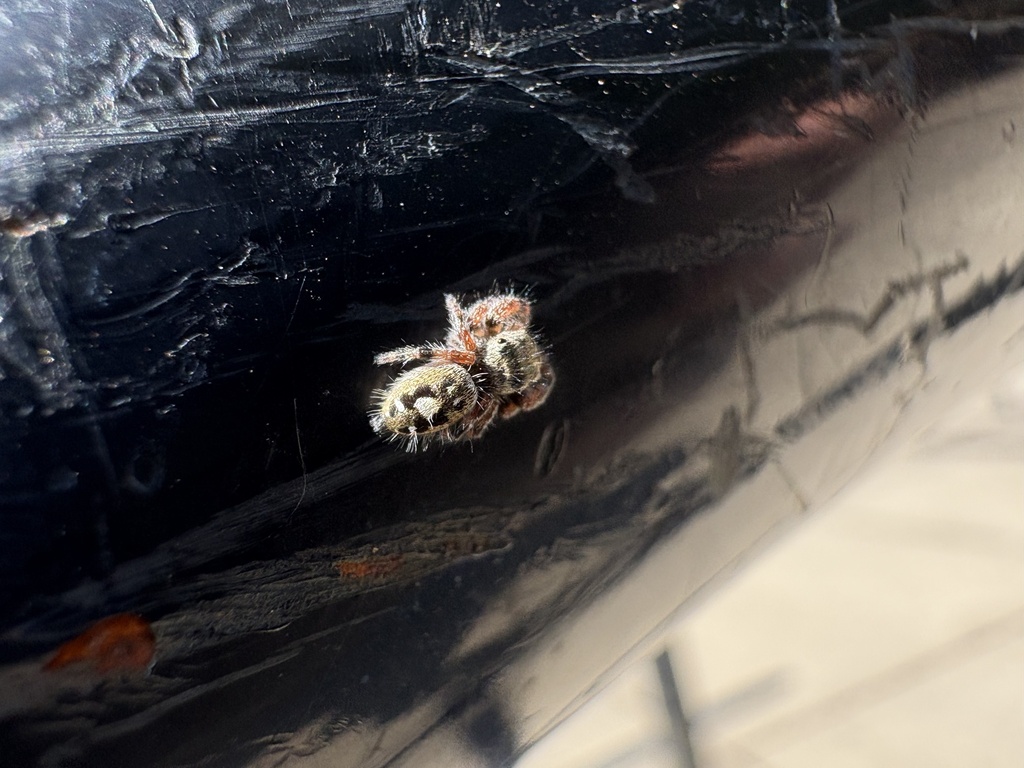
Phidippus audax, the bold jumper or daring jumping spider, is a common species of spider belonging to the genus Phidippus, a group of jumping spiders easily identified by their large eyes and iridescent chelicerae.
- Kingdom
- Animalia
- Phylum
- Arthropoda
- Class
- Arachnida
- Order
- Araneae
- Family
- Salticidae
- Genus
- Phidippus
- Species
- Phidippus audax
Description
Phidippus audax, the bold jumper or daring jumping spider, is a common species of spider belonging to the genus Phidippus, a group of jumping spiders easily identified by their large eyes and iridescent chelicerae. The bold jumper itself bears white abdominal dorsal spots, one of them prominent. Like all jumping spiders, they have excellent stereoscopic vision that aids them in stalking prey and facilitates visual communication with potential mates during courting. Bold jumping spiders are native to North America and have been introduced to Hawaii, Nicobar Islands, Azores, and the Netherlands. Bold jumping spiders are solitary carnivores that use their highly specialized eyesight to actively hunt and stalk prey. They prey on a variety of insects and non-insect terrestrial arthropods such as caterpillars, dragonflies, grasshoppers, and other spiders. They are one of the most common spiders found in agricultural areas and have been studied to determine their impact on crop pest populations. Unlike most spiders, bold jumpers do not build webs to catch prey. These spiders can be found in temperate climates in a variety of terrestrial habitats including grasslands, chaparrals, open woodlands, and agricultural fields. The bold jumper is one of the most commonly occurring spider species within its range and is often found living in close proximity to humans. Bites from Phidippus audax are rare but may occur if they feel threatened or are mishandled.
Gallery
Ajouter des photos
Partagez vos photos de cette espèce (jusqu'à 20 à la fois) : elles sont vérifiées automatiquement, puis publiées.
Répartition
Occurrences observées (données GBIF). Les zones hors aire d'origine peuvent indiquer une présence introduite ou invasive.
Sources et crédits
Informations provenant de plusieurs sources vérifiées. Dernière mise à jour : .
Crédits photos (8)
- Photo : Rowan Nolan (@radiorowan) · CC BY-NC 4.0 · via iNaturalist
- Photo : @mboyd24 · CC BY-NC 4.0 · via iNaturalist
- Photo : @mkclevenger · CC BY-NC 4.0 · via iNaturalist
- Photo : MarblWAH (@marblwah) · CC BY-NC 4.0 · via iNaturalist
- Photo : Matthew L. Pinegar (@mlpinegar) · CC BY-NC 4.0 · via iNaturalist
- Photo : Alison (@amsinclair) · CC BY-NC 4.0 · via iNaturalist
- Photo : @noah_alan_rauch · CC BY-NC 4.0 · via iNaturalist
- Photo : Steve Young (@steveyoung) · CC BY 4.0 · via iNaturalist
Mentions de licence
Texte disponible sous licence CC BY-SA 4.0. Il adapte notamment Wikipedia (CC BY-SA) : Phidippus audax (Wikipédia, auteurs dans l’historique de l’article).
- Taxonomie : GBIF Backbone Taxonomy (CC BY 4.0)
- Carte : occurrences GBIF, fond © contributeurs OpenStreetMap (ODbL)
Détail : Sources et licences.
Discussion (0)
Aucun message pour l’instant. Lancez la discussion sur cette fiche (sources, précisions, débats éditoriaux).
Connectez-vous pour participer à la discussion.