
Pachyballus castaneus
Pachyballus castaneus
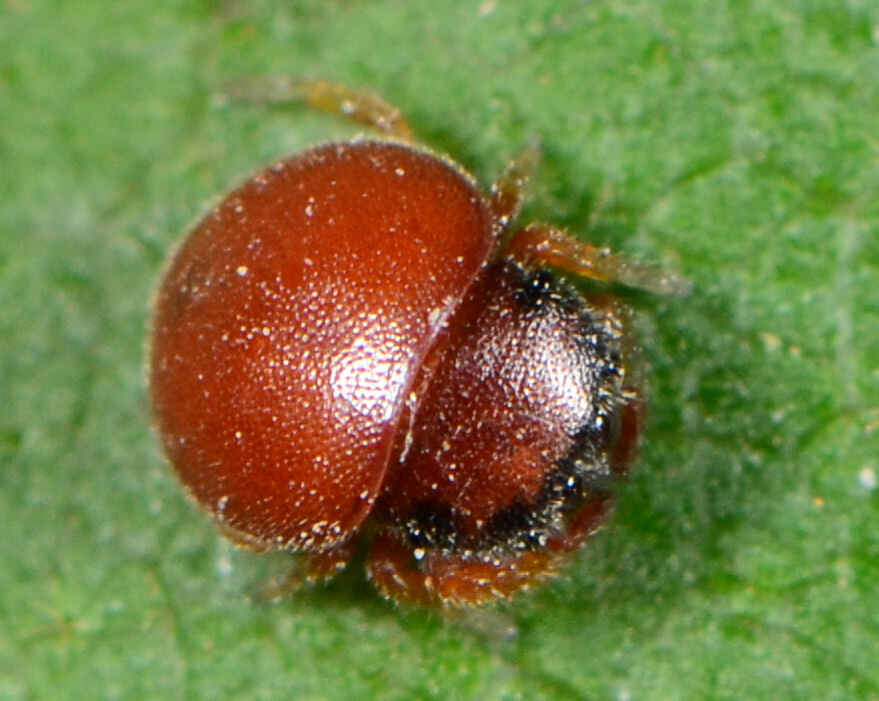
Pachyballus castaneus is a species of jumping spider that is native to South Africa and Zimbabwe.
- Kingdom
- Animalia
- Phylum
- Arthropoda
- Class
- Arachnida
- Order
- Araneae
- Family
- Salticidae
- Genus
- Pachyballus
- Species
- Pachyballus castaneus
Description
Pachyballus castaneus is a species of jumping spider that is native to South Africa and Zimbabwe. Despite being a jumping spider, it prefers to walk rather than to jump and will run if disturbed. It lives in a wide range of habitat, from open grassland to forests. A member of the genus Pachyballus, the spider looks like a beetle, with a body that consists of a round forward section, or cephalothorax, that is between 0.9 and 1.4 mm (0.035 and 0.055 in) in length and a heart-shaped rear section, or abdomen, that is between 1.7 and 2.2 mm (0.067 and 0.087 in) in length. Externally, the spider is hard to distinguish from other species in the genus. It is generally dark brown on top while the abdomen is brownish-grey underneath and has two hard plates known as scuta, the rear one shaped like a trapezium. Its copulatory organs are distinctive. The male has a thinner pedipalp and a more compact coiled embolus than related spiders. The female has a different internal structure to other members of the genus with shorter insemination ducts that lack any loops. A diurnal species, P. castaneus is usually found near broadleaved plants in savannah and grassland regions. It also inhabits wetland amongst trees, the canopy of coastal forests, sand forests of Ndumo Game Reserve, and the more open areas of Kruger National Park. It prefers running rather than jumping on most occasions, even when disturbed. As a natural predator, P. castaneus is a visually-oriented hunter that feeds on various insects, including Chironomidae, Drosophilidae, Psocoptera, and Psyllidae.
Ajouter des photos
Partagez vos photos de cette espèce (jusqu'à 20 à la fois) : elles sont vérifiées automatiquement, puis publiées.
Répartition
Occurrences observées (données GBIF). Les zones hors aire d'origine peuvent indiquer une présence introduite ou invasive.
Sources et crédits
Informations provenant de plusieurs sources vérifiées. Dernière mise à jour : .
Crédits photos (1)
- Photo : Ansie Dippenaar-Schoeman (@crabspider) · CC BY 4.0 · via iNaturalist
Mentions de licence
Texte disponible sous licence CC BY-SA 4.0. Il adapte notamment Wikipedia (CC BY-SA) : Pachyballus castaneus (Wikipédia, auteurs dans l’historique de l’article).
- Taxonomie : GBIF Backbone Taxonomy (CC BY 4.0)
- Carte : occurrences GBIF, fond © contributeurs OpenStreetMap (ODbL)
Détail : Sources et licences.
Discussion (0)
Aucun message pour l’instant. Lancez la discussion sur cette fiche (sources, précisions, débats éditoriaux).
Connectez-vous pour participer à la discussion.