
Opisthacanthus capensis
Opisthacanthus capensis
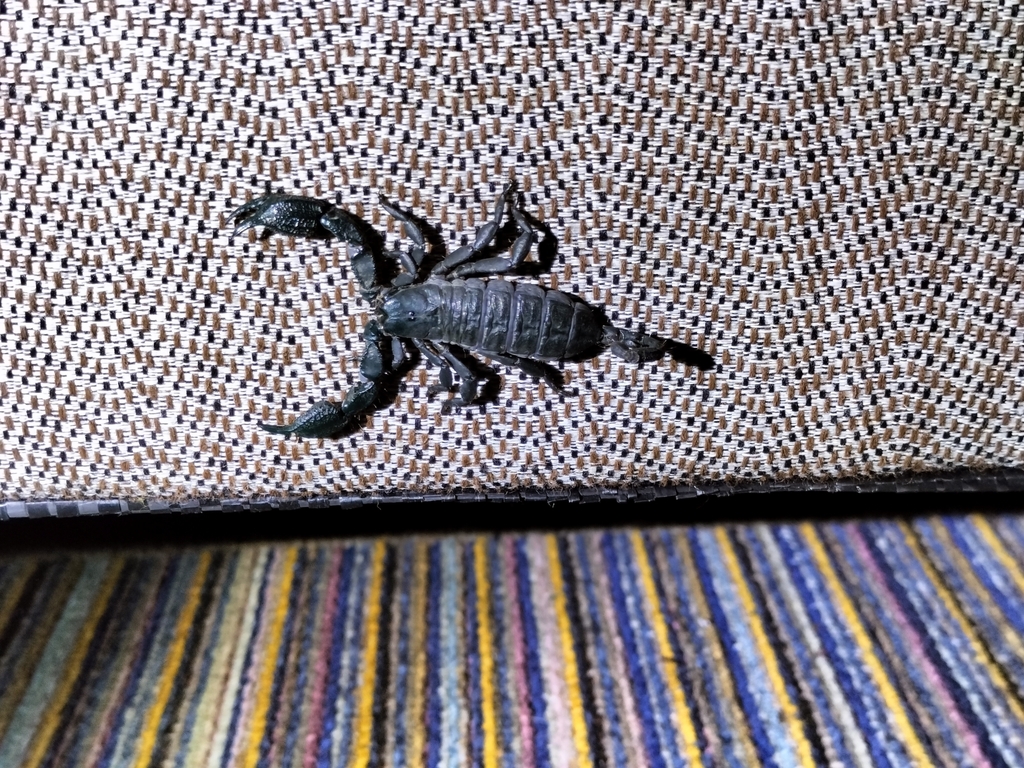
Opisthacanthus capensis is a Cape Province and Zimbabwean species of scorpion with robust chelae, dark brown to black in colour, turning green when under cover for some time.
- Kingdom
- Animalia
- Phylum
- Arthropoda
- Class
- Arachnida
- Order
- Scorpiones
- Family
- Hormuridae
- Genus
- Opisthacanthus
- Species
- Opisthacanthus capensis
Description
Opisthacanthus capensis is a Cape Province and Zimbabwean species of scorpion with robust chelae, dark brown to black in colour, turning green when under cover for some time. Opisthacanthus scorpions are arboreal and ground-dwelling, and found mainly in moist habitats in dense vegetation, pine plantations and forests, and hiding under bark and rocks. Its venom contains powerful neurotoxins and cytotoxins, including mucopolysaccharides, hyaluronidases, phospholipases, serotonins, histamines, enzyme inhibitors, and proteins such as neurotoxic peptides. The venom from O. capensis is largely composed of melittin which stimulates the release of the enzyme phospholipase A2 causing inflammation and pain. Phospholipase A2 cleaves the SN-2 acyl chain, releasing arachidonic acid. However, in humans, it's only mildly venomous, with his sting only causing local pain. This species features in the diets of the bat-eared fox Otocyon megalotis (Canidae), the yellow mongoose Cynictis penicillata, the small grey mongoose Galerella pulverulenta, and the water mongoose Atilax paludinosus (Viverridae).
Gallery
Ajouter des photos
Partagez vos photos de cette espèce (jusqu'à 20 à la fois) : elles sont vérifiées automatiquement, puis publiées.
Répartition
Occurrences observées (données GBIF). Les zones hors aire d'origine peuvent indiquer une présence introduite ou invasive.
Sources et crédits
Informations provenant de plusieurs sources vérifiées. Dernière mise à jour : .
Crédits photos (8)
- Photo : Stephen Moss (@siddd) · CC BY-NC 4.0 · via iNaturalist
- Photo : @buggsbalmer · CC BY-NC 4.0 · via iNaturalist
- Photo : karlagrobler (@groblerkarla) · CC BY-NC 4.0 · via iNaturalist
- Photo : Christiaan Viljoen (@christiaan_viljoen) · CC BY 4.0 · via iNaturalist
- Photo : Paul Bester (@paul_bester) · CC BY-NC 4.0 · via iNaturalist
- Photo : Benjamin Walton (@benjamin_walton) · CC BY-NC 4.0 · via iNaturalist
- Photo : Philipp Hoenle (@myrmecophil) · CC0 (domaine public) · via iNaturalist
- Photo : Ockert van Schalkwyk (@ockertvs) · CC BY-NC 4.0 · via iNaturalist
Mentions de licence
Texte disponible sous licence CC BY-SA 4.0. Il adapte notamment Wikipedia (CC BY-SA) : Opisthacanthus capensis (Wikipédia, auteurs dans l’historique de l’article).
- Taxonomie : GBIF Backbone Taxonomy (CC BY 4.0)
- Carte : occurrences GBIF, fond © contributeurs OpenStreetMap (ODbL)
Détail : Sources et licences.
Discussion (0)
Aucun message pour l’instant. Lancez la discussion sur cette fiche (sources, précisions, débats éditoriaux).
Connectez-vous pour participer à la discussion.