
Crab spider
Misumena vatia
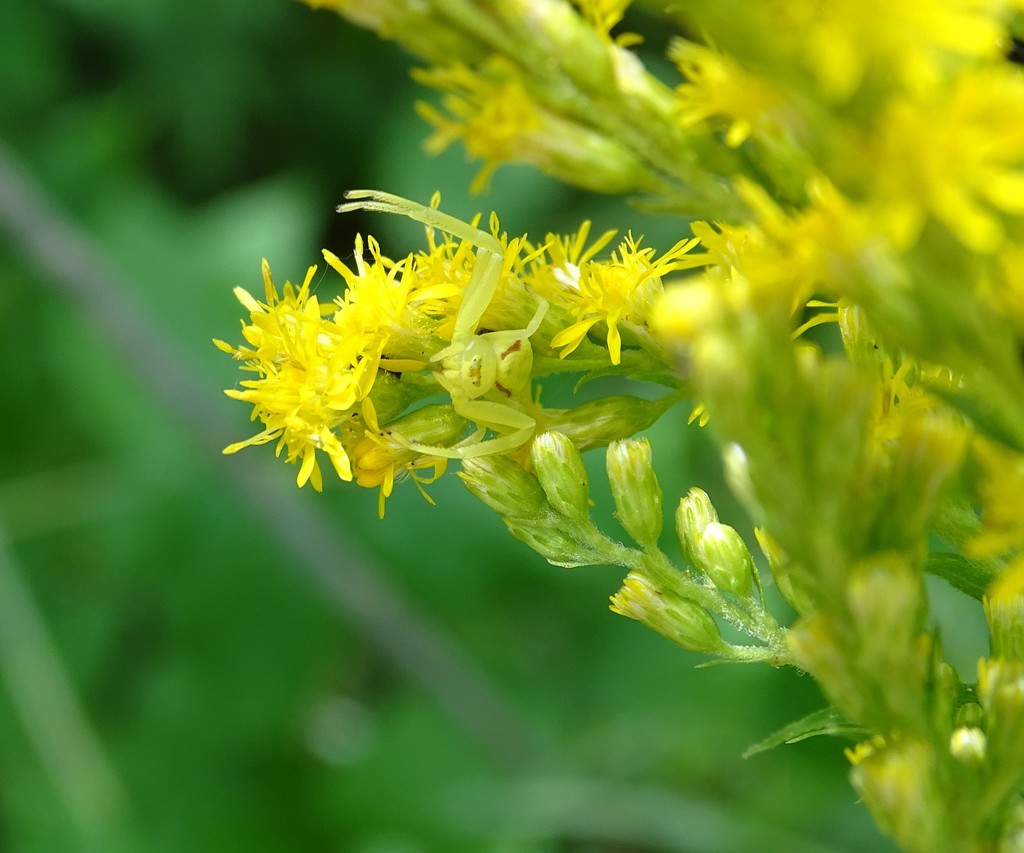
Misumena vatia is a species of crab spider found in Europe and North America.
- Kingdom
- Animalia
- Phylum
- Arthropoda
- Class
- Arachnida
- Order
- Araneae
- Family
- Thomisidae
- Genus
- Misumena
- Species
- Misumena vatia
Description
Misumena vatia is a species of crab spider found in Europe and North America. In North America, it is called the goldenrod crab spider or flower (crab) spider, as it is commonly found hunting in goldenrod sprays and milkweed plants. They are called crab spiders because of their unusual ability to walk sideways as well as forwards and backwards. Both males and females of this species progress through several molts before reaching their adult sizes, though females must molt more to reach their larger size. Females can grow up to 10 mm (0.39 in) while males are quite small, reaching 5 mm (0.20 in) at most. Misumena vatia are usually yellow or white or a pattern of these two colors. They may also present with pale green or pink instead of yellow, again, in a pattern with white. They have the ability to change between these colors based on their surroundings through the molting process. They have a complex visual system, with eight eyes, that they rely on for prey capture and for their color-changing abilities. Sometimes, if Misumena vatia consumes colored prey, the spider itself will take on that color. Misumena vatia feed on common insects, often consuming prey much larger than themselves. They use venom to immobilize their prey, though they are harmless to humans. They face threats due to parasites and larger insects. For Misumena vatia, survival depends on the choice of hunting site. The spiders closely monitor multiple sites to see if others nearby are frequented by greater numbers of potential prey. The primary sex ratio is biased toward females. Females are stationary and choose a flower to settle on, while males cover great distances searching for mates. Females do not emit pheromones; rather, they leave "draglines" of silk behind them as they move, which males follow. Females live longer than males, on average. After mating, females guard their nests until the young have hatched, after which they die.
Gallery
Ajouter des photos
Partagez vos photos de cette espèce (jusqu'à 20 à la fois) : elles sont vérifiées automatiquement, puis publiées.
Répartition
Occurrences observées (données GBIF). Les zones hors aire d'origine peuvent indiquer une présence introduite ou invasive.
Sources et crédits
Informations provenant de plusieurs sources vérifiées. Dernière mise à jour : .
Crédits photos (8)
- Photo : Kristen Osborne (@osborne88) · CC BY-NC 4.0 · via iNaturalist
- Photo : @dexternienhaus · CC BY-NC 4.0 · via iNaturalist
- Photo : Sadie Hickey (@sadie_hickey) · CC BY-NC 4.0 · via iNaturalist
- Photo : @kliewer · CC BY-NC 4.0 · via iNaturalist
- Photo : @kirkland_joe · CC BY-NC 4.0 · via iNaturalist
- Photo : @probitaille · CC BY-NC 4.0 · via iNaturalist
- Photo : Cameron Wilkins (@cammmmm) · CC BY 4.0 · via iNaturalist
- Photo : @christianpl03 · CC BY-NC 4.0 · via iNaturalist
Mentions de licence
Texte disponible sous licence CC BY-SA 4.0. Il adapte notamment Wikipedia (CC BY-SA) : Misumena vatia (Wikipédia, auteurs dans l’historique de l’article).
- Taxonomie : GBIF Backbone Taxonomy (CC BY 4.0)
- Carte : occurrences GBIF, fond © contributeurs OpenStreetMap (ODbL)
Détail : Sources et licences.
Discussion (0)
Aucun message pour l’instant. Lancez la discussion sur cette fiche (sources, précisions, débats éditoriaux).
Connectez-vous pour participer à la discussion.