
Swift Crab Spider
Mecaphesa celer
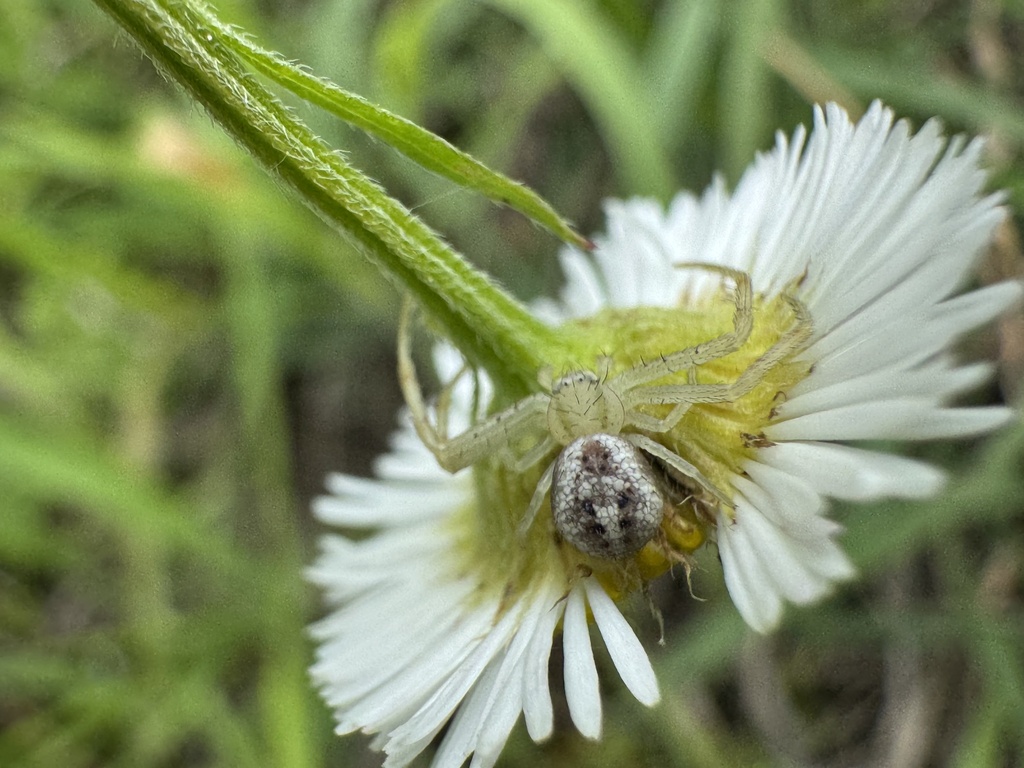
Mecaphesa celer, known generally as the swift crab spider, is a species of crab spider in the family Thomisidae.
- Kingdom
- Animalia
- Phylum
- Arthropoda
- Class
- Arachnida
- Order
- Araneae
- Family
- Thomisidae
- Genus
- Mecaphesa
- Species
- Mecaphesa celer
Description
Mecaphesa celer, known generally as the swift crab spider, is a species of crab spider in the family Thomisidae. Its range is quite large, and it is found throughout much of North and Central America. M. celer are sit-and-wait predators who hide out on the flowers and upper stalks of plants, waiting for prey to pass by. As a variety of crab spider, they have characteristically long first two pairs of legs which they use to grab prey. M. celer spin webs only for creating egg sacs and as part of mating, not for hunting. The spider is a notable example of a species that displays sexual size dimorphism (SSD), a phenomenon in which one sex is significantly larger than the other. In the case of M. celer, females are dramatically larger than males, sometimes over twice their size, making the species a case of extreme sexual size dimorphism. M. celer also displays sexual cannibalism, as the females have been observed to eat their male mates if the males are still in proximity of the females after copulation. Like other spiders within the Thomisidae family, M. celer are an important pest control species for agriculture since they hunt at the upper parts of crop plants where the grains or other harvested products grow. They thereby prey upon and protect agricultural products from potential pests like aphids. This species was formerly a member of the genus Misumenops, and was recently moved to Mecaphesa. Several older website and journal entries about the spider can still be found under the species name Misumenops celer, as with several of the references used in this article.
Gallery
Ajouter des photos
Partagez vos photos de cette espèce (jusqu'à 20 à la fois) : elles sont vérifiées automatiquement, puis publiées.
Répartition
Occurrences observées (données GBIF). Les zones hors aire d'origine peuvent indiquer une présence introduite ou invasive.
Sources et crédits
Informations provenant de plusieurs sources vérifiées. Dernière mise à jour : .
Crédits photos (8)
- Photo : @hbas95 · CC BY-NC 4.0 · via iNaturalist
- Photo : @jeannevc · CC BY-NC 4.0 · via iNaturalist
- Photo : 🌱 Aaron Lincoln 🌱 (@bosqueaaron) · CC BY-NC 4.0 · via iNaturalist
- Photo : Jan Johnson (@janjohn48) · CC BY-NC 4.0 · via iNaturalist
- Photo : @rhacodactylus · CC BY-NC 4.0 · via iNaturalist
- Photo : @lynnwchen · CC BY-NC 4.0 · via iNaturalist
- Photo : Lauren Parker (@lparker24) · CC BY-NC 4.0 · via iNaturalist
- Photo : Derrick L. Mims (@fotosmurf) · CC BY-NC 4.0 · via iNaturalist
Mentions de licence
Texte disponible sous licence CC BY-SA 4.0. Il adapte notamment Wikipedia (CC BY-SA) : Mecaphesa celer (Wikipédia, auteurs dans l’historique de l’article).
- Taxonomie : GBIF Backbone Taxonomy (CC BY 4.0)
- Carte : occurrences GBIF, fond © contributeurs OpenStreetMap (ODbL)
Détail : Sources et licences.
Discussion (0)
Aucun message pour l’instant. Lancez la discussion sur cette fiche (sources, précisions, débats éditoriaux).
Connectez-vous pour participer à la discussion.