
Dimorphic Jumper
Maevia inclemens
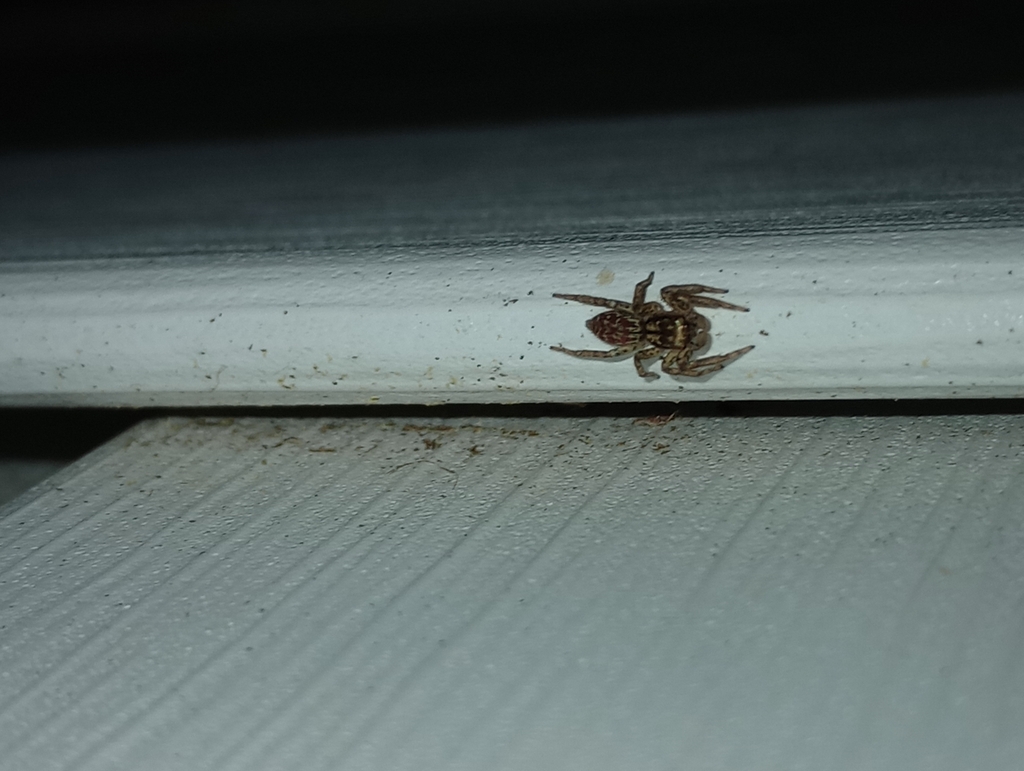
Maevia inclemens or the dimorphic jumping spider is a relatively common and colorful jumping spider of North America.
- Kingdom
- Animalia
- Phylum
- Arthropoda
- Class
- Arachnida
- Order
- Araneae
- Family
- Salticidae
- Genus
- Maevia
- Species
- Maevia inclemens
Description
Maevia inclemens or the dimorphic jumping spider is a relatively common and colorful jumping spider of North America. In the males there are two forms, a very rare phenomenon in zoology. These use different courting displays, and differ in appearance: the "tufted" morph has a black body and pedipalps ("palps"), three black tufts across its "head", and pale legs; and the "gray" morph has black and white stripes all over its body and legs, orange palps, and no tufts. However, each form accounts for 50% of the adult males, and they are equally successful in mating. Like all jumping spiders, M. inclemens has excellent vision. The main eyes, in the front-and-center position, are large, and are more acute than those of a cat and about 10 times as acute as a dragonfly's. The remaining three pairs of eyes are along the sides of the head, and work as motion detectors. The eyes are used for hunting, for avoiding threats and for finding mates. Maevia inclemens is one of the eight species in genus Maevia. The species was first called Attus inclemens, and other names have been used. The two male forms look and behave so differently that they were originally considered two distinct species. In 1955 Robert Barnes chose M. inclemens, and this has become the standard name. The species is found in south-eastern Canada, and in the eastern United States. M. inclemens is frequently seen on man-made structures such as outbuildings or fences.
Gallery
Ajouter des photos
Partagez vos photos de cette espèce (jusqu'à 20 à la fois) : elles sont vérifiées automatiquement, puis publiées.
Répartition
Occurrences observées (données GBIF). Les zones hors aire d'origine peuvent indiquer une présence introduite ou invasive.
Sources et crédits
Informations provenant de plusieurs sources vérifiées. Dernière mise à jour : .
Crédits photos (8)
- Photo : Dakota Parish (@safron) · CC BY-NC 4.0 · via iNaturalist
- Photo : Ari Zakroff (@azf55) · CC BY-NC 4.0 · via iNaturalist
- Photo : Ashley M Bradford (@ashley_bradford) · CC BY-NC 4.0 · via iNaturalist
- Photo : Eli Talhouk (@mythical_mold) · CC BY 4.0 · via iNaturalist
- Photo : Jamie Spence (@wapisay) · CC BY-NC 4.0 · via iNaturalist
- Photo : @headxcase · CC BY-NC 4.0 · via iNaturalist
- Photo : Chesley Andrews Sjulsen (@cas84) · CC BY-NC 4.0 · via iNaturalist
- Photo : @michelcournoyer · CC BY-NC 4.0 · via iNaturalist
Mentions de licence
Texte disponible sous licence CC BY-SA 4.0. Il adapte notamment Wikipedia (CC BY-SA) : Maevia inclemens (Wikipédia, auteurs dans l’historique de l’article).
- Taxonomie : GBIF Backbone Taxonomy (CC BY 4.0)
- Carte : occurrences GBIF, fond © contributeurs OpenStreetMap (ODbL)
Détail : Sources et licences.
Discussion (0)
Aucun message pour l’instant. Lancez la discussion sur cette fiche (sources, précisions, débats éditoriaux).
Connectez-vous pour participer à la discussion.