
Northern Black Widow
Latrodectus variolus
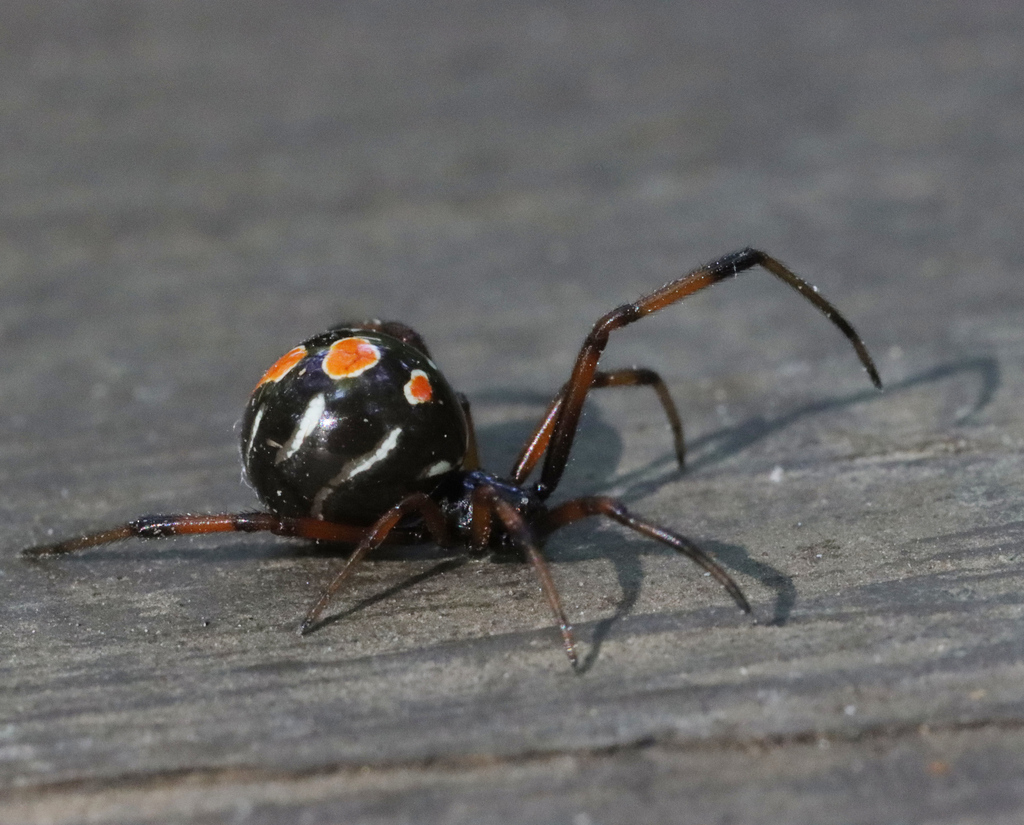
Latrodectus variolus, the northern black widow spider or northern widow, is a venomous species of spider in the genus Latrodectus of the family Theridiidae.
- Kingdom
- Animalia
- Phylum
- Arthropoda
- Class
- Arachnida
- Order
- Araneae
- Family
- Theridiidae
- Genus
- Latrodectus
- Species
- Latrodectus variolus
Description
Latrodectus variolus, the northern black widow spider or northern widow, is a venomous species of spider in the genus Latrodectus of the family Theridiidae. The population is closely related to the red widow, Latrodectus bishopi. In North America, the species is commonly found in Middle Atlantic states (New Jersey, Delaware, Connecticut, Maryland). During the April–May mating season, it can travel north along the coast as far as Massachusetts in summer, and rarely, in southern Ontario and southern Quebec, Michigan, and at least as far northwest as parts of Wisconsin. A bite may cause latrodectism, and requires medical attention in the case of increasingly severe discomfort or spreading local redness accompanied by severe pain. Other symptoms, which can last up to a week, may include body aches, severe pain, fever, inflammation, nausea, and vomiting. Bites to humans are not typically deadly except in infants and the elderly. The LD-50 has been measured in mice as 1.20–2.70 mg (0.019–0.042 gr); each spider contains about 0.254 mg (0.0039 gr) of venom. Unlike for the related Latrodectus mactans, as of 2015 no antivenom was available.
Gallery
Ajouter des photos
Partagez vos photos de cette espèce (jusqu'à 20 à la fois) : elles sont vérifiées automatiquement, puis publiées.
Répartition
Occurrences observées (données GBIF). Les zones hors aire d'origine peuvent indiquer une présence introduite ou invasive.
Sources et crédits
Informations provenant de plusieurs sources vérifiées. Dernière mise à jour : .
Crédits photos (8)
- Photo : Kyle Warnecke (@rbcl_guy) · CC BY-NC 4.0 · via iNaturalist
- Photo : Heather Pickard (@heatherpickard) · CC BY-NC 4.0 · via iNaturalist
- Photo : @jweimerjr · CC BY-NC 4.0 · via iNaturalist
- Photo : East_TX_LCR (@east_tx_lcr) · CC BY-NC 4.0 · via iNaturalist
- Photo : @contingence · CC BY 4.0 · via iNaturalist
- Photo : Garrett Weese (@garrett_weese) · CC BY-NC 4.0 · via iNaturalist
- Photo : Annika Lindqvist (@annikaml) · CC BY 4.0 · via iNaturalist
- Photo : Bert Harris (@bertharris) · CC BY-NC 4.0 · via iNaturalist
Mentions de licence
Texte disponible sous licence CC BY-SA 4.0. Il adapte notamment Wikipedia (CC BY-SA) : Latrodectus variolus (Wikipédia, auteurs dans l’historique de l’article).
- Taxonomie : GBIF Backbone Taxonomy (CC BY 4.0)
- Carte : occurrences GBIF, fond © contributeurs OpenStreetMap (ODbL)
Détail : Sources et licences.
Discussion (0)
Aucun message pour l’instant. Lancez la discussion sur cette fiche (sources, précisions, débats éditoriaux).
Connectez-vous pour participer à la discussion.