
Gasteracantha fornicata
Gasteracantha fornicata
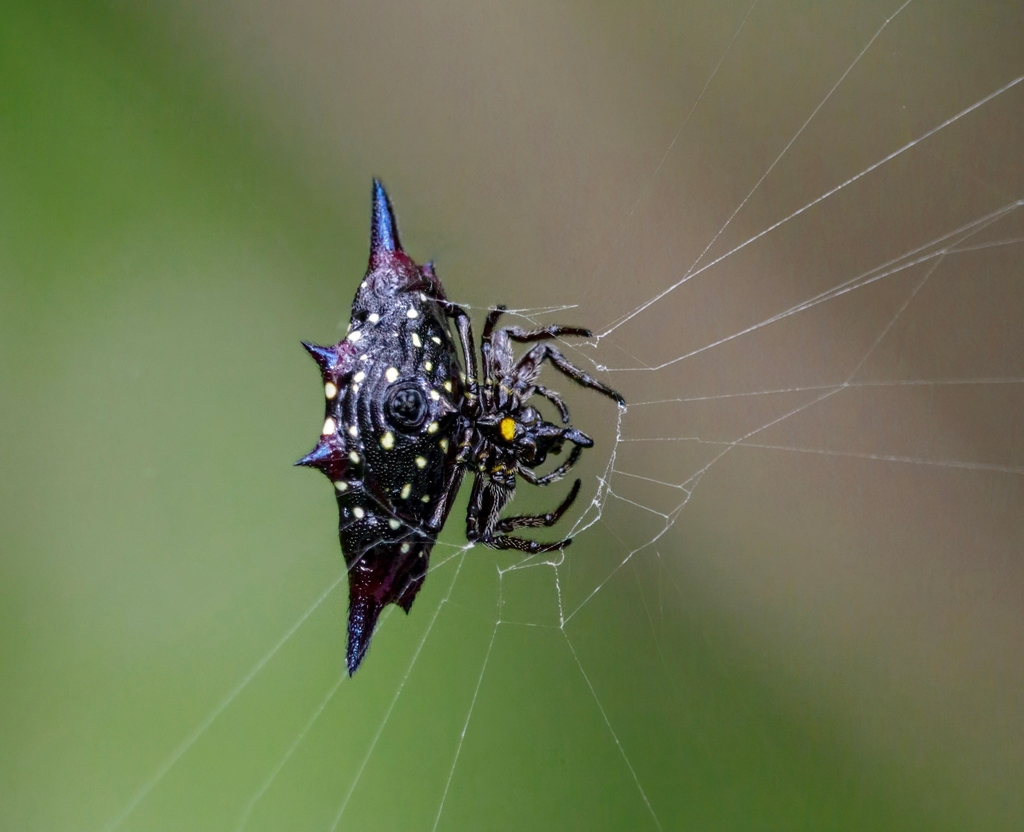
Gasteracantha fornicata (northern jewelled spider) is a species of spiny orb-weavers (family Araneidae) found in Queensland Australia.
- Kingdom
- Animalia
- Phylum
- Arthropoda
- Class
- Arachnida
- Order
- Araneae
- Family
- Araneidae
- Genus
- Gasteracantha
- Species
- Gasteracantha fornicata
Description
Gasteracantha fornicata (northern jewelled spider) is a species of spiny orb-weavers (family Araneidae) found in Queensland Australia. It is similar in shape to Austracantha minax which was originally described as Gasteracantha minax. It was described by Johan Christian Fabricius in 1775, the first Australian species of spider to be named and classified. One of the synonyms of the species is Gasteracantha vittata, a name given to it by Ludwig Carl Christian Koch in 1871. However, it was later discovered that Fabricius had described the species earlier, and according to taxonomic rules, the earlier name has precedence and is the only one that should be used. Also, there are other species that were identified G. vittata at times, namely Gasteracantha irradiata (by Thorell, 1859), Gasteracantha sanguinolenta (by Keyserling, 1877) and Gasteracantha transversa (as subspecies G. v. longicornis by Strand, 1907), further complicating the issue. G. fornicata is known for its female spiders that have a stark banded pattern along its dorsal side, with yellow or white stripes contrasting its dark-coloured body. It has small yellow or white spots along the ventral side. This spider has been described as a "sit-and-wait" predator, where it waits for small insects to approach its web. Gasteracantha fornicata is known for its circular, "orb-shaped" webs with silk tuft decorations.
Gallery
Ajouter des photos
Partagez vos photos de cette espèce (jusqu'à 20 à la fois) : elles sont vérifiées automatiquement, puis publiées.
Répartition
Occurrences observées (données GBIF). Les zones hors aire d'origine peuvent indiquer une présence introduite ou invasive.
Sources et crédits
Informations provenant de plusieurs sources vérifiées. Dernière mise à jour : .
Crédits photos (8)
- Photo : Alexander Smith (@sandysmith6773) · CC BY-NC 4.0 · via iNaturalist
- Photo : @michaelp28 · CC BY-NC 4.0 · via iNaturalist
- Photo : Dan Blamey (@headsoup) · CC BY-NC 4.0 · via iNaturalist
- Photo : Adrian Wolfgang (@adrian272) · CC BY 4.0 · via iNaturalist
- Photo : Carey_Knox_Southern_Scales (@carey_knox_southern_scales) · CC0 (domaine public) · via iNaturalist
- Photo : Lawrence Hylton (@lawrencehylton) · CC BY 4.0 · via iNaturalist
- Photo : Bee-yonce (@bee-yonce) · CC BY-NC 4.0 · via iNaturalist
- Photo : @loicdeleeuw · CC BY-NC 4.0 · via iNaturalist
Mentions de licence
Texte disponible sous licence CC BY-SA 4.0. Il adapte notamment Wikipedia (CC BY-SA) : Gasteracantha fornicata (Wikipédia, auteurs dans l’historique de l’article).
- Taxonomie : GBIF Backbone Taxonomy (CC BY 4.0)
- Carte : occurrences GBIF, fond © contributeurs OpenStreetMap (ODbL)
Détail : Sources et licences.
Discussion (0)
Aucun message pour l’instant. Lancez la discussion sur cette fiche (sources, précisions, débats éditoriaux).
Connectez-vous pour participer à la discussion.