
Diguetia canities
Diguetia canities
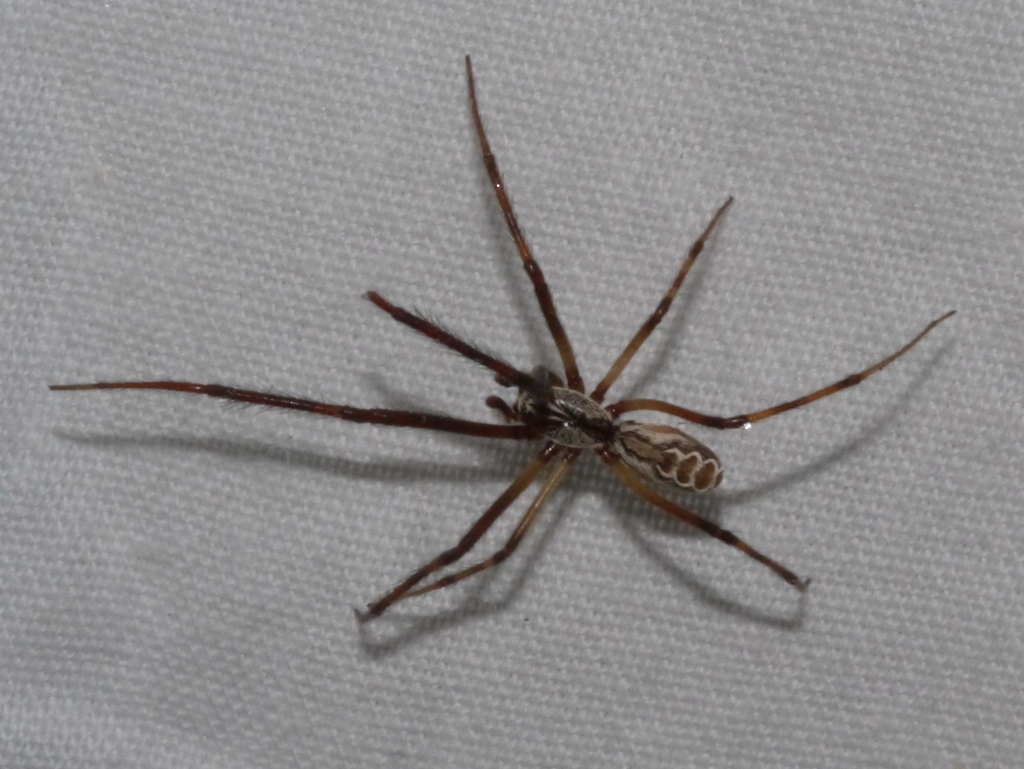
Diguetia canities, commonly called the desert bush spider, is a species of coneweb spider found in desert and semidesert habitats in the United States from California eastward to Oklahoma and Texas.
- Kingdom
- Animalia
- Phylum
- Arthropoda
- Class
- Arachnida
- Order
- Araneae
- Family
- Diguetidae
- Genus
- Diguetia
- Species
- Diguetia canities
Description
Diguetia canities, commonly called the desert bush spider, is a species of coneweb spider found in desert and semidesert habitats in the United States from California eastward to Oklahoma and Texas. This rather hairy spider has a body length of around 9 mm. The rather elongated cephalothorax is orange-brown and covered in short white hairs. The brown abdomen has dark, leaf-like markings bordered with white. The legs are yellow-brown. The sexes are generally similar. As with other members of this family, this spider constructs an elaborate and distinctive web with a domed sheet topped by a tubular retreat which has plant material incorporated. This retreat is used by the female spider to conceal its egg sac. The web is placed up to 60 cm above the ground, often in a bush (hence the common name). The desert bush spider produces Dc1a, a potent insect-selective poisonous 57-residue peptide, which is lethal to the German cockroach (B. germanica).
Gallery
Ajouter des photos
Partagez vos photos de cette espèce (jusqu'à 20 à la fois) : elles sont vérifiées automatiquement, puis publiées.
Répartition
Occurrences observées (données GBIF). Les zones hors aire d'origine peuvent indiquer une présence introduite ou invasive.
Sources et crédits
Informations provenant de plusieurs sources vérifiées. Dernière mise à jour : .
Crédits photos (8)
- Photo : Matt Muir (@muir) · CC BY 4.0 · via iNaturalist
- Photo : Matthew Salkiewicz (@matthew_salkiewicz) · CC BY-NC 4.0 · via iNaturalist
- Photo : William Mason (@ectothermist) · CC BY-NC 4.0 · via iNaturalist
- Photo : BJ Stacey (@finatic) · CC BY-NC 4.0 · via iNaturalist
- Photo : @llellin · CC BY-NC 4.0 · via iNaturalist
- Photo : Courtney Christie (@court_rae) · CC BY-NC 4.0 · via iNaturalist
- Photo : Kuoni W (@reptipods) · CC BY-NC 4.0 · via iNaturalist
- Photo : William Mason (@ectothermist) · CC BY-NC 4.0 · via iNaturalist
Mentions de licence
Texte disponible sous licence CC BY-SA 4.0. Il adapte notamment Wikipedia (CC BY-SA) : Diguetia canities (Wikipédia, auteurs dans l’historique de l’article).
- Taxonomie : GBIF Backbone Taxonomy (CC BY 4.0)
- Carte : occurrences GBIF, fond © contributeurs OpenStreetMap (ODbL)
Détail : Sources et licences.
Discussion (0)
Aucun message pour l’instant. Lancez la discussion sur cette fiche (sources, précisions, débats éditoriaux).
Connectez-vous pour participer à la discussion.