
Rocky Mountain Wood Tick
Dermacentor andersoni
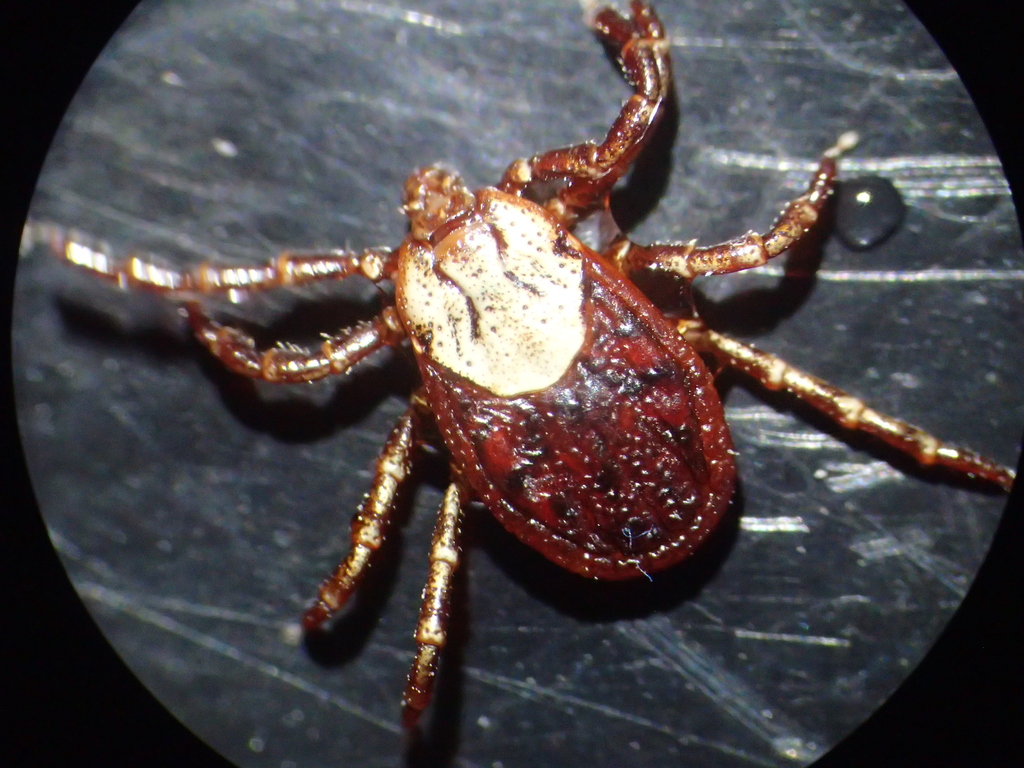
Dermacentor andersoni, commonly known as the Rocky Mountain wood tick, is a hard tick, or member of the Ixodidae family, with three life stages including larvae, nymph, and finally adult, or, more entomologically, imago.
- Kingdom
- Animalia
- Phylum
- Arthropoda
- Class
- Arachnida
- Order
- Ixodida
- Family
- Ixodidae
- Genus
- Dermacentor
- Species
- Dermacentor andersoni
Description
Dermacentor andersoni, commonly known as the Rocky Mountain wood tick, is a hard tick, or member of the Ixodidae family, with three life stages including larvae, nymph, and finally adult, or, more entomologically, imago. This tick is generally located in the northwest United States and southwest Canada along the Rocky Mountains. This tick is generally a vector for Colorado tick fever, but can also be a vector for Rocky Mountain spotted fever and tularemia. During the larval and nymphal stages, the tick does not feed on humans, but during the adult stage, it will. Prevention of infections associated with these ticks is based on control of exposure to the vector, including wearing proper clothing when in woods/wet areas, and checking oneself thoroughly after returning home. Adult female ticks can feed for 5 to 15 days, thus removing a tick if present is very important.
Gallery
Ajouter des photos
Partagez vos photos de cette espèce (jusqu'à 20 à la fois) : elles sont vérifiées automatiquement, puis publiées.
Répartition
Occurrences observées (données GBIF). Les zones hors aire d'origine peuvent indiquer une présence introduite ou invasive.
Sources et crédits
Informations provenant de plusieurs sources vérifiées. Dernière mise à jour : .
Crédits photos (8)
- Photo : Tyson Ehlers (@tyson_ehlers) · CC BY-NC 4.0 · via iNaturalist
- Photo : Tyler Miller (@tyler_miller) · CC BY-NC 4.0 · via iNaturalist
- Photo : Jack Bindernagel (@jbindernagel) · CC BY-NC 4.0 · via iNaturalist
- Photo : John D Reynolds (@johndreynolds) · CC BY-NC 4.0 · via iNaturalist
- Photo : @piercingmouthparts · CC BY-NC 4.0 · via iNaturalist
- Photo : @pcastrovillo · CC BY-NC 4.0 · via iNaturalist
- Photo : Hilary A. Turner (@birder0288) · CC BY-NC 4.0 · via iNaturalist
- Photo : Micah Grove (@micah_g) · CC BY-NC 4.0 · via iNaturalist
Mentions de licence
Texte disponible sous licence CC BY-SA 4.0. Il adapte notamment Wikipedia (CC BY-SA) : Dermacentor andersoni (Wikipédia, auteurs dans l’historique de l’article).
- Taxonomie : GBIF Backbone Taxonomy (CC BY 4.0)
- Carte : occurrences GBIF, fond © contributeurs OpenStreetMap (ODbL)
Détail : Sources et licences.
Discussion (0)
Aucun message pour l’instant. Lancez la discussion sur cette fiche (sources, précisions, débats éditoriaux).
Connectez-vous pour participer à la discussion.