
Elk tick; Moose tick; White fern winter tick; Winter tick
Dermacentor albipictus
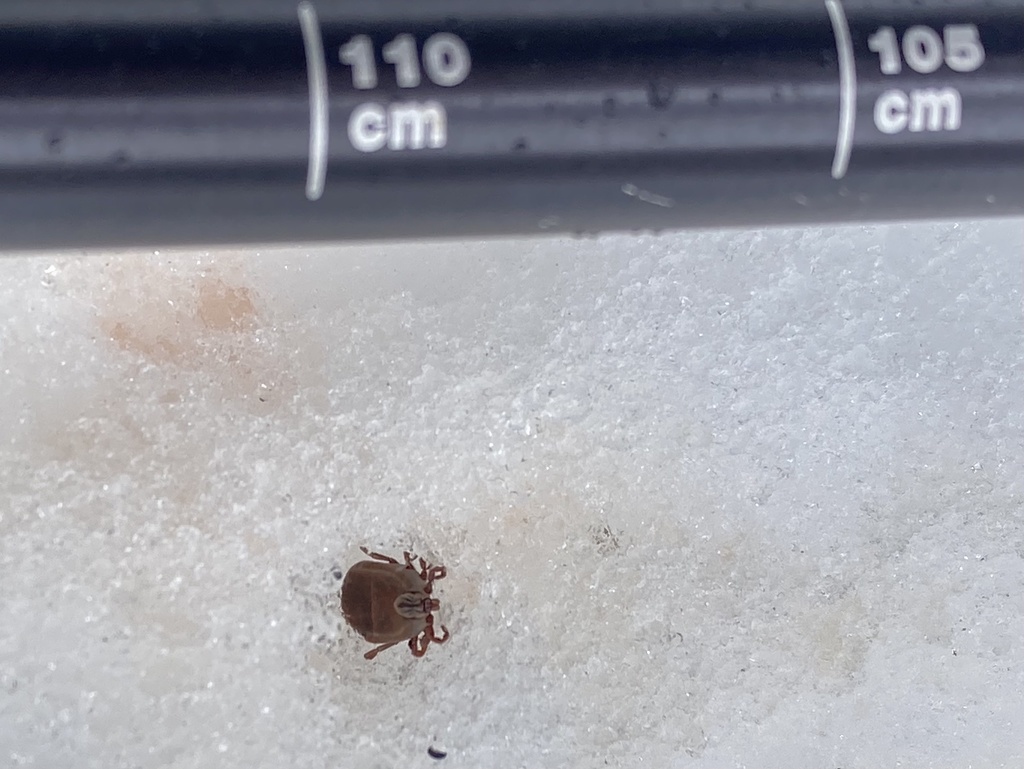
Dermacentor albipictus, the winter tick, is a species of hard tick that parasitizes many different mammal species in North America.
- Kingdom
- Animalia
- Phylum
- Arthropoda
- Class
- Arachnida
- Order
- Ixodida
- Family
- Ixodidae
- Genus
- Dermacentor
- Species
- Dermacentor albipictus
Description
Dermacentor albipictus, the winter tick, is a species of hard tick that parasitizes many different mammal species in North America. It is commonly associated with cervid species such as elk (Cervus canadensis), white-tailed deer (Odocoileus virginianus), mule deer (O. hemionus) and caribou (Rangifer tarandus) but is primarily known as a serious pest of moose (Alces alces). As early as 1909, Ernest Thompson Seton described the winter tick as a greater enemy of the moose than were "wolves, bears, and cougars." Feral swine, another common host, is also home to many other tick species, which can help increase the population of winter tick and increase the distribution of the population in some areas, harming moose and ecosystems further. The ticks do not have a preference of host but moose are the most affected because of the areas they traverse through and their struggle to get them off. White-tailed deer are significantly better at getting rid of the pests. The tick can be found all across North America, and has a large geographic distribution. While it can be found in several different habitats, it is often located in areas with a presence of moose. The tick prefers vegetation up to 1.25 m in height, for ease of finding a host. Some evidence indicates that increasing populations of the winter tick may be responsible for a steep decline in the eastern moose population throughout the southern half of their range. In recent years, heavy infestations up to 150,000 ticks have been seen on single moose, and can lead to the death of the animal.
Gallery
Ajouter des photos
Partagez vos photos de cette espèce (jusqu'à 20 à la fois) : elles sont vérifiées automatiquement, puis publiées.
Répartition
Occurrences observées (données GBIF). Les zones hors aire d'origine peuvent indiquer une présence introduite ou invasive.
Sources et crédits
Informations provenant de plusieurs sources vérifiées. Dernière mise à jour : .
Crédits photos (5)
- Photo : @katiespangler · CC BY-NC 4.0 · via iNaturalist
- Photo : David LeGros (@david_legros) · CC BY-NC 4.0 · via iNaturalist
- Photo : Jason J. Dombroskie (@jasondombroskie) · CC BY-NC 4.0 · via iNaturalist
- Photo : Emily Chenery (@emilychenery) · CC BY-NC 4.0 · via iNaturalist
- Photo : Tulipifera-ike (@tulipifera-ike) · CC BY-NC 4.0 · via iNaturalist
Mentions de licence
Texte disponible sous licence CC BY-SA 4.0. Il adapte notamment Wikipedia (CC BY-SA) : Dermacentor albipictus (Wikipédia, auteurs dans l’historique de l’article).
- Taxonomie : GBIF Backbone Taxonomy (CC BY 4.0)
- Carte : occurrences GBIF, fond © contributeurs OpenStreetMap (ODbL)
Détail : Sources et licences.
Discussion (0)
Aucun message pour l’instant. Lancez la discussion sur cette fiche (sources, précisions, débats éditoriaux).
Connectez-vous pour participer à la discussion.