
Tropical tent-web spider
Cyrtophora citricola
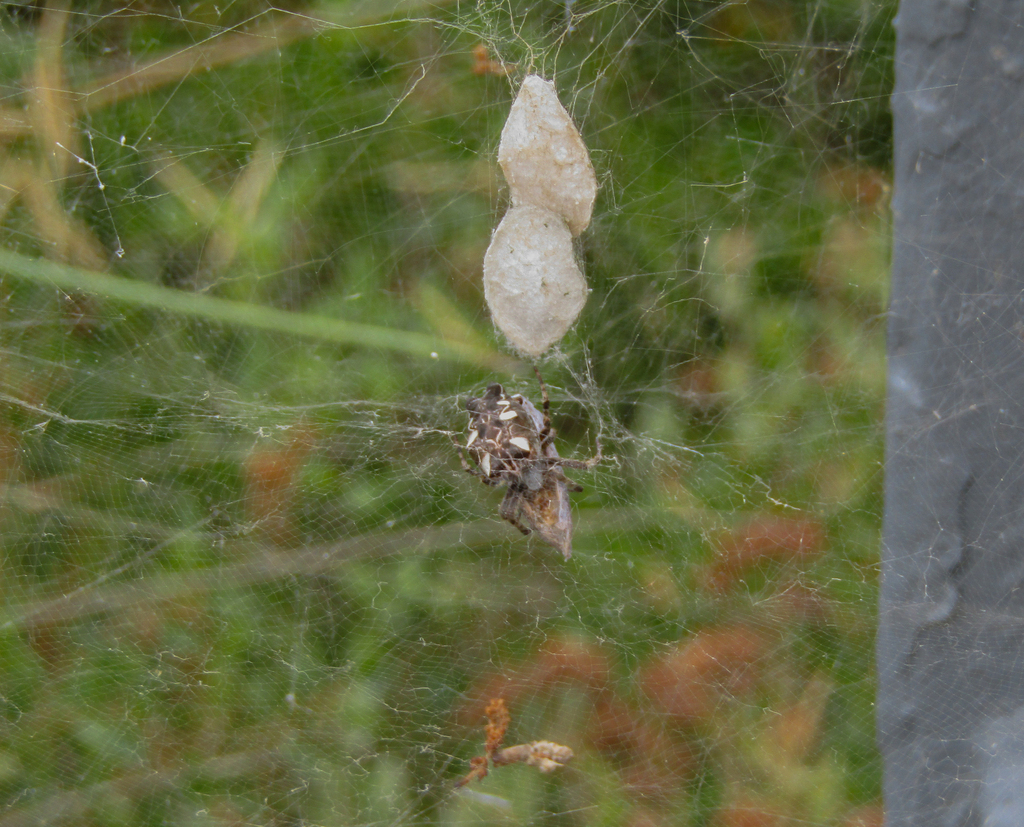
Cyrtophora citricola, also known as the tropical tent-web spider, is an orb-weaver spider in the family Araneidae.
- Kingdom
- Animalia
- Phylum
- Arthropoda
- Class
- Arachnida
- Order
- Araneae
- Family
- Araneidae
- Genus
- Cyrtophora
- Species
- Cyrtophora citricola
Description
Cyrtophora citricola, also known as the tropical tent-web spider, is an orb-weaver spider in the family Araneidae. It is found in Asia, Africa, Australia, Costa Rica, Hispaniola, Colombia, and Southern Europe and in 2000, it was discovered in Florida. C. citricola differs from many of its close relatives due its ability to live in a wide variety of environments. In North America and South America, the spider has caused extensive damage to agricultural operations. C. citricola is in the orb web spider family, but its orb webs are considered atypical. They have a thick silk strand barrier above the orb and a thinner barrier below the orb. This gives the webs a horizontal mesh-like appearance. The spider has developed distinct and specific prey-capturing techniques using its unconventional webs. The prey flies into the upper mesh layer of the web and is deflected into the orb web. The spider then collects and stores the prey in its web. The difference in C. citricola's web silk stems from physiological variations in its spinning apparatuses, as compared to other closely related species. Its webs are non-adhesive and do not require daily respinning. This spider is one of the few species to exhibit a variable level of sociality. C. citricola can be seen in colonies, which may have arisen due to reduced predation. Within these colonies, each spider has its own web that is linked to other spiders through communal webbing. The spider webs are often built in large matrices next to one another and can span entire trees. The spider usually peacefully coexists with other spiders in the colony. However, at times the spider may have to ward off other spiders in the colony that may try and claim its web. C. citricola is nocturnal, only performing necessary tasks during the day. During the day, it remains idle and tries to stay out of sight from predators. Most of its foraging and prey capture happen at night. C. citricola's color and size can vary greatly. Many spiders sport a black and white pattern while others are brown. Males often appear black. Male and female spiders have a sexual dimorphism. The body length in females normally reaches 10 millimetres (0.39 in), while males are only 3 millimetres (0.12 in) long.
Gallery
Ajouter des photos
Partagez vos photos de cette espèce (jusqu'à 20 à la fois) : elles sont vérifiées automatiquement, puis publiées.
Répartition
Occurrences observées (données GBIF). Les zones hors aire d'origine peuvent indiquer une présence introduite ou invasive.
Sources et crédits
Informations provenant de plusieurs sources vérifiées. Dernière mise à jour : .
Crédits photos (8)
- Photo : philadelphe william (@ormr) · CC BY-NC 4.0 · via iNaturalist
- Photo : Sunčana Bradley (@suncana) · CC BY 4.0 · via iNaturalist
- Photo : Caroline Voget (@cpvoget) · CC BY 4.0 · via iNaturalist
- Photo : Victor Hugo Rebecchi Siqueira (@victorhugorebecchisiqueira) · CC BY-NC 4.0 · via iNaturalist
- Photo : @joseronchel · CC BY-NC 4.0 · via iNaturalist
- Photo : Mathias (@butor) · CC BY-NC 4.0 · via iNaturalist
- Photo : James Lefebvre (@chasseur_de_licorne) · CC BY-NC 4.0 · via iNaturalist
- Photo : Célio Moura Neto (@celiomoura) · CC BY-NC 4.0 · via iNaturalist
Mentions de licence
Texte disponible sous licence CC BY-SA 4.0. Il adapte notamment Wikipedia (CC BY-SA) : Cyrtophora citricola (Wikipédia, auteurs dans l’historique de l’article).
- Taxonomie : GBIF Backbone Taxonomy (CC BY 4.0)
- Carte : occurrences GBIF, fond © contributeurs OpenStreetMap (ODbL)
Détail : Sources et licences.
Discussion (0)
Aucun message pour l’instant. Lancez la discussion sur cette fiche (sources, précisions, débats éditoriaux).
Connectez-vous pour participer à la discussion.