
Coelotes terrestris
Coelotes terrestris
Coelotes terrestris, the ground-living spider, is a spider in the family Agelenidae that stems from the once-assumed affiliation of the genus Coelotes, including this species, with the family Amaurobiidae, which has since been refuted.
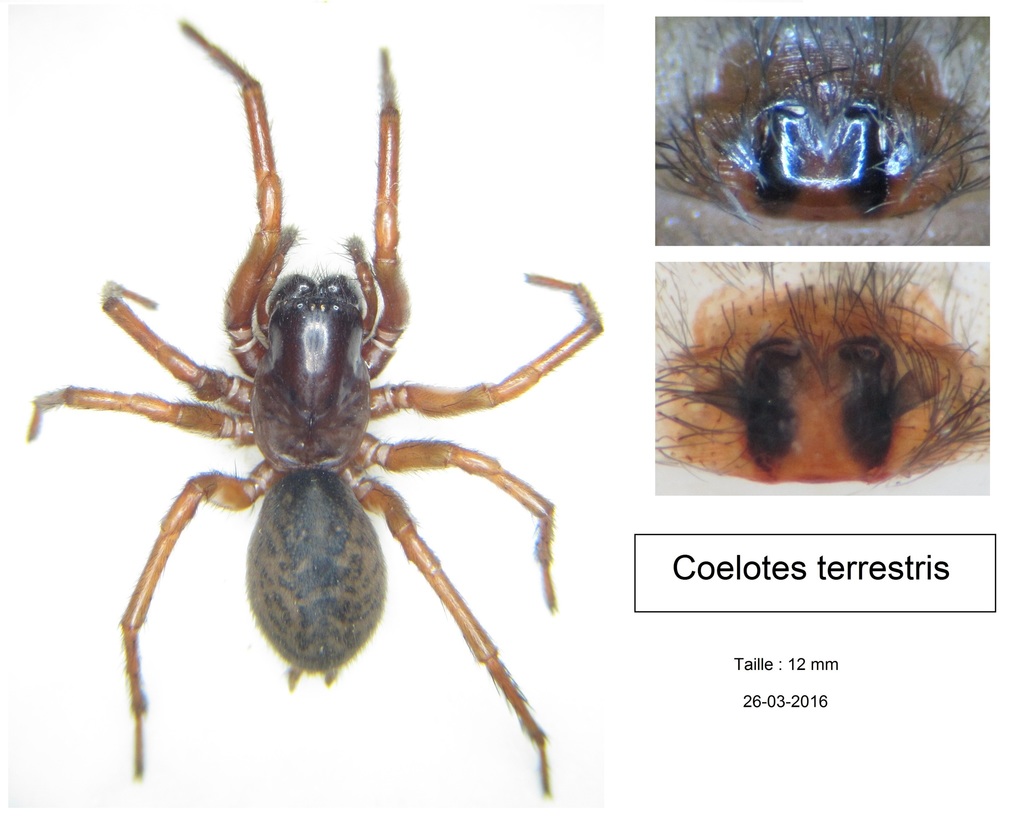
- Kingdom
- Animalia
- Phylum
- Arthropoda
- Class
- Arachnida
- Order
- Araneae
- Family
- Agelenidae
- Genus
- Coelotes
- Species
- Coelotes terrestris
Description
Coelotes terrestris, the ground-living spider, is a spider in the family Agelenidae that stems from the once-assumed affiliation of the genus Coelotes, including this species, with the family Amaurobiidae, which has since been refuted. The distribution of Coelotes terrestris extends from Europe to Turkey. It occurs in a broad spectrum of habitats, but is particularly found in forests of various types, where it preferably inhabits the ground level. The abundance of the species depends on the diversity of the forest biotope, including various microhabitats, as well as air humidity. The latter is especially relevant in habitat selection because Coelotes terrestris is rather hemihygrophilous (moisture-loving) and thus avoids habitats that are too dry or too wet. Like all species in the family Agelenidae, Coelotes terrestris constructs a funnel web typical of the family and named after it for catching prey, though its structure can vary in this species. In addition to the actual web sheet for prey capture, the web also features a retreat tube built in a cavity. Using the catching web, the spider captures a wide range of other invertebrates, particularly beetles. Compared to other spiders, the female of Coelotes terrestris exhibits highly developed parental care. The juveniles remain in the web for some time and are fed by their mother before becoming independent.
Gallery
Ajouter des photos
Partagez vos photos de cette espèce (jusqu'à 20 à la fois) : elles sont vérifiées automatiquement, puis publiées.
Répartition
Occurrences observées (données GBIF). Les zones hors aire d'origine peuvent indiquer une présence introduite ou invasive.
Sources et crédits
Informations provenant de plusieurs sources vérifiées. Dernière mise à jour : .
Crédits photos (8)
- Photo : Julien Bottinelli (@bottin) · CC BY-NC 4.0 · via iNaturalist
- Photo : Dominic Pfab (@affenbrotbaum) · CC BY-NC 4.0 · via iNaturalist
- Photo : Julien Tchilinguirian (@jtch) · CC BY 4.0 · via iNaturalist
- Photo : Tom (@thomasmacro) · CC BY-NC 4.0 · via iNaturalist
- Photo : Felix Riegel (@felix_riegel) · CC BY-NC 4.0 · via iNaturalist
- Photo : Fabian A. Boetzl (@fboetzl) · CC BY-NC 4.0 · via iNaturalist
- Photo : Jan Grathwohl (@grathwohl) · CC BY-NC 4.0 · via iNaturalist
- Photo : @pavouk · CC BY-NC 4.0 · via iNaturalist
Mentions de licence
Texte disponible sous licence CC BY-SA 4.0. Il adapte notamment Wikipedia (CC BY-SA) : Coelotes terrestris (Wikipédia, auteurs dans l’historique de l’article).
- Taxonomie : GBIF Backbone Taxonomy (CC BY 4.0)
- Carte : occurrences GBIF, fond © contributeurs OpenStreetMap (ODbL)
Détail : Sources et licences.
Discussion (0)
Aucun message pour l’instant. Lancez la discussion sur cette fiche (sources, précisions, débats éditoriaux).
Connectez-vous pour participer à la discussion.