
Chaetodactylus krombeini
Chaetodactylus krombeini
Chaetodactylus krombeini (Krombein's hairy-footed pollen mite) was described by Karl Krombein and E.
- Kingdom
- Animalia
- Phylum
- Arthropoda
- Class
- Arachnida
- Order
- Sarcoptiformes
- Family
- Chaetodactylidae
- Genus
- Chaetodactylus
- Species
- Chaetodactylus krombeini
Description
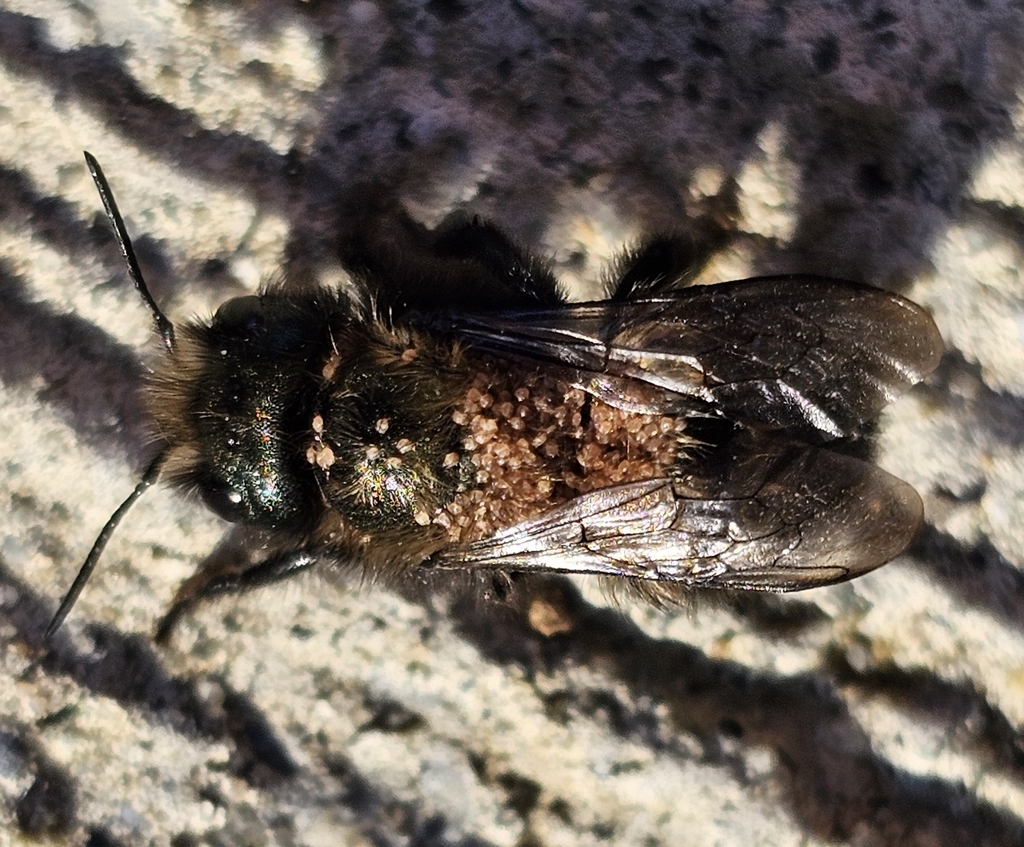
Chaetodactylus krombeini (Krombein's hairy-footed pollen mite) was described by Karl Krombein and E. W. Baker in 1962. The mites are about 0.5 mm across, with the females larger than the males. Pollen mites are a kleptoparasitic pest of megachilid solitary bees, with Ch. krombeini found with Osmia lignaria of North America, (the orchard mason bee). Pollen mites do not feed on bees, but rather their provisions, and are harmful because they consume the food resources and starve or stunt the developing larvae; there is evidence that pollen mites also directly harm the egg by puncturing it. The common name is somewhat misleading, as pollen mites consume more nectar than pollen. Both their feeding habits and their size differs significantly from Varroa destructor, the mite very harmful to the European honey bee. Although both are classified as mites, varroa mites are more closely related to ticks and only distantly related to Chaetodactylus. A mason bee, upon emerging from its nest, may be burdened by hundreds of hitchhiking pollen mites. While mites do shed off bees after leaving the nest, including during mating, studies find that mites are rarely picked up when visiting flowers. The mite's life cycle is necessarily tied to the bee's reproductive cycle, but the mechanisms are not fully understood. They have both mobile and immobile phases that are reproductive and non-reproductive, at times simultaneously. Ch. krombeini appears to be more successful in humid conditions, possibly because the food mass stays moist longer under these conditions; heat and dehydration is sometimes used for pollen mite pest management.
Gallery
Ajouter des photos
Partagez vos photos de cette espèce (jusqu'à 20 à la fois) : elles sont vérifiées automatiquement, puis publiées.
Répartition
Occurrences observées (données GBIF). Les zones hors aire d'origine peuvent indiquer une présence introduite ou invasive.
Sources et crédits
Informations provenant de plusieurs sources vérifiées. Dernière mise à jour : .
Crédits photos (6)
- Photo : Karla Salp (@swisschick) · CC BY-NC 4.0 · via iNaturalist
- Photo : Susanna Heideman (@susanna_h) · CC BY-NC 4.0 · via iNaturalist
- Photo : Ben Keen (@benkeen) · CC0 (domaine public) · via iNaturalist
- Photo : Harsi S. Parker (@harsiparker) · CC BY-NC 4.0 · via iNaturalist
- Photo : @ecologyquail · CC BY-NC 4.0 · via iNaturalist
- Photo : Sarka Martinez (@sarka) · CC BY-NC 4.0 · via iNaturalist
Mentions de licence
Texte disponible sous licence CC BY-SA 4.0. Il adapte notamment Wikipedia (CC BY-SA) : Chaetodactylus krombeini (Wikipédia, auteurs dans l’historique de l’article).
- Taxonomie : GBIF Backbone Taxonomy (CC BY 4.0)
- Carte : occurrences GBIF, fond © contributeurs OpenStreetMap (ODbL)
Détail : Sources et licences.
Discussion (0)
Aucun message pour l’instant. Lancez la discussion sur cette fiche (sources, précisions, débats éditoriaux).
Connectez-vous pour participer à la discussion.