
Argyrodes elevatus
Argyrodes elevatus
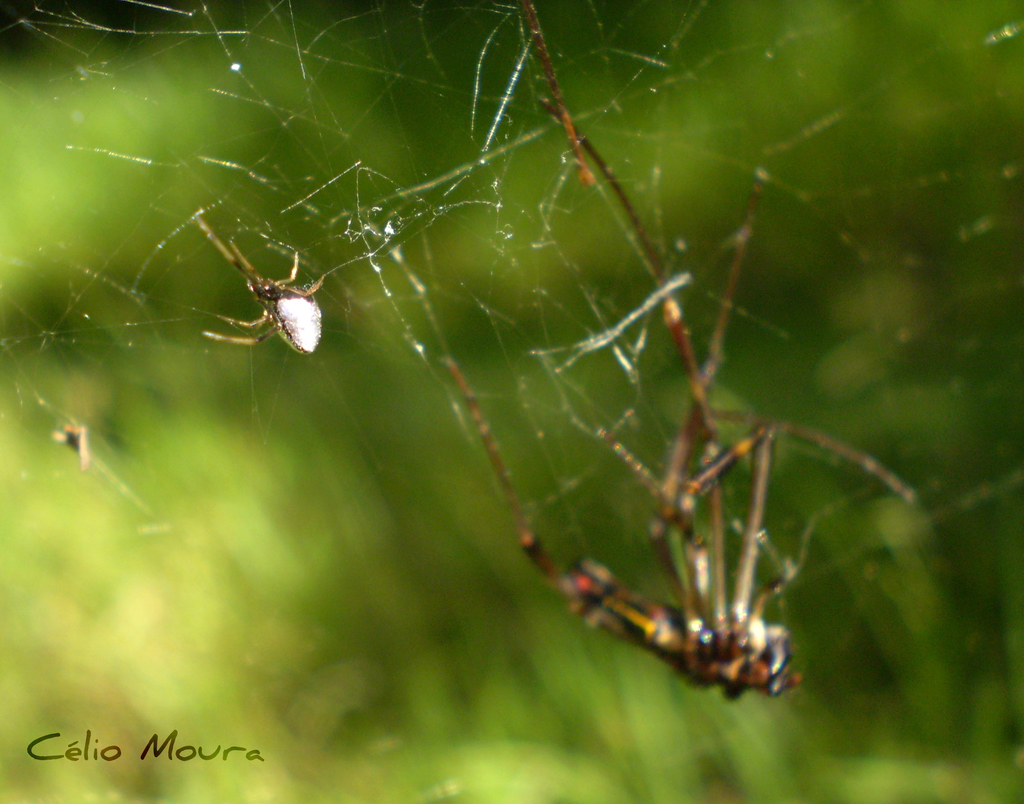
Argyrodes elevatus, commonly referred to as dew-drop spider, is a species of arachnid in the family Theridiidae.
- Kingdom
- Animalia
- Phylum
- Arthropoda
- Class
- Arachnida
- Order
- Araneae
- Family
- Theridiidae
- Genus
- Argyrodes
- Species
- Argyrodes elevatus
Description
Argyrodes elevatus, commonly referred to as dew-drop spider, is a species of arachnid in the family Theridiidae. These spiders are most commonly found in subtropical and tropical regions in South and Central America, as well as southern regions of the United States. One of the key distinguishing characteristics of A. elevatus is its kleptoparasitic behavior through which it primarily procures food for survival. Typically 1 or 2 A. elevatus spiders preside in outer areas of webs built by other species of spiders, although it is possible for up to 45 spiders to share a web. There are two main mechanisms by which A. elevatus raid the hub of the host's web to steal insects preyed and wrapped by the host spider. A. elevatus follows an intricate course to the hub of the web to search for prey, using vibrational detection enhanced by laid out threads along the web to find and capture the insect. These spiders are highly efficient, with the theft lasting a maximum of 12 seconds and high success rates. This reliance on a host spider for food has led to adaptations in sleep schedules and alternate food sources to revolve around the host species activity. A. elevatus display a unique courtship routine in which male A. elevatus presents prey wrapped in silk as a nuptial gift to the female spider. The male spider approaches the female, carrying the nuptial gift on its chelicerae while communicating with a distinct courting vibration, followed by copulation. Approximately twenty-four hours after the A. elevatus courtship and copulation series of events, the female spider will lay one to two eggs on the outer regions of the host's web.
Gallery
Ajouter des photos
Partagez vos photos de cette espèce (jusqu'à 20 à la fois) : elles sont vérifiées automatiquement, puis publiées.
Répartition
Occurrences observées (données GBIF). Les zones hors aire d'origine peuvent indiquer une présence introduite ou invasive.
Sources et crédits
Informations provenant de plusieurs sources vérifiées. Dernière mise à jour : .
Crédits photos (7)
- Photo : Célio Moura Neto (@celiomoura) · CC BY-NC 4.0 · via iNaturalist
- Photo : Jeff Clark (@jeffdc) · CC BY 4.0 · via iNaturalist
- Photo : Célio Moura Neto (@celiomoura) · CC BY-NC 4.0 · via iNaturalist
- Photo : Jean Martins (@jeanmartins) · CC BY 4.0 · via iNaturalist
- Photo : A. Rector (@scopic) · CC BY-NC 4.0 · via iNaturalist
- Photo : Thomas Campbell (@thomasrc) · CC BY-NC 4.0 · via iNaturalist
- Photo : @ibhappy · CC BY-NC 4.0 · via iNaturalist
Mentions de licence
Texte disponible sous licence CC BY-SA 4.0. Il adapte notamment Wikipedia (CC BY-SA) : Argyrodes elevatus (Wikipédia, auteurs dans l’historique de l’article).
- Taxonomie : GBIF Backbone Taxonomy (CC BY 4.0)
- Carte : occurrences GBIF, fond © contributeurs OpenStreetMap (ODbL)
Détail : Sources et licences.
Discussion (0)
Aucun message pour l’instant. Lancez la discussion sur cette fiche (sources, précisions, débats éditoriaux).
Connectez-vous pour participer à la discussion.