
St Andrews cross spider
Argiope keyserlingi
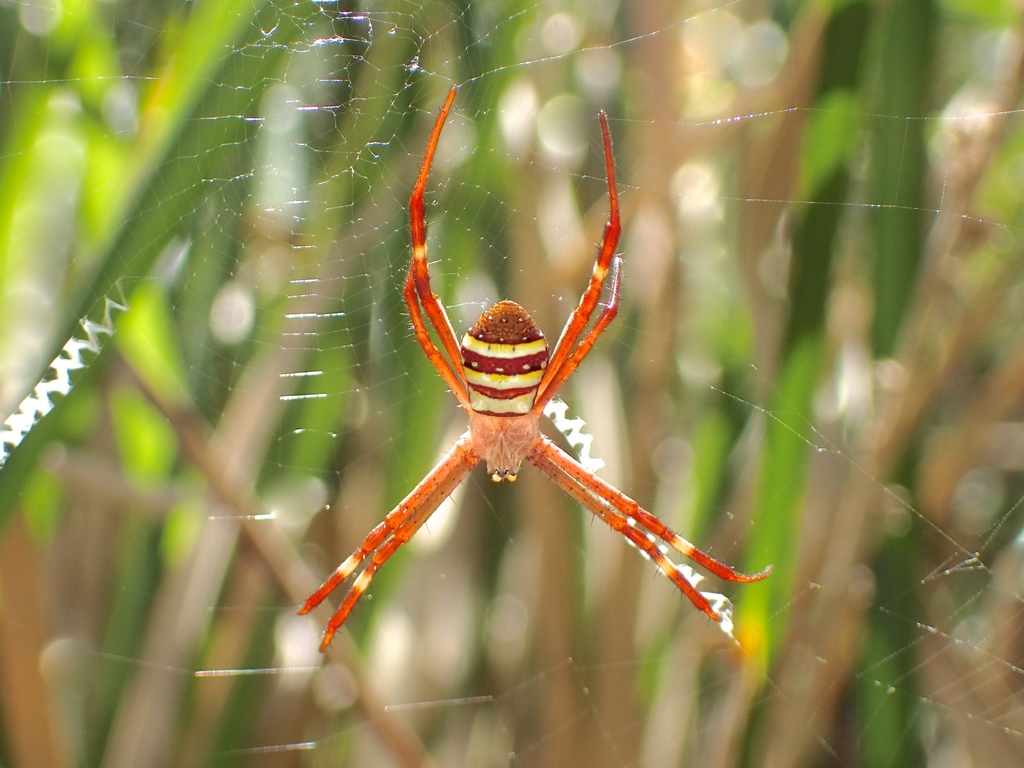
Argiope keyserlingi is a species of orb-web spider found on the east coast of Australia, from Victoria to northern Queensland.
- Kingdom
- Animalia
- Phylum
- Arthropoda
- Class
- Arachnida
- Order
- Araneae
- Family
- Araneidae
- Genus
- Argiope
- Species
- Argiope keyserlingi
Description
Argiope keyserlingi is a species of orb-web spider found on the east coast of Australia, from Victoria to northern Queensland. It is very similar in appearance to a closely related north Queensland species, Argiope aetherea. A. keyserlingi is commonly found in large populations in suburban parks and gardens, particularly among the leaves of Lomandra longifolia. Like many species of orb-web spiders, A. keyserlingi shows considerable sexual dimorphism, with the females being many times larger than the males. Mature females can be seen during the summer, and seeing multiple males on the web of one female is not uncommon. A. keyserlingi is commonly known as the St. Andrew's cross spider, due to the construction of bands of silk forming the arms of an X-shaped cross, similar to the one upon which St. Andrew is traditionally said to have been crucified. Juveniles of this species sometimes build a spiral-shaped pattern of silk. Referred to as web decorations or stabilimenta, these bands are thought to increase the species' prey capture rate, but as in other species, they have been found to protect the spider against predators. A. keyserlingi is an important model species in studies of spider ecology and behaviour. Using this species, scientists have investigated sperm competition, sexual size dimorphism, cryptic female choice, the role of pheromones in mating behaviour, and the function and evolution of web decorations. Its main predators in Sydney are mantids and birds. This type of orb-weaver is cathemeral.
Gallery
Ajouter des photos
Partagez vos photos de cette espèce (jusqu'à 20 à la fois) : elles sont vérifiées automatiquement, puis publiées.
Répartition
Occurrences observées (données GBIF). Les zones hors aire d'origine peuvent indiquer une présence introduite ou invasive.
Sources et crédits
Informations provenant de plusieurs sources vérifiées. Dernière mise à jour : .
Crédits photos (8)
- Photo : John Eichler (@johneichler) · CC BY-NC 4.0 · via iNaturalist
- Photo : @glemann · CC BY-NC 4.0 · via iNaturalist
- Photo : @bushreader · CC BY-NC 4.0 · via iNaturalist
- Photo : Michelle Colpus (@coddiwompler) · CC BY-NC 4.0 · via iNaturalist
- Photo : Kegworth Public School (@kegworthps) · CC BY-NC 4.0 · via iNaturalist
- Photo : Zoë Davis (@zoedavis) · CC BY-NC 4.0 · via iNaturalist
- Photo : warren cameron (@warrencameron) · CC BY-NC 4.0 · via iNaturalist
- Photo : @slamshed · CC BY-NC 4.0 · via iNaturalist
Mentions de licence
Texte disponible sous licence CC BY-SA 4.0. Il adapte notamment Wikipedia (CC BY-SA) : Argiope keyserlingi (Wikipédia, auteurs dans l’historique de l’article).
- Taxonomie : GBIF Backbone Taxonomy (CC BY 4.0)
- Carte : occurrences GBIF, fond © contributeurs OpenStreetMap (ODbL)
Détail : Sources et licences.
Discussion (0)
Aucun message pour l’instant. Lancez la discussion sur cette fiche (sources, précisions, débats éditoriaux).
Connectez-vous pour participer à la discussion.