
Argas persicus
Argas persicus
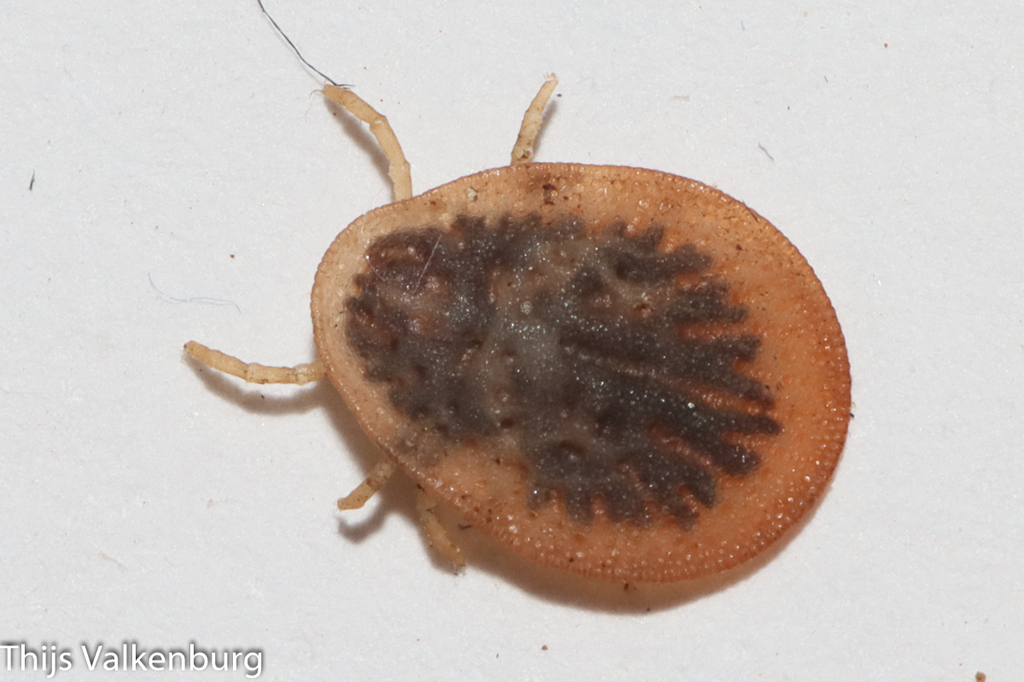
Argas persicus, also known as fowl tick or poultry tick, is a small soft-bodied tick that is found primarily on domestic fowl such as chickens, ducks, and geese.
- Kingdom
- Animalia
- Phylum
- Arthropoda
- Class
- Arachnida
- Order
- Ixodida
- Family
- Argasidae
- Genus
- Argas
- Species
- Argas persicus
Description
Argas persicus, also known as fowl tick or poultry tick, is a small soft-bodied tick that is found primarily on domestic fowl such as chickens, ducks, and geese. It was first recorded by Lorenz Oken in 1818 in Mianeh, Persia, and named Rhynochoprion persicum. Argas persicus appears yellowish-brown when starved and slatey-blue when engorged. They are found on an animal host, in cracks and crevices of buildings or in nests. They are also carriers of the spirochete bacteria Borrelia anserina which causes avian spirochetosis, one of the most severe diseases affecting the poultry industry. In addition to domestic fowl, A. persicus may also feed on humans, although an immunity has been acquired by some individuals.
Gallery
Ajouter des photos
Partagez vos photos de cette espèce (jusqu'à 20 à la fois) : elles sont vérifiées automatiquement, puis publiées.
Répartition
Occurrences observées (données GBIF). Les zones hors aire d'origine peuvent indiquer une présence introduite ou invasive.
Sources et crédits
Informations provenant de plusieurs sources vérifiées. Dernière mise à jour : .
Crédits photos (3)
- Photo : Thijs Valkenburg (@thijsvalkenburg) · CC BY-NC 4.0 · via iNaturalist
- Photo : Thomas Friedrich (@thomasfriedrich) · CC BY-NC 4.0 · via iNaturalist
- Photo : Juan Carrillo Contreras (@juancarrillocc) · CC BY-NC 4.0 · via iNaturalist
Mentions de licence
Texte disponible sous licence CC BY-SA 4.0. Il adapte notamment Wikipedia (CC BY-SA) : Argas persicus (Wikipédia, auteurs dans l’historique de l’article).
- Taxonomie : GBIF Backbone Taxonomy (CC BY 4.0)
- Carte : occurrences GBIF, fond © contributeurs OpenStreetMap (ODbL)
Détail : Sources et licences.
Discussion (0)
Aucun message pour l’instant. Lancez la discussion sur cette fiche (sources, précisions, débats éditoriaux).
Connectez-vous pour participer à la discussion.