
Anelosimus studiosus
Anelosimus studiosus
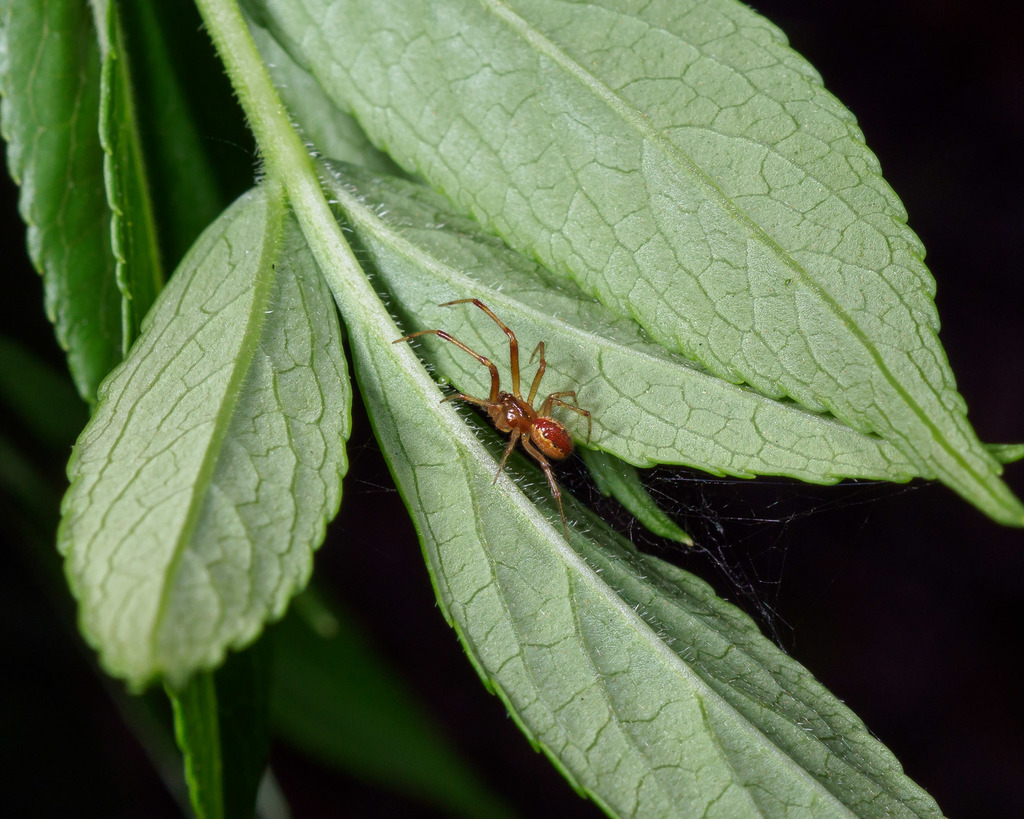
Anelosimus studiosus is a subsocial tangle web spider or theridiid spider living in both North America and South America.
- Kingdom
- Animalia
- Phylum
- Arthropoda
- Class
- Arachnida
- Order
- Araneae
- Family
- Theridiidae
- Genus
- Anelosimus
- Species
- Anelosimus studiosus
Description
Anelosimus studiosus is a subsocial tangle web spider or theridiid spider living in both North America and South America. In 2012, genetic analysis revealed a previously identified species, A. tungurahua, is in fact the same species as A. studiosus. Anelosimus studiosus is part of the comb-footed spider family, Theridiidae, and can be found throughout much of North and South America, as it is a tropical and temperate spider. A. studiosus exhibit social polymorphism with two behavioral phenotypes; social spiders that live communally, and asocial solitary spiders. Social spiders not only share the same living space, but also share in the duties of brood care and capturing of prey, while asocial spiders live completely alone and will attack other female spiders that encroach its nesting territory. Populations displaying the social phenotype, generally are not found below 30˚ latitude, and the social phenotype becomes increasingly common moving north. Studies suggest that the correlation between a higher frequency of social phenotypes and colder temperatures is due to decreased survival rates amongst mothers and delayed juvenile development in colder temperatures. In other words, it is believed that sociality developed in A. studiosus in order to mitigate fitness costs for offspring should their mother die before the brood is ready to disperse and survive on their own. Despite drastic differences in behavioral phenotypes, both social and asocial spiders readily interbreed and produce viable offspring. Research on the relatedness of the socially polymorphic spider shows that social spiders in any given nest are more closely related genetically than asocial spiders. These findings suggest that social spiders have a lower dispersal distance than asocial spiders. Spiders that are more closely related genetically and display the social phenotype incur a fitness advantage by staying close to the nest and cooperating with their relatives Although the emergence of a social phenotype may increase survival rates of offspring in the short term, research suggests it may cause long-term fitness consequences. Development of a social phenotype ultimately leads to a loss of aggression; meaning social spiders are less likely to fight off predators than their asocial counterparts. Social spiders can produce more young in a shorter period of time than asocial spiders, but when predators are introduced, nests of social spiders suffer high predation. This has been suggested to potentially lead to the extinction of large populations of A. studiosus.
Gallery
Ajouter des photos
Partagez vos photos de cette espèce (jusqu'à 20 à la fois) : elles sont vérifiées automatiquement, puis publiées.
Répartition
Occurrences observées (données GBIF). Les zones hors aire d'origine peuvent indiquer une présence introduite ou invasive.
Sources et crédits
Informations provenant de plusieurs sources vérifiées. Dernière mise à jour : .
Crédits photos (8)
- Photo : Francisco Herrera (@fherrerav) · CC BY-NC 4.0 · via iNaturalist
- Photo : @tracysfeldman · CC BY-NC 4.0 · via iNaturalist
- Photo : Thomas Campbell (@thomasrc) · CC BY-NC 4.0 · via iNaturalist
- Photo : Katja Schulz (@treegrow) · CC BY 4.0 · via iNaturalist
- Photo : Lucas Garriga (@lgarriga) · CC BY-NC 4.0 · via iNaturalist
- Photo : Zachary Chapman (@galactic_bug_man) · CC BY-NC 4.0 · via iNaturalist
- Photo : Rick Nirschl (@ricknirschl) · CC BY-NC 4.0 · via iNaturalist
- Photo : Amanda Gabehart (@sylshessa) · CC BY-NC 4.0 · via iNaturalist
Mentions de licence
Texte disponible sous licence CC BY-SA 4.0. Il adapte notamment Wikipedia (CC BY-SA) : Anelosimus studiosus (Wikipédia, auteurs dans l’historique de l’article).
- Taxonomie : GBIF Backbone Taxonomy (CC BY 4.0)
- Carte : occurrences GBIF, fond © contributeurs OpenStreetMap (ODbL)
Détail : Sources et licences.
Discussion (0)
Aucun message pour l’instant. Lancez la discussion sur cette fiche (sources, précisions, débats éditoriaux).
Connectez-vous pour participer à la discussion.