
Lone Star Tick
Amblyomma americanum
Amblyomma americanum, also known as the lone star tick, northeastern water tick, turkey tick, and cricker tick, is a type of tick indigenous to much of the eastern United States and Mexico that bites painlessly and commonly goes…
- Kingdom
- Animalia
- Phylum
- Arthropoda
- Class
- Arachnida
- Order
- Ixodida
- Family
- Ixodidae
- Genus
- Amblyomma
- Species
- Amblyomma americanum
Description
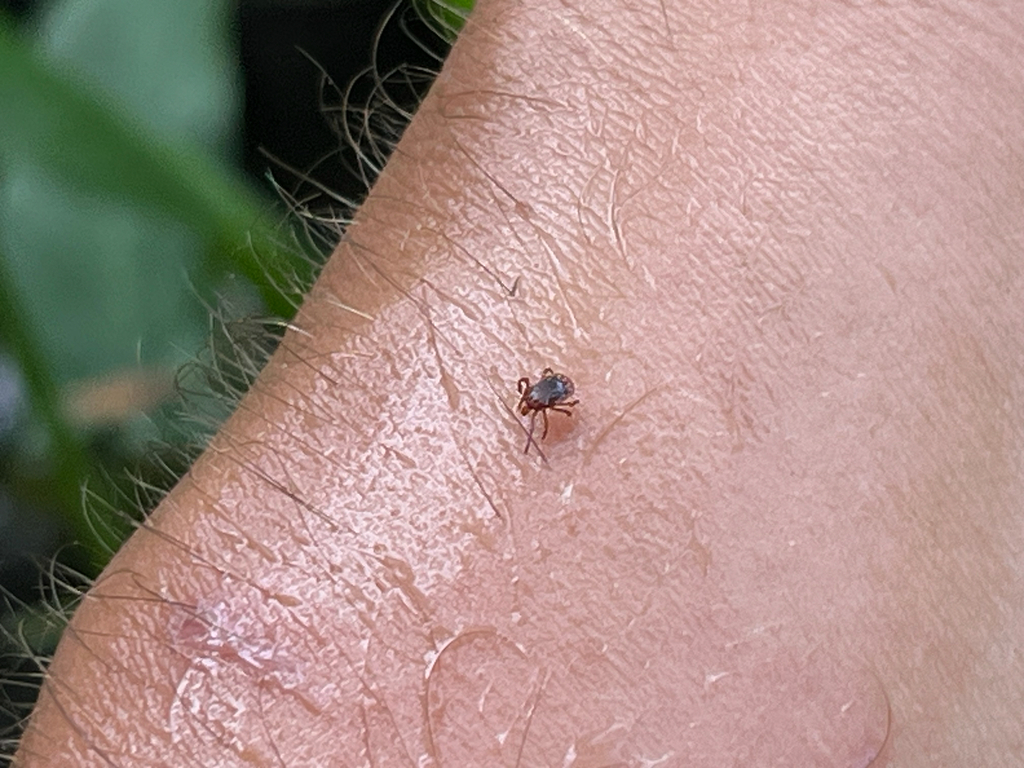
Amblyomma americanum, also known as the lone star tick, northeastern water tick, turkey tick, and cricker tick, is a type of tick indigenous to much of the eastern United States and Mexico that bites painlessly and commonly goes unnoticed, remaining attached to its host for as long as seven days until it is fully engorged with blood. It bites aggressively, and its larvae may transfer themselves to skin from discarded clothing that is put back on. The sexually dimorphic adult female lone star tick bears a silvery-white, somewhat star-shaped spot near the center of the posterior portion of its dorsal shield (scutum); adult males conversely have varied white streaks or spots around the margins of their shields. It is to the female's identifying spot, not to the nickname of the state of Texas, that A. americanum owes the name lone star tick, while it owes the name turkey tick to the wild turkeys that are a common host in its immature stages in some Midwestern U.S. states. It is the primary vector of Ehrlichia chaffeensis, which causes human monocytic ehrlichiosis, and Ehrlichia ewingii, which causes human and canine granulocytic ehrlichiosis. Its bite may also cause a human to develop alpha-gal syndrome, an allergy to non-catarrhine mammalian meat. Other disease-causing bacterial agents isolated from lone star ticks include Francisella tularensis, Rickettsia amblyommii, and Coxiella burnetti.
Gallery
Ajouter des photos
Partagez vos photos de cette espèce (jusqu'à 20 à la fois) : elles sont vérifiées automatiquement, puis publiées.
Répartition
Occurrences observées (données GBIF). Les zones hors aire d'origine peuvent indiquer une présence introduite ou invasive.
Sources et crédits
Informations provenant de plusieurs sources vérifiées. Dernière mise à jour : .
Crédits photos (8)
- Photo : @axicus · CC BY-NC 4.0 · via iNaturalist
- Photo : Jabin (@mississippi_fish_guy) · CC BY-NC 4.0 · via iNaturalist
- Photo : Robert Leak (@robertleak) · CC BY-NC 4.0 · via iNaturalist
- Photo : Jon Weeden (@jonweeden) · CC BY-NC 4.0 · via iNaturalist
- Photo : @sandyo · CC BY-NC 4.0 · via iNaturalist
- Photo : M. Acquafredda (@macquafredda13) · CC BY-NC 4.0 · via iNaturalist
- Photo : Bonnie Semmling (@mertensia) · CC BY 4.0 · via iNaturalist
- Photo : @freelydia123 · CC BY-NC 4.0 · via iNaturalist
Mentions de licence
Texte disponible sous licence CC BY-SA 4.0. Il adapte notamment Wikipedia (CC BY-SA) : Amblyomma americanum (Wikipédia, auteurs dans l’historique de l’article).
- Taxonomie : GBIF Backbone Taxonomy (CC BY 4.0)
- Carte : occurrences GBIF, fond © contributeurs OpenStreetMap (ODbL)
Détail : Sources et licences.
Discussion (0)
Aucun message pour l’instant. Lancez la discussion sur cette fiche (sources, précisions, débats éditoriaux).
Connectez-vous pour participer à la discussion.