
Balkan crested newt
Triturus ivanbureschi
The Balkan crested newt or Buresch's crested newt (Triturus ivanbureschi) is a newt species of the crested newt species complex in genus Triturus, found in Southeastern Europe and Anatolia.
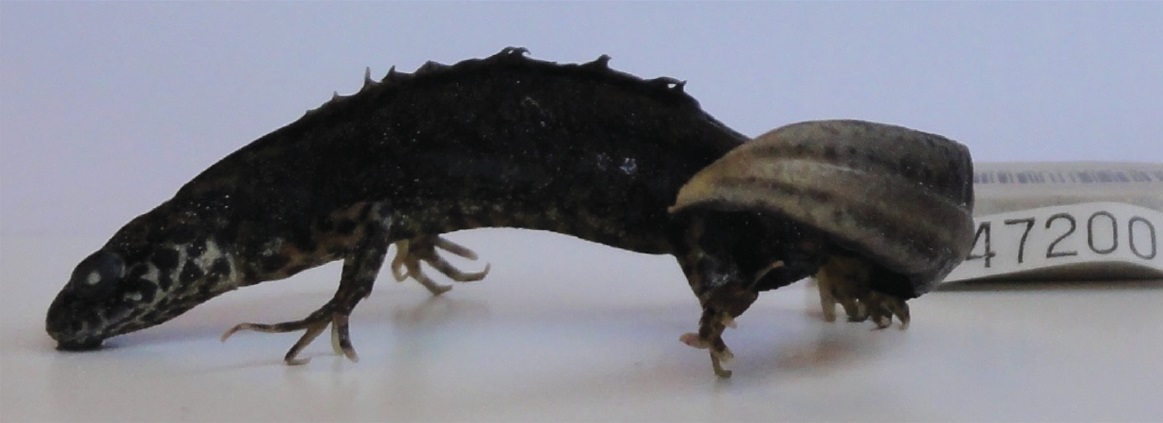
- Kingdom
- Animalia
- Phylum
- Chordata
- Class
- Amphibia
- Order
- Caudata
- Family
- Salamandridae
- Genus
- Triturus
- Species
- Triturus ivanbureschi
Description
The Balkan crested newt or Buresch's crested newt (Triturus ivanbureschi) is a newt species of the crested newt species complex in genus Triturus, found in Southeastern Europe and Anatolia. It was originally described as a subspecies of the southern crested newt, "Triturus karelinii arntzeni", in 1999, and later considered a full species when genetic data showed it to be distinct. After it was suggested the type specimen of "T. arntzeni" belonged in fact to the Macedonian crested newt (T. macedonicus), the species was redescribed, with a new type specimen, as T. ivanbureschi in 2013. The species epithet was chosen in honour of Bulgarian herpetologist Ivan Buresh. Its distribution ranges from the Southeastern Balkan peninsula (Western North Macedonia, Northwestern Greece, Bulgaria, Eastern Thrace) to Western Anatolia. An isolated population, surrounded by other crested newt species, occurs in Serbia. Genetic data showed that Northern Anatolian populations east of the Bosphorus and Bursa form a separate, but morphologically indistinguishable sibling species, which was described as Anatolian crested newt (T. anatolicus) in 2016. The Balkan crested newt hybridises with the Anatolian crested newt at its eastern range end. At the western and northern borders, it hybridises with the Macedonian crested newt, the Danube crested newt (T. dobrogicus), and the northern crested newt (T. cristatus). The type specimen of "T. arntzeni" is in fact a hybrid between the Balkan and the Macedonian crested newt, so that this name is a synonym for both species.
Gallery
Ajouter des photos
Partagez vos photos de cette espèce (jusqu'à 20 à la fois) : elles sont vérifiées automatiquement, puis publiées.
Répartition
Occurrences observées (données GBIF). Les zones hors aire d'origine peuvent indiquer une présence introduite ou invasive.
Sources et crédits
Informations provenant de plusieurs sources vérifiées. Dernière mise à jour : .
Crédits photos (6)
- Photo : Wielstra, B.; Litvinchuk, S. N.; Naumov, B.; Tzankov, N.; Arntzen, J. W. · CC BY 3.0
- Photo : katunchik (@katya) · CC BY 4.0 · via iNaturalist
- Photo : @j-jira2000 · CC BY-NC 4.0 · via iNaturalist
- Photo : Valia Pavlou (@karakaxa) · CC BY-NC 4.0 · via iNaturalist
- Photo : Ivaylo Georgiev (@ivaylog) · CC BY-NC 4.0 · via iNaturalist
- Photo : @savvassim · CC BY-NC 4.0 · via iNaturalist
Mentions de licence
Texte disponible sous licence CC BY-SA 4.0. Il adapte notamment Wikipedia (CC BY-SA) : Balkan crested newt (Wikipédia, auteurs dans l’historique de l’article).
- Taxonomie : GBIF Backbone Taxonomy (CC BY 4.0)
- Carte : occurrences GBIF, fond © contributeurs OpenStreetMap (ODbL)
Détail : Sources et licences.
Discussion (0)
Aucun message pour l’instant. Lancez la discussion sur cette fiche (sources, précisions, débats éditoriaux).
Connectez-vous pour participer à la discussion.