
Norhayati’s gliding frog
Rhacophorus norhayatii
Rhacophorus norhayatii, the orange-sided whipping frog, Norhayati's gliding frog, or Wallace's orange-sided tree frog, is a species of frog in the family Rhacophoridae.
- Kingdom
- Animalia
- Phylum
- Chordata
- Class
- Amphibia
- Order
- Anura
- Family
- Rhacophoridae
- Genus
- Rhacophorus
- Species
- Rhacophorus norhayatii
Description
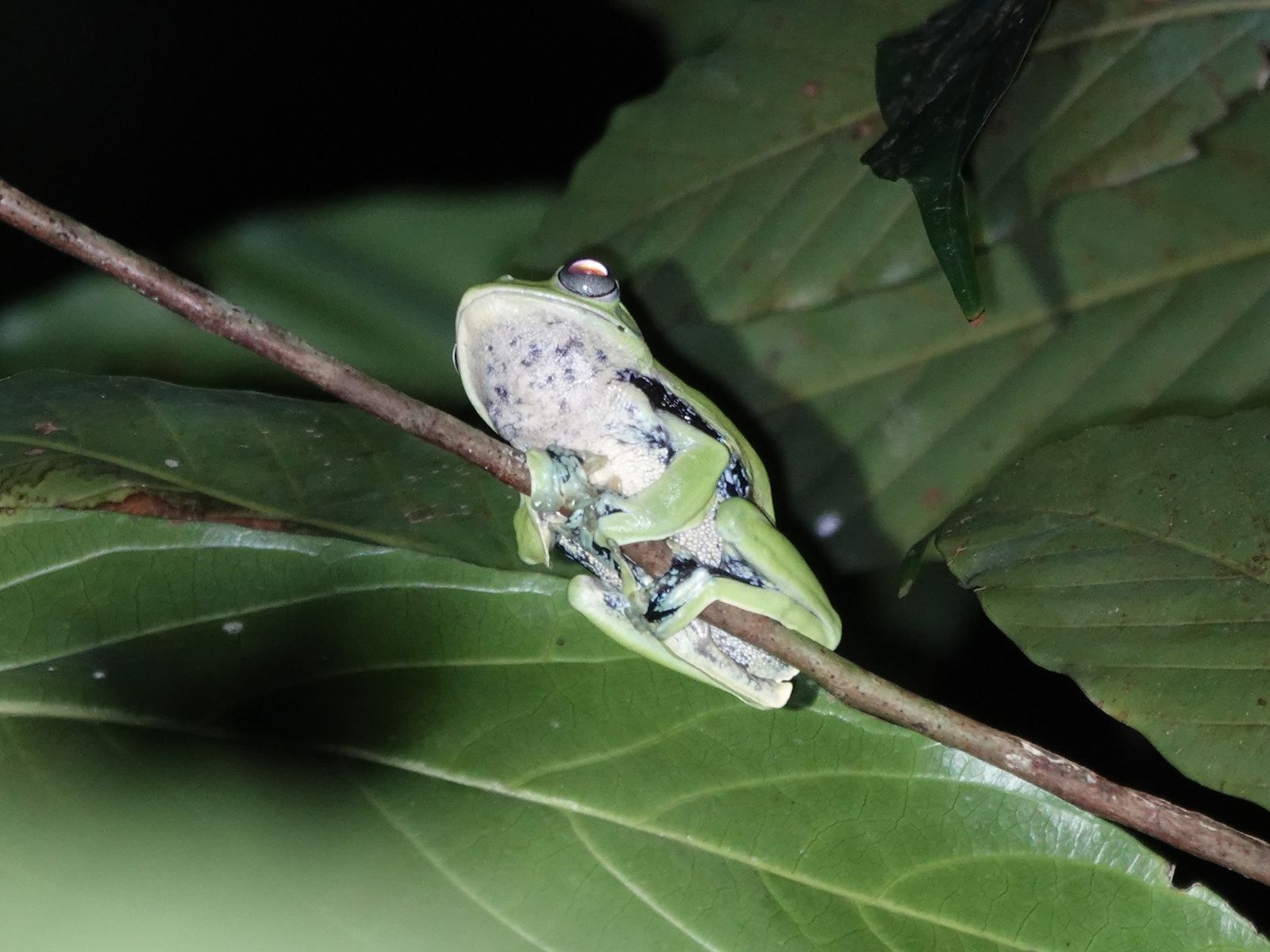
Rhacophorus norhayatii, the orange-sided whipping frog, Norhayati's gliding frog, or Wallace's orange-sided tree frog, is a species of frog in the family Rhacophoridae. It has been observed in Malaysia, Myanmar, and Thailand, though scientists believe the Sumatran population may be another closely related specie. Scientists believed this frog to be conspecific with Rhacophorus reinwardtii until 2010. They distinguish the species in that R. norhayatii has darker coloration on the webbed skin on its feet, which are black with blue marks. Also, the first toe of the front feet is not webbed as far as in other species, which are webbed almost all the way to disk. R. norhayatii also has brown coloration on its flanks, while R. reinwardtii has bright orange. The skin of R. norhayatii's back is green with no marks or spots. Also, R. norhayatii males are larger than those of R. reinwardtii and smaller than those of R. nigropalmatus and R. kio: The adult male R. norhayatii frog can be as big as 64.7 mm long from nose to rear end. The adult female frog can be 83 mm long. The front feet of R. norhayatii are larger than the rest of the front leg. The frog's ventrum is white in color, except for blue and white marks on the chin and neck. The toes on all four feet are black with some blue and green marks, like the webbed skin. The climbing disks on its toes are dull green in color. Rhacophorus norhayatii climbs on plants to a confirmed height of 7 m off the ground. It is sympatric with a few other species in Rhacophorus. Some of the places where R. norhayatii are protected parks. Scientists named this frog norhayatii for Dr. Norhayati Ahmad of the National University of Malaysia.
Gallery
Ajouter des photos
Partagez vos photos de cette espèce (jusqu'à 20 à la fois) : elles sont vérifiées automatiquement, puis publiées.
Répartition
Occurrences observées (données GBIF). Les zones hors aire d'origine peuvent indiquer une présence introduite ou invasive.
Sources et crédits
Informations provenant de plusieurs sources vérifiées. Dernière mise à jour : .
Crédits photos (10)
- Photo : pgkaestner · CC BY-NC 4.0 · via GBIF
- Photo : a_f_r · CC BY-NC 4.0 · via GBIF
- Photo : Ioannis Magouras · CC BY 4.0 · via GBIF
- Photo : harry beaman · CC BY 4.0 · via GBIF
- Photo : harry beaman · CC BY 4.0 · via GBIF
- Photo : harry beaman · CC BY 4.0 · via GBIF
- Photo : 昆虫学liuye · CC BY-NC 4.0 · via GBIF
- Photo : kdvorhies · CC BY-NC 4.0 · via GBIF
- Photo : Dave Holland · CC BY-NC 4.0 · via GBIF
- Photo : Alexandre Roux · CC BY-NC 4.0 · via GBIF
Mentions de licence
Texte disponible sous licence CC BY-SA 4.0. Il adapte notamment Wikipedia (CC BY-SA) : Rhacophorus norhayatii (Wikipédia, auteurs dans l’historique de l’article).
- Taxonomie : GBIF Backbone Taxonomy (CC BY 4.0)
- Carte : occurrences GBIF, fond © contributeurs OpenStreetMap (ODbL)
Détail : Sources et licences.
Discussion (0)
Aucun message pour l’instant. Lancez la discussion sur cette fiche (sources, précisions, débats éditoriaux).
Connectez-vous pour participer à la discussion.