
Northern corroboree frog
Pseudophryne pengilleyi
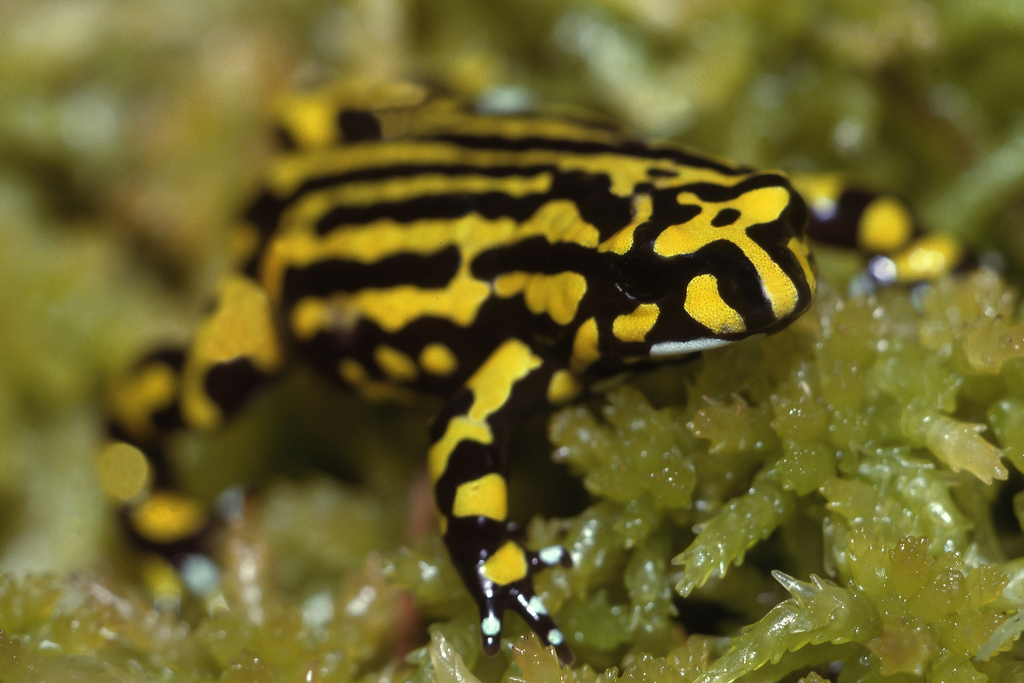
The northern corroboree frog (Pseudophryne pengilleyi) is a species of Australian ground frog, native to southeastern Australia.
- Kingdom
- Animalia
- Phylum
- Chordata
- Class
- Amphibia
- Order
- Anura
- Family
- Myobatrachidae
- Genus
- Pseudophryne
- Species
- Pseudophryne pengilleyi
Description
The northern corroboree frog (Pseudophryne pengilleyi) is a species of Australian ground frog, native to southeastern Australia. It is differentiated by the southern corroboree frog by having slightly narrower and greener stripes, while also being smaller. Northern corroboree frogs live in waterlogged grasslands and adjacent woodlands. Northern corrboree frogs spend most of their time in the woodlands, going to the waterlogged grasslands in the summer to breed. Females lay around 25 eggs in damp vegetation, and hatch when water levels rise. The northern corrboree frog is listed as critically endangered and has decreased massively, due to chytrid, weeds, droughts, climate change, and livestock. Northern corroboree frogs live 750–1,800 m (2,460–5,910 ft) above sea level, in three distinct regions, with the frogs displaying three distinct genetic characteristics. These populations live in the following areas: spanning the Fiery Range and Bogong Peaks in Kosciuszko National Park, the Bondo, Micalong and Wee Jasper State Forests in NSW; along the Brindabella Ranges in Namadgi National Park in the ACT; and Bimberi Nature Reserve and Brindabella National Park in NSW. The northern corroboree frog has not suffered as badly as the southern. It is more widely distributed across about 550 km2 (210 sq mi) of the Brindabella and Fiery Ranges in Namadgi National Park in the ACT, and Kosciuszko National Park and Buccleuch State Forest in NSW. In 2004 it was downgraded from an IUCN assessment of critically endangered to endangered, though in 2022 this decision was reverted.
Ajouter des photos
Partagez vos photos de cette espèce (jusqu'à 20 à la fois) : elles sont vérifiées automatiquement, puis publiées.
Répartition
Occurrences observées (données GBIF). Les zones hors aire d'origine peuvent indiquer une présence introduite ou invasive.
Sources et crédits
Informations provenant de plusieurs sources vérifiées. Dernière mise à jour : .
Crédits photos (1)
- Photo : @kengriffiths · CC BY-NC 4.0 · via iNaturalist
Mentions de licence
Texte disponible sous licence CC BY-SA 4.0. Il adapte notamment Wikipedia (CC BY-SA) : Northern corroboree frog (Wikipédia, auteurs dans l’historique de l’article).
- Taxonomie : GBIF Backbone Taxonomy (CC BY 4.0)
- Carte : occurrences GBIF, fond © contributeurs OpenStreetMap (ODbL)
- Statut de conservation : Liste rouge de l'UICN, via Wikidata (CC0)
Détail : Sources et licences.
Discussion (0)
Aucun message pour l’instant. Lancez la discussion sur cette fiche (sources, précisions, débats éditoriaux).
Connectez-vous pour participer à la discussion.