
Cuyaba dwarf frog
Physalaemus nattereri
Physalaemus nattereri (common name: Cuyaba dwarf frog) is a frog native to central and southeastern Brazil and eastern Bolivia and Paraguay.
- Kingdom
- Animalia
- Phylum
- Chordata
- Class
- Amphibia
- Order
- Anura
- Family
- Leptodactylidae
- Genus
- Physalaemus
- Species
- Physalaemus nattereri
Description
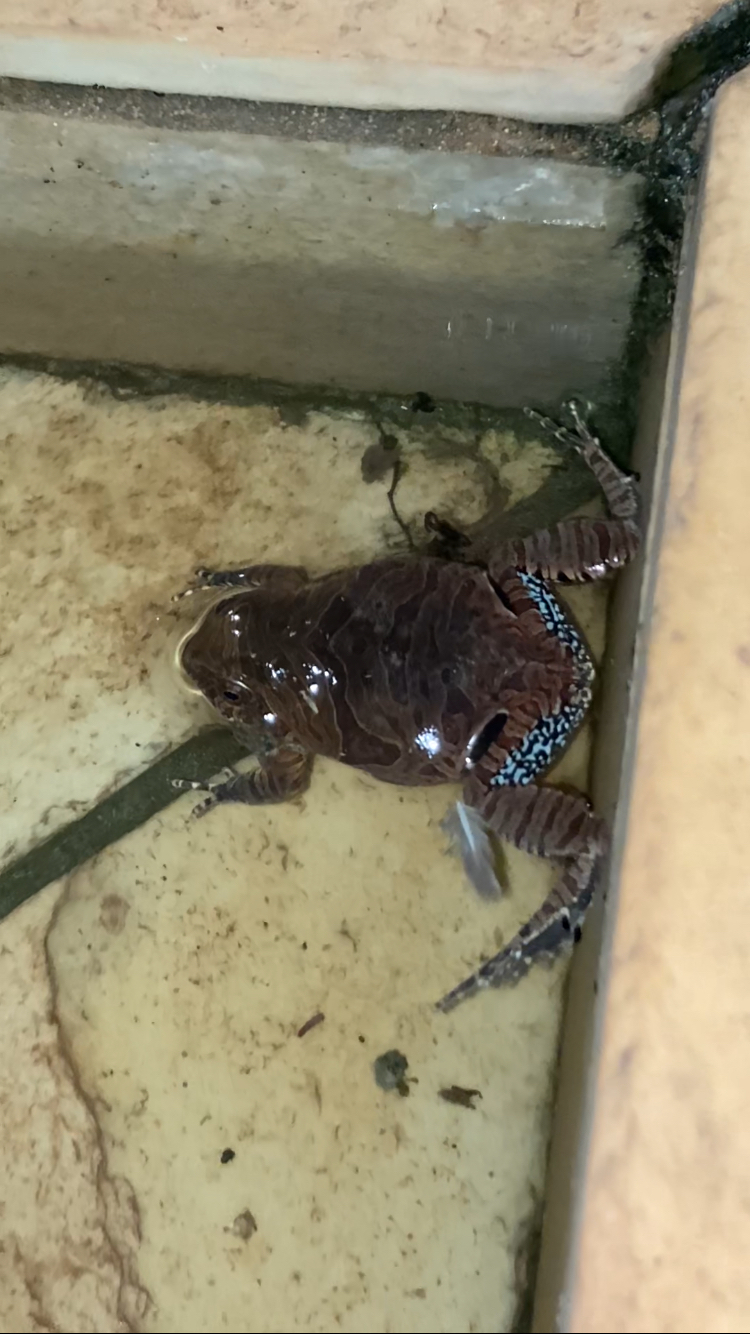
Physalaemus nattereri (common name: Cuyaba dwarf frog) is a frog native to central and southeastern Brazil and eastern Bolivia and Paraguay. It inhabits savanna and Cerrado regions, always near permanent or temporary water bodies such as ponds and swamps, where it typically nests. The species is not adapted to areas with human activity. Males have an average length of 4.7 centimeters (1.9 in), while females measure 4.9 centimeters (1.9 in). The dorsal coloration ranges from light brown to dark brown or reddish, featuring a mosaic of darker spots or stripes. The ventral surface is light brown with dark spots. The species is unmistakable in its habitat due to a pair of ocelli on the posterior part of its body. Its testicles and other organs are brightly colored, a rare trait among anurans, caused by a high concentration of melanocytes. Its diet is generalist and opportunistic, primarily consisting of termites and ants. Despite an effective defense strategy and highly potent toxins, it can be preyed upon by various animals, including birds and beetles. Its primary predators are giant water bugs, which often attack during reproduction and metamorphosis. One defense mechanism is deimatic behaviour, where the frog inflates its lungs, lowers its head, and raises its posterior, displaying its ocelli to startle predators, appearing as a larger animal facing them. Additionally, its ocelli contain venomous macro glands that produce a fast-acting toxin with a median lethal dose comparable to that of a jararaca snake. Its reproduction is explosive, meaning all individuals gather synchronously at breeding sites for a few days, typically between October and January. Males form choruses and vocalize after heavy rainfall exceeding 50 millimeters to attract females. Their call consists of simple, multi-pulsed, harmonic notes. During amplexus, which is axillary, the pair moves to the water's edge, where they deposit approximately 3 500 eggs in a foam nest. The nest is created from mucus secreted by the female, whipped into foam by the male's hind legs in a motion akin to whisking egg whites. The tadpoles have a grayish-brown dorsum and a globular body. Their metamorphosis takes 20 to 30 days.
Gallery
Ajouter des photos
Partagez vos photos de cette espèce (jusqu'à 20 à la fois) : elles sont vérifiées automatiquement, puis publiées.
Répartition
Occurrences observées (données GBIF). Les zones hors aire d'origine peuvent indiquer une présence introduite ou invasive.
Sources et crédits
Informations provenant de plusieurs sources vérifiées. Dernière mise à jour : .
Crédits photos (6)
- Photo : anajuliamag · CC BY-NC 4.0 · via GBIF
- Photo : @geraldomorais · CC BY-NC 4.0 · via iNaturalist
- Photo : @flavioubaid · CC BY-NC 4.0 · via iNaturalist
- Photo : M. A. Lagares (@mlagares) · CC BY-NC 4.0 · via iNaturalist
- Photo : MarcosHalemFelix (@marcosfelix_birdscuiaba) · CC BY-NC 4.0 · via iNaturalist
- Photo : Marco Aurelio Oliveira (@marco_oliveira) · CC BY-NC 4.0 · via iNaturalist
Mentions de licence
Texte disponible sous licence CC BY-SA 4.0. Il adapte notamment Wikipedia (CC BY-SA) : Physalaemus nattereri (Wikipédia, auteurs dans l’historique de l’article).
- Taxonomie : GBIF Backbone Taxonomy (CC BY 4.0)
- Carte : occurrences GBIF, fond © contributeurs OpenStreetMap (ODbL)
- Statut de conservation : Liste rouge de l'UICN, via Wikidata (CC0)
Détail : Sources et licences.
Discussion (0)
Aucun message pour l’instant. Lancez la discussion sur cette fiche (sources, précisions, débats éditoriaux).
Connectez-vous pour participer à la discussion.