
Black-legged poison frog
Phyllobates bicolor
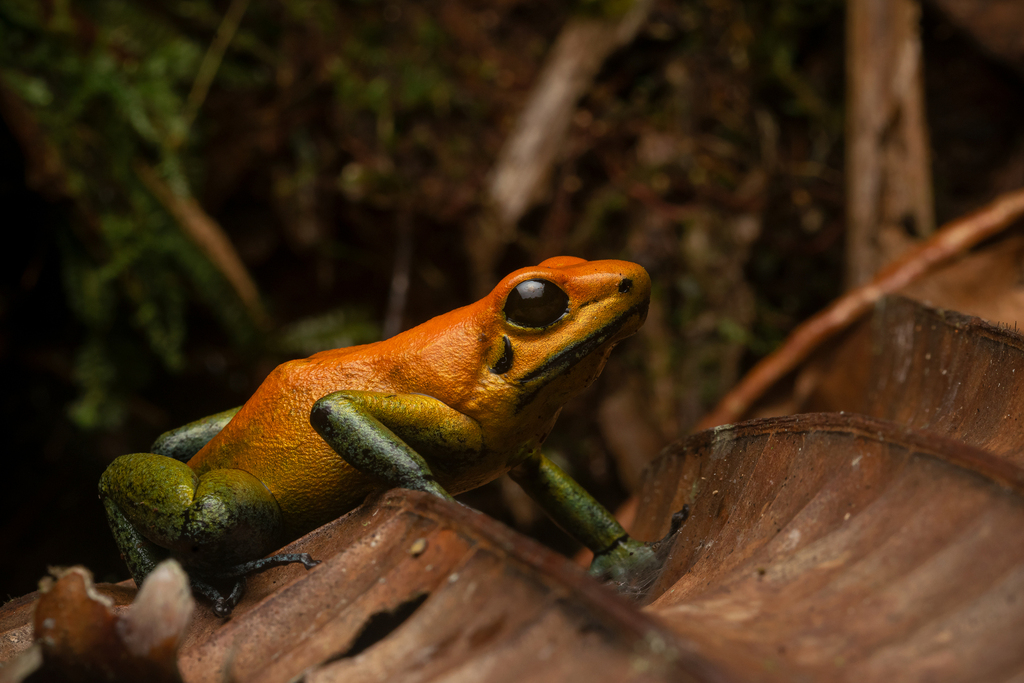
Phyllobates bicolor, or more commonly referred to as the black-legged poison dart frog, is the world's second-most toxic dart frog.
- Kingdom
- Animalia
- Phylum
- Chordata
- Class
- Amphibia
- Order
- Anura
- Family
- Dendrobatidae
- Genus
- Phyllobates
- Species
- Phyllobates bicolor
Description
Phyllobates bicolor, or more commonly referred to as the black-legged poison dart frog, is the world's second-most toxic dart frog. Under the genus Phyllobates, this organism is often mistaken as Phyllobates terribilis, the golden poison frog, as both are morphologically similar. However, Phyllobates bicolor is identifiable by the yellow or orange body and black or dark blue forelimbs and hindlegs, hence the name black-legged dart frog. Phyllobates bicolor are commonly found in tropical forests of the Chocó region of Colombia. The diurnal frogs live along the rainforest ground near streams or puddles that form. Notably, P. bicolor is a member of the family Dendrobatidae, or poison dart frog. P. bicolor, along with the rest of the Phyllobates species, produce a neurotoxin known as a batrachotoxin that inhibits specific transmembrane channels in cells. Due to this highly deadly toxin that the frogs secrete, many indigenous groups of the Colombian rainforest have extracted the toxins to create poison tipped darts used for hunting. During the breeding period, P. bicolor emits high pitched single notes as a mating call. As in all poison dart frogs, it is common for the father of tadpoles to carry the offspring on his back until they reach a suitable location for the tadpoles to develop. P. bicolor is an endangered species according to the IUCN red list. Currently, deforestation, habitat loss, and pollution pose the biggest threat to the species. Limited conservation efforts have been attempted to prevent further damage to the species. Despite this, there are still institutions such as the Baltimore National Aquarium in Baltimore, Maryland and the Tatamá National Natural Park in Colombia that are engaged in P. bicolor conservation efforts such as captive breeding.
Gallery
Ajouter des photos
Partagez vos photos de cette espèce (jusqu'à 20 à la fois) : elles sont vérifiées automatiquement, puis publiées.
Répartition
Occurrences observées (données GBIF). Les zones hors aire d'origine peuvent indiquer une présence introduite ou invasive.
Sources et crédits
Informations provenant de plusieurs sources vérifiées. Dernière mise à jour : .
Crédits photos (3)
- Photo : Khristian Venegas Valencia (@khristimantis) · CC BY-NC 4.0 · via iNaturalist
- Photo : Isaac (@itadinag) · CC BY-NC 4.0 · via iNaturalist
- Photo : Brayan (@brayan1416) · CC BY-NC 4.0 · via iNaturalist
Mentions de licence
Texte disponible sous licence CC BY-SA 4.0. Il adapte notamment Wikipedia (CC BY-SA) : Phyllobates bicolor (Wikipédia, auteurs dans l’historique de l’article).
- Taxonomie : GBIF Backbone Taxonomy (CC BY 4.0)
- Carte : occurrences GBIF, fond © contributeurs OpenStreetMap (ODbL)
Détail : Sources et licences.
Discussion (0)
Aucun message pour l’instant. Lancez la discussion sur cette fiche (sources, précisions, débats éditoriaux).
Connectez-vous pour participer à la discussion.