
Boulenger’s narrow-eyed frog
Nyctibatrachus major
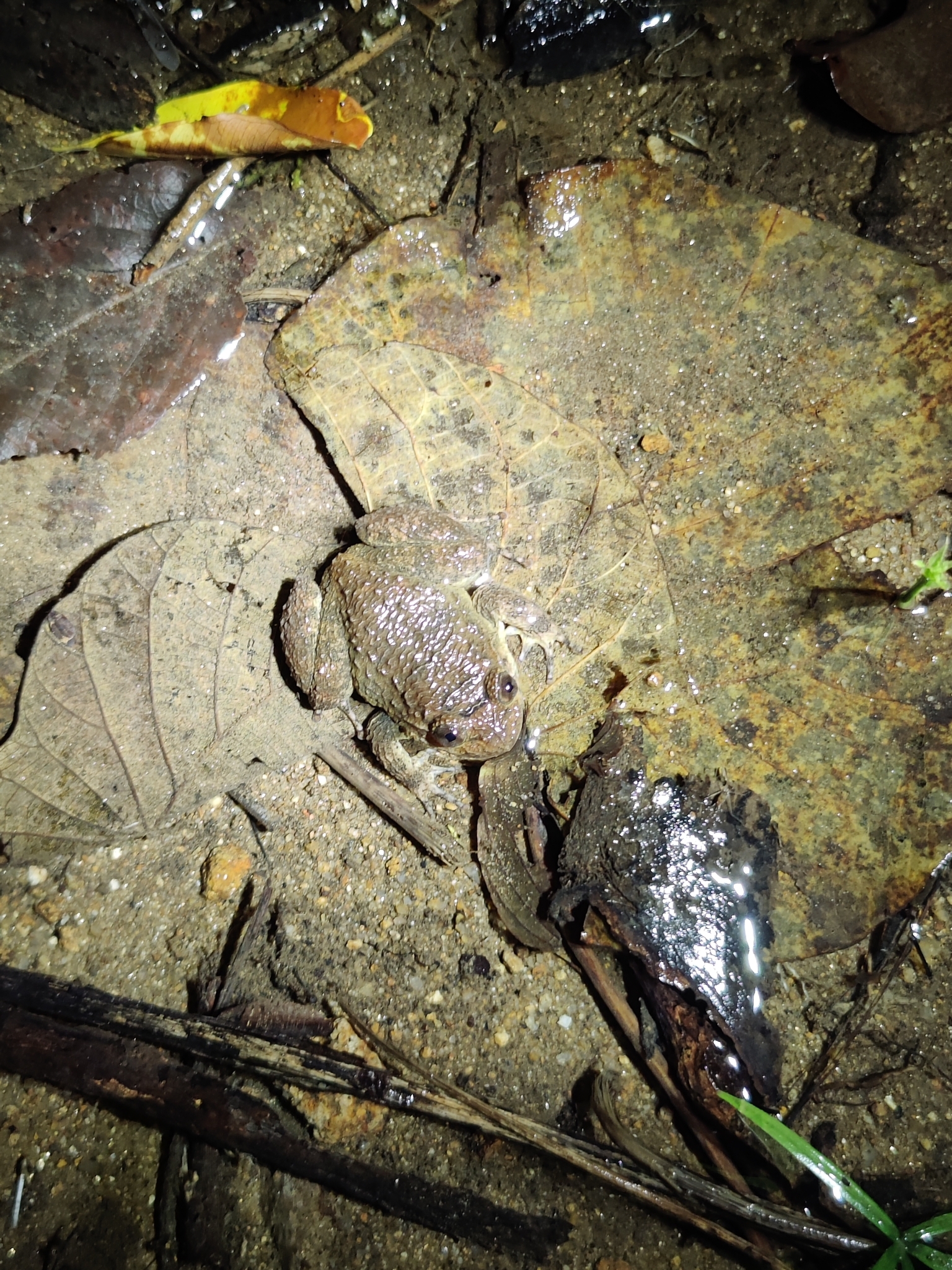
Nyctibatrachus major, the Malabar night frog, large wrinkled frog, or Boulenger's narrow-eyed frog, is a species of frog in the family Nyctibatrachidae, commonly known as the robust frogs.
- Kingdom
- Animalia
- Phylum
- Chordata
- Class
- Amphibia
- Order
- Anura
- Family
- Nyctibatrachidae
- Genus
- Nyctibatrachus
- Species
- Nyctibatrachus major
Description
Nyctibatrachus major, the Malabar night frog, large wrinkled frog, or Boulenger's narrow-eyed frog, is a species of frog in the family Nyctibatrachidae, commonly known as the robust frogs. It was described in 1882 by the zoologist George Albert Boulenger, and is the type species of the genus Nyctibatrachus. It is a large frog for its genus, with an adult snout–vent length of 31.5–52.0 mm (1.24–2.05 in) for males and 43.7–54.2 mm (1.72–2.13 in) for females. It is mainly brownish to greyish in colour, with a dark greyish-brown upperside, a greyish-white underside, and light grey sides. It also has a variety of grey or brown markings. When preserved in ethanol, it is mostly greyish-brown to grey, with whitish sides. Sexes can be told apart by the presence of the femoral glands (bulbous glands near the inner thigh) in males. The species is endemic to the Western Ghats mountain range of India, where it is found in Kerala, Tamil Nadu, and Karnataka. Adults inhabit fast-moving forest streams at elevations of up to 900 m (3,000 ft) and have highly specific habitat requirements. Adults are mostly found in or near water and are nocturnal; subadults can be found during both the night and day. Its diet mainly consists of other frogs and insect larvae. Over a period of several days or weeks, females lay multiple small clutches of eggs on leaves and rocks overhanging water; tadpoles drop into the water below on hatching. The species is currently classified as being endangered on the IUCN Red List owing to its small and severely fragmented range and ongoing habitat degradation. Threats to the species include habitat loss, increased human presence near the streams it inhabits, and possibly nitrate pollution caused by fertiliser overuse.
Gallery
Ajouter des photos
Partagez vos photos de cette espèce (jusqu'à 20 à la fois) : elles sont vérifiées automatiquement, puis publiées.
Répartition
Occurrences observées (données GBIF). Les zones hors aire d'origine peuvent indiquer une présence introduite ou invasive.
Sources et crédits
Informations provenant de plusieurs sources vérifiées. Dernière mise à jour : .
Crédits photos (3)
Mentions de licence
Texte disponible sous licence CC BY-SA 4.0. Il adapte notamment Wikipedia (CC BY-SA) : Nyctibatrachus major (Wikipédia, auteurs dans l’historique de l’article).
- Taxonomie : GBIF Backbone Taxonomy (CC BY 4.0)
- Carte : occurrences GBIF, fond © contributeurs OpenStreetMap (ODbL)
Détail : Sources et licences.
Discussion (0)
Aucun message pour l’instant. Lancez la discussion sur cette fiche (sources, précisions, débats éditoriaux).
Connectez-vous pour participer à la discussion.