
Mexican Narrow-mouthed Toad
Hypopachus variolosus
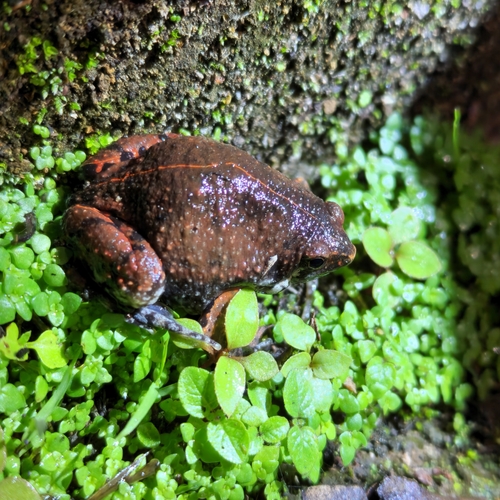
The northern sheep frog (Hypopachus variolosus) is native to Central America, Mexico, and extreme south Texas, United States.
- Kingdom
- Animalia
- Phylum
- Chordata
- Class
- Amphibia
- Order
- Anura
- Family
- Microhylidae
- Genus
- Hypopachus
- Species
- Hypopachus variolosus
Description
The northern sheep frog (Hypopachus variolosus) is native to Central America, Mexico, and extreme south Texas, United States. It occurs in the lowlands from Sonora, Mexico, to northern Costa Rica on the Pacific coast, and south Texas to Honduras on the Gulf of Mexico and Caribbean coasts. The sheep frog inhabits semiarid thornscrub, savannas, pasturelands, and open woodlands, as well as more humid, moist forest in the canyons, basins, foothills, and lower elevations of mountains slopes. It is a fossorial, burrowing frog that is seldom seen on the surface except at night after heavy rains when they emerge to breed. The sheep frog gets its name from its distinctive call that resembles a sheep's bleat. It is a diet specialist primarily feeding on termites and ants. The sheep frog is a small, stout frog with short legs, ranging about 2.5-3.8 cm, with females growing larger than the males. The dorsal color ranges from tan, to reddish-tan, to various shades of brown with irregular black flecks or spots, which may be extensive on some individuals, or absent on others. An orange, red, or yellowish mid-dorsal stripe, running from the snout to the vent is present on some specimens, but may by absent, vague, or fragmented on others. It is a common species in some areas of its range, but it is uncommon in the US and listed as a threatened species in the state of Texas.
Gallery
Ajouter des photos
Partagez vos photos de cette espèce (jusqu'à 20 à la fois) : elles sont vérifiées automatiquement, puis publiées.
Répartition
Occurrences observées (données GBIF). Les zones hors aire d'origine peuvent indiquer une présence introduite ou invasive.
Sources et crédits
Informations provenant de plusieurs sources vérifiées. Dernière mise à jour : .
Crédits photos (5)
- Photo : (c) Kevin Ramírez, some rights reserved (CC BY-NC) · CC BY-NC 4.0 · via iNaturalist
- Photo : Jon McIntyre (@mako252) · CC BY-NC 4.0 · via iNaturalist
- Photo : Oscar Gonzalez Diaz (@oscar312) · CC0 (domaine public) · via iNaturalist
- Photo : Pablo Carrillo-Reyes (@pcarreyes) · CC BY-NC 4.0 · via iNaturalist
- Photo : @josephoakley · CC BY-NC 4.0 · via iNaturalist
Mentions de licence
Texte disponible sous licence CC BY-SA 4.0. Il adapte notamment Wikipedia (CC BY-SA) : Northern sheep frog (Wikipédia, auteurs dans l’historique de l’article).
- Taxonomie : GBIF Backbone Taxonomy (CC BY 4.0)
- Carte : occurrences GBIF, fond © contributeurs OpenStreetMap (ODbL)
- Statut de conservation : Liste rouge de l'UICN, via Wikidata (CC0)
Détail : Sources et licences.
Discussion (0)
Aucun message pour l’instant. Lancez la discussion sur cette fiche (sources, précisions, débats éditoriaux).
Connectez-vous pour participer à la discussion.