
Blue Ridge Two-lined Salamander
Eurycea wilderae
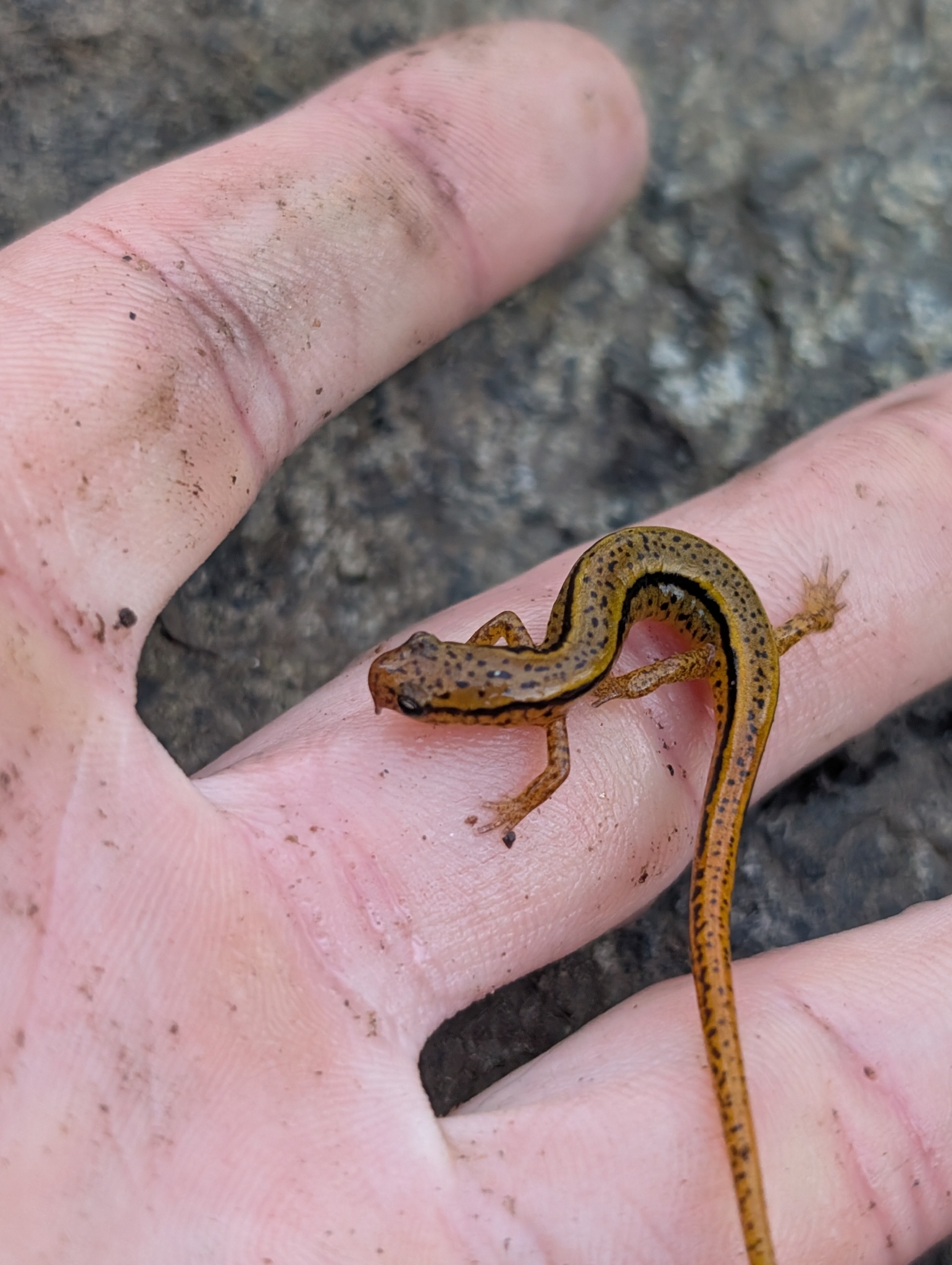
The Blue Ridge two-lined salamander (Eurycea wilderae) is a species of salamander in the family Plethodontidae, endemic to the United States.
- Kingdom
- Animalia
- Phylum
- Chordata
- Class
- Amphibia
- Order
- Caudata
- Family
- Plethodontidae
- Genus
- Eurycea
- Species
- Eurycea wilderae
Description
The Blue Ridge two-lined salamander (Eurycea wilderae) is a species of salamander in the family Plethodontidae, endemic to the United States. This species is found in the southern Appalachian Mountains, mostly south of Virginia. To the north is a similar salamander, Eurycea bislineata, or the northern two-lined salamander. Its genus, Eurycea contains 33 species and includes taxa that have either a metamorphic life cycle or larval-form paedomorphosis. In species that metamorphose, there can be within-and among-population variation in larval life-history characteristics, e.g., duration of the larval period and size at metamorphosis. Intraspecific geographic variation in species of Eurycea has been attributed to several factors: temperature, stream order and productivity of the larval habitat. Adult Blue Ridge two-lined salamanders are commonly found near stream banks. The larvae are aquatic, living in streams and seeps. Its natural habitats are temperate forests, rivers, intermittent rivers, and freshwater springs. It is threatened by habitat loss. This species is named after zoologist Inez Whipple Wilder, who studied biology of Eurycea species. These amphibians are listed by the IUCN as a species of least concern for conservation.
Gallery
Ajouter des photos
Partagez vos photos de cette espèce (jusqu'à 20 à la fois) : elles sont vérifiées automatiquement, puis publiées.
Répartition
Occurrences observées (données GBIF). Les zones hors aire d'origine peuvent indiquer une présence introduite ou invasive.
Sources et crédits
Informations provenant de plusieurs sources vérifiées. Dernière mise à jour : .
Crédits photos (6)
- Photo : Billy Gottenstrater · CC BY-NC 4.0 · via GBIF
- Photo : Ashley Hale (@skylark12) · CC BY-NC 4.0 · via iNaturalist
- Photo : @this_person_exists · CC BY-NC 4.0 · via iNaturalist
- Photo : Alex Wiebe (@alexwiebe) · CC BY-NC 4.0 · via iNaturalist
- Photo : Jonathan Hakim (@jonhakim) · CC BY-NC 4.0 · via iNaturalist
- Photo : Brianna Hines (@brianna_hines) · CC BY-NC 4.0 · via iNaturalist
Mentions de licence
Texte disponible sous licence CC BY-SA 4.0. Il adapte notamment Wikipedia (CC BY-SA) : Blue Ridge two-lined salamander (Wikipédia, auteurs dans l’historique de l’article).
- Taxonomie : GBIF Backbone Taxonomy (CC BY 4.0)
- Carte : occurrences GBIF, fond © contributeurs OpenStreetMap (ODbL)
- Statut de conservation : Liste rouge de l'UICN, via Wikidata (CC0)
Détail : Sources et licences.
Discussion (0)
Aucun message pour l’instant. Lancez la discussion sur cette fiche (sources, précisions, débats éditoriaux).
Connectez-vous pour participer à la discussion.